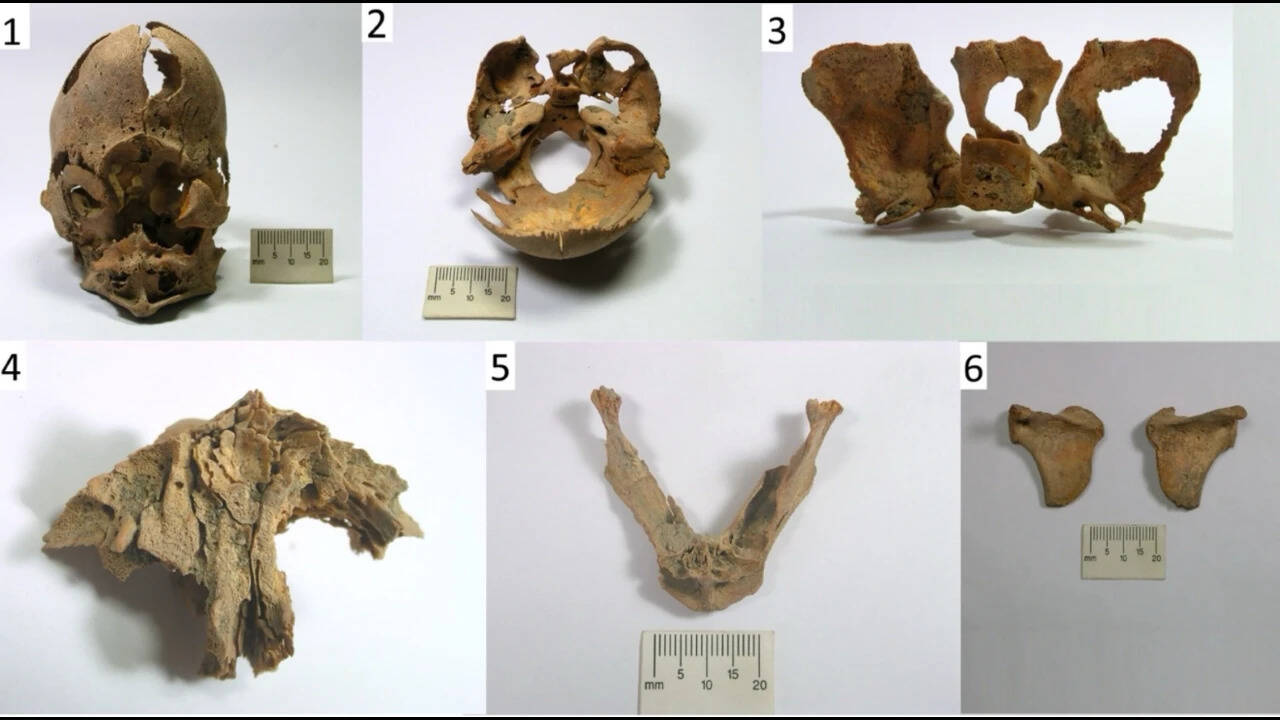
Two infants buried 1,600 years ago on the northern coast of Peru are forcing archaeologists and medical historians to rethink how pre-Columbian societies treated severe congenital disabilities. Excavated from a cemetery associated with the Moche culture, one of the newborns exhibited cyclopia, a fatal and exceptionally rare birth defect in which the embryonic forebrain fails to divide properly into two hemispheres, resulting in a single central eye socket. Rather than being discarded or treated as a bad omen, both infants received formal, intentional burials complete with grave goods, proving that ancient Andean communities integrated even the most medically complex infants into their social and spiritual worlds.
Most media coverage of archaeological anomalies treats ancient human remains like sensationalist sideshows. Headlines focus on the shock value of a single-eyed skull while ignoring the forensic and cultural reality surrounding the grave. When you strip away the morbid curiosity, a far more compelling story emerges. These two burials sit at the intersection of ancient epidemiology, Moche religious iconography, and the enduring human impulse to care for the vulnerable. Also making headlines recently: Beijing’s Taiwan Rhetoric Isn’t a Countdown to War—It’s a Masterclass in Strategic Exhaustion.
The Anatomy of an Ancient Tragedy
To understand what happened in that coastal Peruvian valley roughly four centuries after the birth of Christ, you first have to understand the biology of the defect itself. Cyclopia is the most severe form of holoprosencephaly, a cephalic disorder occurring during the first few weeks of gestation. In a healthy human embryo, the prosencephalon divides into the left and right cerebral hemispheres, which subsequently triggers the separation of the optic vesicles into two distinct eyes.
When that division stalls, the consequences are catastrophic. The brain remains a single fused mass, the nasal structures fail to form normally—often resulting in a tubular appendage called a proboscis situated above the eye—and a single central orbit develops in the middle of the face. Modern neonatal medicine classifies cyclopia as universally incompatible with life outside the womb. Infants born with the condition either arrive stillborn or succumb to respiratory and neurological failure within hours of delivery. More information on this are detailed by NPR.
In the archaeological record, confirmed cases of cyclopia are vanishingly rare. Soft tissue decays rapidly in most environments, leaving bioarchaeologists to rely entirely on skeletal morphology. A single central orbit in an infant cranium is unmistakable, yet fewer than a handful of verified pre-Columbian examples exist across the entire Western Hemisphere. Finding one in a controlled, stratified excavation on Peru's north coast provides a rare physical baseline for studying birth defects in populations completely isolated from Old World pathogens and modern industrial pollutants.
Why did it happen here? Modern genetics points to a combination of chromosomal abnormalities, such as trisomy 13 (Patau syndrome), and environmental teratogens. In livestock, cyclopia is famously triggered when pregnant sheep graze on Veratrum californicum, a wild lily containing the alkaloid cyclopamine. In ancient coastal Peru, environmental triggers could have ranged from naturally occurring plant toxins in traditional herbal remedies to heavy metal exposure from early metallurgical practices, or simply spontaneous genetic mutations occurring at baseline human rates. Without soft tissue or viable ancient DNA preserved in the salty coastal soil, pinpointing the exact catalyst remains an open forensic question.
Ritual Care in the Moche World
The true revelation lies not in the pathology of the skull, but in the architecture of the grave. The northern coast of Peru around 400 AD was dominated by the Moche civilization, a sophisticated, stratified society famous for its monumental adobe pyramids, complex irrigation networks, and hyper-realistic ceramic art.
Moche pottery is an encyclopedia of ancient life and physical variation. Artisans routinely depicted individuals with cleft palates, spinal deformities, amputations, and blindness. These figures were not mocked. In Andean cosmology, physical anomalies often marked an individual as spiritually distinct, carrying a unique connection to the supernatural world or the ancestors.
When the two infants died—likely within moments of each other or buried in close chronological succession—their community did not toss them into a midden heap. Bioarchaeological analysis of the burial context shows deliberate placement. The bodies were wrapped in textiles, positioned according to established funerary customs, and accompanied by offerings intended to sustain them in the afterlife.
This contradicts a persistent, lazy assumption about the ancient world. Popular history often portrays pre-modern societies as ruthlessly utilitarian, practicing infanticide whenever a newborn displayed severe physical abnormalities. While exposure and infanticide certainly existed in ancient Greece, Rome, and elsewhere, the archaeological evidence from coastal Peru tells a different story. The Moche invested labor, textiles, and ceramic vessels into the burial of a newborn who never took a breath, or at best lived for a few agonizing minutes.
The Mystery of the Second Infant
The presence of the second infant alongside the child with cyclopia adds another layer of complexity to the excavation. In bioarchaeology, double infant burials immediately raise questions about kinship, mortality, and ritual pairing.
Were they twins? Twin births were deeply significant in ancient Andean cultures, frequently associated with lightning, fertility, and duality—a core concept in pre-Columbian philosophy. If a mother carried twins and one developed holoprosencephaly while the other developed normally, the trauma of the delivery could easily have claimed both lives, along with the mother's. Alternatively, the two infants could have been unrelated members of the same extended kinship group who died during the same seasonal spike in neonatal mortality and were interred together to share a single funerary rite.
Determining whether these two children shared a biological mother requires advanced ancient DNA sequencing, a process complicated by the arid, mineral-rich soils of the Peruvian coast that frequently degrade collagen and genetic material. Until genomic testing yields clear results, archaeologists must rely on osteological measurements and stratigraphic positioning, both of which confirm that the two burials were treated as a unified ritual event.
How Media Sensationalism Distorts Bioarchaeology
Whenever a discovery involving a severe congenital defect hits the press, a predictable cycle of distortion begins. Wire services pick up the academic presentation or regional report, strip away the archaeological context, and lead with words like "mutant" or "cyclops."
This framing does a massive disservice to both science and history. By turning an ancient human infant into a mythological monster, modern reporting erases the grief of the parents and the ritual sophistication of the community that buried them. There is no evidence that the Moche associated a single-eyed infant with the one-eyed giants of Greek mythology—a cultural tradition that existed an ocean away and had zero bearing on Andean thought.
Furthermore, sensationalist coverage obscures the actual scientific value of the find. Paleopathologists do not excavate ancient cemeteries to collect anatomical oddities. They study these remains to map the deep history of human disease. Understanding the prevalence of congenital disorders in ancient populations helps modern geneticists establish baseline mutation rates prior to the introduction of synthetic chemicals, radiation, and modern pharmaceuticals. Every verified ancient case acts as a control data point in the long-term study of human developmental biology.
The Forensic Reality of Ancient Neonatal Mortality
Life on the northern coast of Peru 1,600 years ago was precarious even under ideal conditions. The Moche thrived in one of the driest deserts on Earth by mastering river-valley agriculture, yet their environment was regularly battered by El Niño events. Torrential rains destroyed irrigation canals, wiped out crops, and triggered outbreaks of waterborne diseases.
In any pre-antibiotic society, infant mortality rates hovered between 30 and 50 percent. Famine, maternal malnutrition, and parasitic infections routinely compromised fetal development. For a Moche mother, carrying a pregnancy to term was a high-stakes biological gamble.
When a birth ended in tragedy, the funerary response served a vital psychological and social function for the survivors. Anthropologists studying Andean mortuary practices emphasize that death was viewed not as an absolute termination, but as a transition into a different state of social existence. Dead infants, uncorrupted by adult transgressions, were often regarded as potent intermediaries with the spirit world.
By burying the infant with cyclopia alongside a second newborn with full ceremonial dignity, the community reasserted order over biological chaos. The grave goods—typically small ceramic bowls, gourds, or copper fragments placed near the body or in the mouth—were practical provisions for a journey. They demonstrate that the community recognized the humanity of the child, regardless of its severe cranial deformity.
What Modern Science Still Needs to Answer
Excavating the bones is only the first phase of the investigation. True archaeological insight happens in the laboratory over years of meticulous, unglamorous analysis, and several critical questions about these two Peruvian infants remain unresolved.
First, isotopic analysis of the infant bones and teeth—specifically strontium, oxygen, and carbon isotopes—can reveal the mother's diet and geographic origins. Since infant enamel forms in utero, its chemical signature acts as a direct record of what the mother ate and drank during pregnancy. If the mother consumed contaminated water or migrated from a highland region with different mineral profiles, the isotopes will show it.
Second, high-resolution micro-CT scanning of the cranium allows researchers to examine the internal architecture of the skull without damaging the fragile bone. By reconstructing the intracranial cavity digitally, neuroanatomists can map the exact degree of brain fusion and identify secondary skeletal anomalies in the spine or limbs that might point toward a specific genetic syndrome rather than an isolated environmental event.
Finally, contextual comparison with other Moche cemeteries is essential. Archaeologists need to cross-reference this burial with contemporary sites like Huacas de Moche, El Brujo, and Sipán to determine whether infants with severe congenital conditions were consistently granted standard burials across the entire Moche territory, or if this particular valley practiced unique mortuary customs.
The two graves on Peru's coast offer no easy answers about the exact genetic trigger that halted an embryo's development sixteen centuries ago. What they provide instead is undeniable physical proof of how an ancient society responded to tragedy—not with abandonment, but with ritual, care, and lasting respect.