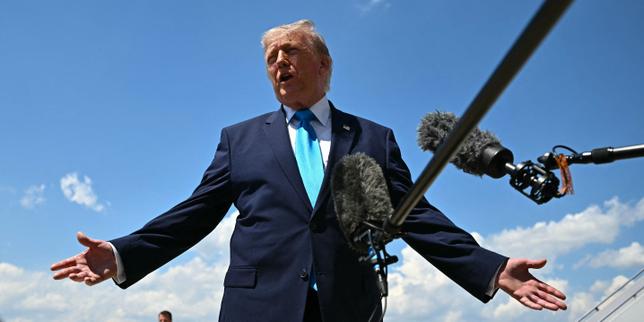
Mainstream foreign policy analysts are wringing their hands over Donald Trump’s refusal to "rush" into a new nuclear deal with Iran. They look at the maintained blockade, the stagnant diplomatic channels, and the cautious rhetoric coming out of Washington, and they see hesitation. They see a administration paralyzed by the complexity of Middle Eastern geopolitics, or worse, a repeat of old maximum pressure campaigns that failed to yield a signed piece of parchment.
They are reading the chessboard completely wrong.
The lazy consensus among the legacy media is that negotiations are failing because a treaty isn't being signed. This stems from a fundamental misunderstanding of modern economic warfare. In the current geopolitical environment, the blockade isn't the prelude to the deal. The blockade is the deal.
By keeping Tehran in economic limbo while refusing to rush to the table, Washington isn't stalling. It is executing a highly deliberate strategy of strategic exhaustion. Forcing an adversary to operate under permanent uncertainty is infinitely more damaging than enforcing explicit, static sanctions.
The Illusion of the "Signed Treaty"
Western diplomats have an unhealthy obsession with signed pieces of paper. They treat a binding accord like the ultimate trophy, ignoring the fact that regimes like the one in Tehran have spent decades mastering the art of asymmetric non-compliance.
When you rush to conclude an agreement, you concede leverage. You signal to the market that stability is returning, which immediately allows your opponent to price in future revenue. Oil traders breathe a sigh of relief. Secondary boycotts lose their teeth. Capital flight slows down because the target country can project a timeline for economic recovery.
Imagine a scenario where the US wraps up a hasty deal by next month. What happens? Iran instantly gains access to frozen assets, oil exports formalize, and the regime scores a massive domestic propaganda victory without fundamentally altering its regional proxy architecture.
By maintaining a suffocating blockade while dangling the vague prospect of future talks, the current strategy achieves the exact opposite. It creates an environment of total market unpredictability.
- No foreign corporation will sign a long-term infrastructure contract with Tehran when a snap-back or a sudden shift in Washington’s stance could wipe out their investment overnight.
- Domestic capital inside Iran continues to flee into hard assets or foreign currencies because nobody knows what the economy will look like in six months.
- The regime is forced to burn through its remaining foreign currency reserves just to subsidize basic goods and prevent domestic unrest.
I have watched corporate compliance departments navigate these exact waters during previous sanction regimes. Executives do not fear explicit bans half as much as they fear ambiguity. A clear ban allows you to find legal loopholes or alternative markets. Total ambiguity forces legal teams to freeze all operations out of sheer risk aversion. That is what the mainstream press labels "a lack of progress." In reality, it is a devastatingly effective economic chokehold.
Dismantling the Flawed Premises of Middle East Diplomacy
If you look at the queries dominating search engines and foreign policy panels, the underlying assumptions are fundamentally broken. Let's address the flawed logic head-on.
Why doesn't the US just lift the blockade to build goodwill?
This question assumes that international relations operate like a corporate team-building exercise. Goodwill does not exist in statecraft, especially not with an ideological regime whose foundational identity is built on anti-Western sentiment. Lifting a blockade prior to structural concessions isn't "building a bridge"; it is unilateral disarmament. It relieves the internal economic pressure that brought them to the conceptual table in the first place.
Isn't a prolonged blockade driving Iran closer to China and Russia?
This is the classic geopolitical boogeyman argument. Newsflash: Iran is already deeply integrated into the adversarial axis. They are supplying drones to Moscow and selling discounted crude to Beijing through ghost fleets.
A hasty deal won't magically transform Tehran into a Western-aligned trading partner. What a prolonged blockade does do, however, is ensure that Iran enters its partnerships with China and Russia as a desperate, impoverished junior partner. China is looking for cheap energy, not an expensive geopolitical liability that requires constant financial bailouts. By draining Iran's economic vitality, the US makes them a much less attractive asset for Beijing to leverage.
The Brutal Mechanics of Strategic Exhaustion
To understand why this approach works, we must look at the hard macroeconomic realities inside Iran. This is not about forcing a regime change through a popular uprising—that is a neoconservative fantasy that rarely pans out. This is about forcing hard budgetary choices on a state that funds regional instability.
When inflation hovers at crushing levels and the national currency, the rial, continues its downward trajectory against the dollar, the Iranian leadership faces an existential math problem. Every dollar spent funding regional proxies in Yemen, Lebanon, or Syria is a dollar stolen from domestic subsidies.
[Available State Revenues]
       │
       ├─► Domestic Subsidies (Suppressed to prevent riots)
       │
       └─► Proxy Funding (Squeezed by blockade)
In a static sanctions environment, a government can optimize its black-market supply chains and stabilize its budget. But under a regime of permanent negotiation and shifting goalposts, optimization is impossible. The regime cannot plan a multi-year budget for its regional operations because it cannot guarantee its oil revenues for the next quarter.
The downside to this strategy? It requires immense political discipline and a tolerance for friction. It means ignoring the screeching headlines from European allies who want a quick return to business as usual. It means accepting that regional tensions will simmer at a high temperature for a prolonged period.
But the alternative—rushing into a flawed, front-loaded agreement just to secure a diplomatic victory lap—is a proven failure. It treats the symptom while financing the disease.
Stop Looking for the Signing Ceremony
The true metric of success in this conflict is not a photo-op on a lawn in Geneva. The metric of success is the systemic degradation of an adversary's financial capability to project power.
Every week that passes without a deal is a week where Iran's central bank burns through reserves. Every month the blockade remains intact is a month where institutional investors steer clear of Persian markets. The stagnation that the media bemoans is actually the grinding gears of economic attrition doing exactly what they were designed to do.
Stop asking when the deal will be signed. Start tracking the discount Iran has to offer Chinese independent refineries just to get its oil offloaded in the dark. That is where the real war is being won. The administration isn't dragging its feet; it is letting the clock do the heavy lifting. Move fast, and you break your own leverage. Wait it out, and the adversary’s options shrink every single day. Let them stew.


