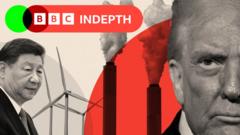
The corporate media is having its predictable annual meltdown over the Conference of the Parties. With the Trump administration refusing to send an official delegation to COP30 in Belém, Brazil, the hand-wringing has reached a fever pitch. Commentators are calling it an "ethical faux pas," a "shameful disregard," and an existential threat to global climate governance.
They are asking the entirely wrong question. The mainstream press wants to know if the UN climate summit still has a point when the world's largest economy and its fellow heavyweight carbon polluters skip the party.
The real question we should be asking is why we ever believed a traveling circus of 40,000 bureaucrats, private jet owners, and corporate lobbyists could solve a global thermodynamic asset problem in the first place.
Let’s be clear: Trump’s absolute boycott of COP30 is not the death knell for climate action. It is a necessary clearing of the theater. The presence of Washington at these high-level negotiations has historically functioned as a massive, bureaucratic brake pad. For three decades, American delegations—regardless of which party held the Oval Office—have spent their time diluting text, inserting legal loopholes, and blocking liability clauses for loss and damage.
By staying home, the White House didn't kill the summit; it accidentally removed the primary obstructionist from the room.
The Myth of the Imperial Climate President
The lazy consensus dominating international news states that without a US federal signature on a multilateral treaty, decarbonization grindingly halts. This viewpoint betrays a fundamental ignorance of how capital actually flows.
I have spent years watching institutional investors and infrastructure funds deploy capital into energy markets. Do you know how many 20-year utility-scale solar pro formas hinge on whether a diplomat signed a non-binding text in the Amazon? Zero.
The mechanism driving the transition away from fossil fuels is no longer international law; it is raw industrial economics. Decarbonization is a technology race, not an administrative compliance exercise.
When the US federal government exits the diplomatic stage, two structural shifts occur that the mainstream analysis completely misses:
- Subnational Dominance: State governments and regional economies step into the vacuum. California, which has an economy larger than India or the United Kingdom, sent its own heavy hitters to Belém. Subnational actors control actual infrastructure budgets, building codes, and portfolio standards—the real levers of market change.
- The Elimination of Direct Bullying: Diplomatic veterans have already noted that the American absence stripped the summit of its loudest veto. Without Washington playing defense for domestic oil interests on the convention floor, developing countries and alternative economic blocs face a significantly clearer path to codifying financial frameworks.
The panic over missing signatures is a legacy artifact from the 1990s. The real infrastructure buildout operates on a completely different plane.
The Inversion of Clean Energy Leadership
The narrative that a US boycott automatically cedes the entire clean tech market to China is equally flawed. It assumes the US market operates under command-and-control dictates.
Consider the mechanics of the current private capital environment. The Inflation Reduction Act (IRA) of 2022 locked in hundreds of billions of dollars in tax credits for manufacturing, hydrogen, and carbon capture. Those incentives are structurally woven into the corporate balance sheets of red and blue states alike.
[Global Private Capital] ──> [State-Level Tax Incentives] ──> [Steel-in-the-Ground Infrastructure]
                                     │
                             (Bypasses UN Treaties)
                                     │
                                     └──> [Real Decarbonization]
Imagine a scenario where a federal administration attempts to manually dismantle every single domestic battery facility or solar manufacturing plant built over the last four years. It would face immediate, ferocious resistance from its own corporate donors and governors who are currently enjoying the manufacturing boom. Market forces have already cleared the launchpad.
The United Nations Framework Convention on Climate Change (UNFCCC) process treats carbon reduction as a shared global sacrifice. That is a broken psychological framework. True industrial transition occurs when clean technology becomes cheaper, more efficient, and more secure than the incumbent system.
The Hard Truth of Climate Finance Deadlocks
The real failure of the UN summits isn't who skips them; it's the structural design of the meetings themselves. The mid-year negotiations in Bonn ahead of COP31 have already drifted into the standard gridlock over the Global Goal on Adaptation. Developing nations want the wealthy world to fulfill its promises to triple adaptation finance. Wealthy nations are quietly trying to water the terms down.
This happens every single year, whether the US president shows up or not. The multilateral framework is designed for symbolic gridlock. It produces a theater of commitments where wealthy nations promise capital they have no domestic legislative authority to deliver, and developing nations negotiate based on funds that will never materialize.
If you are a business leader or investor waiting for a unified global carbon price or a grand UN treaty to greenlight your capital allocation, you are setting money on fire. The game is highly fragmented, localized, and driven by industrial capacity.
Stop Watching the Stage
The obsession with who attends COP30 is a distraction from where the actual power lies. The real implementation is happening in low-friction, bilateral trade corridors, corporate supply chain mandates, and subnational procurement policies.
If you want to understand where the energy transition is actually heading, look away from the plenary halls of Belém. Stop reading the communiqués. Instead, look at the capital expenditure reports of heavy industry, the grid interconnection queues in PJM and ERCOT, and the battery chemistries scaling out of commercial laboratories.
The era of top-down global climate governance is officially over. The age of competitive industrial decarbonization has begun, and it doesn't care who is sitting in the VIP lounge in Brazil.


