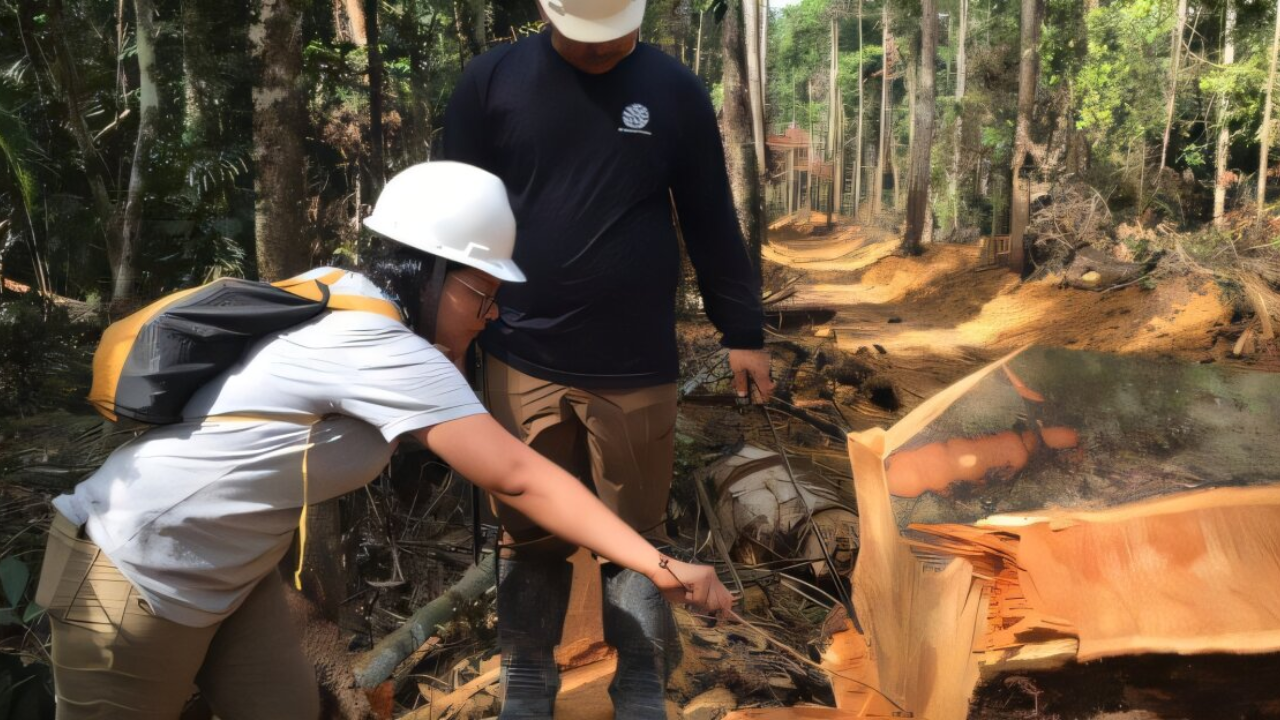
Illegal logging in the Amazon rainforest has long operated as a masterclass in jurisdictional evasion. Timber poachers cut down protected species deep inside indigenous reserves or conservation parks, forge transport documents, and mix illicit logs with legally harvested timber at sawmills. By the time the lumber reaches international ports in Europe, North America, or Asia, it carries a pristine paper trail. Customs officials stamp the manifests. Buyers assume their exotic hardwood flooring or luxury furniture came from a sustainable concession. The paper trail lies, but the wood itself tells a completely different story.
Brazilian scientists have begun deploying atomic fingerprinting to crack open this illicit global market. By analyzing the stable isotopes and trace mineral signatures locked inside tree rings across 800 trees in 63 distinct Amazonian locations, researchers can now match a finished plank of mahogany or ipê back to its exact geographic birthplace. This is not speculative conservation theory. It is a forensic accountability tool that threatens to dismantle the trillion-dollar illegal wildlife and timber trafficking rings operating with impunity across South America.
The Chemistry of Canopy Origins
Trees are chemical archives. As roots pull water and nutrients from the soil, they absorb specific ratios of chemical elements unique to that local geology. Ancient bedrock, recent alluvial sediment, rainfall patterns, and atmospheric conditions all leave an indelible stamp on the cellulose and lignin forming each annual growth ring. A tree grown in the mineral-rich soils of the southern Brazilian state of Pará possesses a vastly different atomic makeup than one harvested in the sandy floodplains of the western Amazon near the Peruvian border.
Traditional enforcement relied entirely on paperwork: forest management plans, state transport permits, and commercial invoices. Criminal syndicates exploited this bureaucratic fragility with ease. Bribes bought legitimate permits for deforested zones where no trees actually stood, allowing loggers to launder timber stolen from protected federal lands.
Atomic fingerprinting bypasses the paperwork entirely. When forensic labs test a wood sample, they measure isotopic ratios of elements like strontium, carbon, oxygen, and nitrogen. Strontium isotopes, in particular, serve as a geological GPS. Strontium-87 and Strontium-86 ratios remain remarkably stable as they move from soil into tree tissue. Because geological formations vary wildly across the millions of square kilometers of the Amazon basin, these ratios create a high-resolution map that smugglers cannot fake. You can forge a timber permit in a backroom office in Belém, but you cannot rewrite the geological history embedded in the cellular structure of a log.
Why Paper Trails Fail
Corruption and bureaucratic inertia have historically crippled Amazonian forestry enforcement. Environmental agencies in Brazil and neighboring countries face chronic underfunding, hostile political administrations, and geographical isolation that makes patrolling millions of acres of dense jungle nearly impossible. Smugglers know the odds. Even if a shipment is stopped at a port, proving that a specific shipping container holds illegally felled timber requires forensic proof that withstands intense courtroom scrutiny.
Law enforcement agencies previously relied on genetic testing to identify timber species, which could confirm whether a shipment contained an endangered variety like big-leaf mahogany. Yet knowing the species solves only half the mystery. It tells you what the tree is, but not where it died. A legal logging operation might harvest mahogany in a designated zone, while a criminal gang strips the same species from a national park five hundred miles away. To prosecute the criminals, prosecutors must prove geographic origin.
This is where isotopic profiling changes the operational calculus. When timber enters the supply chain, enforcement bodies can draw core samples from suspicious shipments and cross-reference the mineral signatures against regional databases. If a declared source in Mato Grosso yields a chemical profile matching a protected indigenous territory in the Xingu river basin, the lie falls apart instantly.
The Implementation Roadblocks
Despite the scientific breakthrough, scaling atomic fingerprinting from academic research papers to routine border control presents severe logistical hurdles. Building a comprehensive reference database for the entire Amazon basin requires years of field collection. Researchers must sample hundreds of tree species across thousands of square kilometers to account for natural geochemical variations within micro-climates.
Cost remains another significant barrier. Isotope ratio mass spectrometry requires expensive laboratory equipment, highly trained technicians, and rigorous quality control protocols. Customs offices in developing nations struggle to fund basic dockside inspections, let alone maintain high-tech forensic timber laboratories. Without streamlined, portable testing kits that can provide rapid screening at shipping ports, isotopic tracking risks remaining a niche tool utilized only for high-profile federal investigations rather than everyday border enforcement.
Furthermore, supply chain pushback from international trade lobbies creates political friction. Importers in major consumer nations benefit from plausible deniability. As long as the paperwork looks legitimate, corporations face minimal legal liability under current import laws like the United States Lacey Act or the European Union Deforestation Regulation. Forcing these entities to verify atomic origins introduces financial friction and liability they have actively lobbied to avoid.
Shifting Liability to the Buyer
The true power of forensic timber tracking lies in its ability to shift legal liability upstream. Historically, local field operators and low-level truck drivers absorbed the brunt of enforcement actions while international brokers and multinational furniture conglomerates hid behind layers of corrupt middlemen. When atomic data traces a luxury deck or high-end flooring material directly back to a devastated patch of illegally cleared rainforest, corporate deniability evaporates.
Regulators in the European Union and the United States are currently updating import compliance frameworks to demand stricter due diligence. Companies caught importing conflict timber face catastrophic financial penalties, asset seizures, and brand destruction. As forensic databases expand, the market for laundered wood shrinks. Criminal syndicates find it increasingly difficult to place high-risk timber into legitimate retail channels when any random spot-check by an independent laboratory can expose the fraud.
Science has provided the courtroom weapon that conservationists needed. The survival of the remaining old-growth canopy now depends entirely on whether governments have the political will to fund the labs, mandate the testing, and prosecute the corporate buyers who profit from the plunder.
The chainsaws in the deep jungle keep running, but every felled trunk now carries an invisible, unalterable signature waiting to be read.