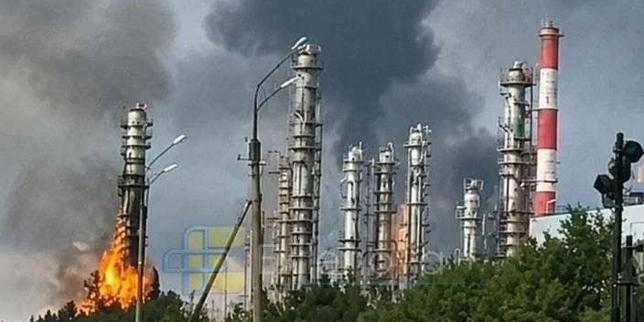
Distance used to mean safety. Two thousand kilometers used to be an ocean of breathing room.
When Ukrainian forces targeted the Tobolsk petrochemical complex deep inside Russian territory, they threw out the old playbook. Kyiv didn't just hit a factory. They shattered the geographic illusion that Russian infrastructure far from the front lines could operate without consequence.
You hear a lot of talk about drones and shifting front lines, but the real story here is endurance, reach, and the sheer vulnerability of sprawling industrial supply chains. Tobolsk-Neftekhim isn't some dusty warehouse on the border. It's a massive, critical node in Western Siberia's energy and chemical grid. Reaching it changes the math entirely.
Let's break down why this specific strike matters so much right now.
The Geography of Reach
Tobolsk sits way out in the Tyumen Oblast. If you look at a map, it feels impossibly remote from the trenches of eastern Ukraine. It's roughly two thousand kilometers away. That distance used to require heavy strategic bombers or intercontinental missiles—assets guarded by layers of early-warning radar and sophisticated air defense networks.
Instead, modern long-range uncrewed aerial vehicles are rewriting the rules. These aren't high-end stealth jets costing hundreds of millions of dollars. They are cheaper, adaptable, and increasingly autonomous flying systems designed to slip through gaps in vast continental radar coverage.
Russia spans eleven time zones. Defending every square kilometer of industrial pipeline, refinery, and petrochemical plant is a logistical impossibility. Kyiv's strategy exploits this exact reality. They aren't trying to match tank for tank on the frontline. They are finding the soft, high-value economic underbelly that powers the entire machinery.
Inside the Tobolsk Complex
Why Tobolsk? What makes a petrochemical facility thousands of miles away a legitimate target in an active warzone?
Petrochemical plants are the invisible glue of modern industrial economies. They turn raw hydrocarbons into polymers, plastics, synthetic rubbers, and chemical precursors that feed manufacturing sectors. When you disrupt a facility like Tobolsk-Neftekhim, you ripple economic pain across multiple domestic supply chains.
- Polymer production: Essential for various industrial and manufacturing inputs.
- Feedstock supply: Feeds downstream chemical factories that rely on continuous raw material streams.
- Export revenue: Contributes directly to the broader industrial output that funds state budgets.
When these massive complexes catch fire or face emergency shutdowns, repairing them isn't like swapping out a car part. You need specialized Western or high-tech machinery, precision engineering components, and months of uninterrupted labor. Sanctions already made procuring spare parts a nightmare. Add kinetic strikes to the mix, and downtime stretches from weeks to indefinite paralysis.
The Strategy Behind Deep Strikes
Military analysts love to debate whether strategic bombing works. History gives us messy answers, from the blitzes of World War II to modern air campaigns. But the drone era offers a different twist.
You don't need to flatten a city to win. You just need to impose a staggering economic and psychological cost on the home front.
When explosions rock a petrochemical facility two thousand kilometers from the border, the local population stops feeling untouchable. Air raid sirens echo in regions that previously treated the conflict as something happening on a television screen thousands of miles away. That shift alters public perception. It forces military planners to pull precious air defense batteries away from the front lines to protect domestic refineries, factories, and power grids.
Every surface-to-air missile parked around Tobolsk is a missile missing from the contested skies of Donbas or Zaporizhzhia. That is the genius of asymmetric reach. You force your opponent into a defensive shell game where they have to protect everything, which means they end up protecting nothing well enough.
What Happens When Borders Stop Mattering
We are watching a permanent evolution in how regional wars are fought. The sanctuary of distance is dead.
As autonomous flight technology improves and guidance systems become immune to localized jamming, long-range strikes will only get cheaper and more precise. Nations can no longer rely on vast territories to absorb or deter attacks. Industrial depth requires active, mobile, and decentralized defense networks that simply didn't exist a decade ago.
Keep an eye on how defense budgets pivot toward domestic infrastructure shielding. The next phase of this conflict won't just be decided by who holds the trenches. It will be decided by who can keep their lights on, their factories running, and their supply chains intact while cheap flying metal crosses half a continent to test their resolve.