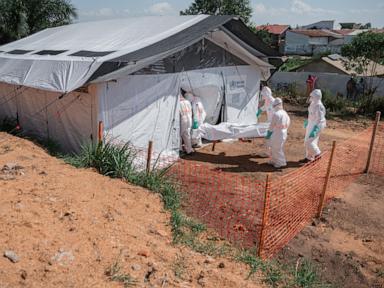
The plastic sheet of the isolation tent flaps in the hot wind, a rhythmic, snapping sound that mimics a frantic heartbeat. Inside, the air is thick with the smell of chlorine and sweat. A woman named Marie sits on a wooden stool just beyond the red plastic ribbon that marks the boundary between the living and the dying. She cannot touch her son. She can only watch his eyes, yellowed and heavy with exhaustion, track her movements through the scratched visor of a protective suit.
Exactly one month ago, this province in the Democratic Republic of the Congo was quiet. Today, it is the epicenter of a biological wildfire.
Health officials recently confirmed a grim milestone. In a single twenty-four-hour period, twenty-six new cases of Ebola were registered. It is the highest single-day spike since the outbreak was declared thirty days ago. To the global community, twenty-six is a statistic on a spreadsheet, a data point to be analyzed by epidemiologists in distant, air-conditioned offices. To Marie, it represents a devastating reality. Her son is one of those twenty-six.
Statistics obscure the terrifying intimacy of viral transmission. Ebola does not travel through the air on a breeze. It requires closeness. It preys on the very instincts that make us human—the urge to comfort a crying child, the duty to wash the body of a deceased parent, the instinct to hold a feverish hand. The virus transforms love into a vector.
Consider the trajectory of a localized outbreak. It begins with a single spillover event, perhaps a hunter in the dense forest touching infected bushmeat. Then, a fever. A family gathers around the sickbed. By the time the laboratory tests return positive days later, the invisible web of transmission has already spiderwebbed through a village.
The current containment effort faces a double-front war: the biology of the pathogen and the psychology of fear.
When emergency vehicles arrive in remote communities, they do not bring immediate comfort. They bring outsiders clad in head-to-toe white biometric suits, looking less like doctors and more like entities from a science fiction nightmare. The psychological barrier this creates is immense. Rumors spread faster than the fever. Some believe the treatment centers are where people go to die, not to heal. Others fear that the western medicine is the source of the affliction itself.
Breaking this cycle requires more than just shipping experimental antiviral drugs or thousands of doses of the Ervebo vaccine. It requires trust.
Medical teams are learning that they cannot simply enforce quarantine by dictate. They must sit down with village elders, under the shade of the palmyra palms, and explain the science using metaphors that resonate. They must acknowledge the terror. Trust is built when health workers allow traditional healers to view the treatment protocols, proving that nothing is being hidden behind the heavy plastic walls.
The logistics of this response are dizzying. Imagine trying to maintain a cold chain for vaccines that must be stored at ultra-low temperatures, while transporting them over roads that are little more than muddy ruts carved into the jungle. Vehicles break down. Generators fail. Yet, the vaccine must remain frozen until the moment it enters an arm.
Time is the enemy. Every hour a contact goes untraced is an hour the virus has to leap to another household, another village, or across a border into a bustling urban center. The daily spike in numbers is a warning siren. It signals that the surveillance teams are playing catch-up, discovering cases that had been hidden or ignored for days.
The international community often responds to these updates with a brief flurry of financial pledges, followed by a swift return to complacency. This is a mistake born of geographic arrogance. In an interconnected world, an outbreak in a remote Congolese village is only a few commercial flights away from any major city on Earth. The health security of a suburb in London or a neighborhood in Tokyo is inextricably linked to the strength of the clinic in this dust-choked province.
The sun begins to dip below the tree line, casting long, bruised shadows across the treatment center compound. The heat does not break; it merely grows heavy.
Marie stands up from her stool. Her joints ache from hours of waiting. Through the plastic window, she sees a nurse in a biohazard suit approach her son's cot, holding a cup of clean water to his dry lips. It is an act of profound courage, executed under layers of stifling rubber and synthetic fabric.
The twenty-four-hour news cycle will soon move on to another crisis, another headline. The spreadsheet will be updated tomorrow with new numbers, higher or lower, parsed by analysts who have never stepped foot in the dust. But here, the fight remains stubbornly, fiercely human. It is waged in the quiet space between a mother's gaze and her son's failing strength, a battle measured not in macroeconomics, but in the slow, agonizing persistence of a single heartbeat.