Water weighs eight pounds a gallon.
Lift a jug from the grocery store shelf and your wrist tells you the truth of it. Now multiply that weight by the daily thirst of a billion people pinned against the edge of an ocean they cannot drink. For generations, humanity has stood on the shore of the planet's greatest reservoir, dying of thirst because the price of salvation was simply too high. You might also find this connected article useful: The Mapmaker Who Looks Past the Stars.
Desalination is an old promise. Take the salt out, keep the water in. Simple in theory. Brute force in practice.
If you have ever stood inside a traditional thermal desalination plant, you remember the sound first. It is a roar of boiling pressure, a cathedral of screaming turbines and burning fossil fuels. It smells of sulfur, superheated steam, and staggering industrial expense. To strip the brine from seawater required an engine of immense violence. For every drop of sweet water pulled from the deep blue, oceans of greenhouse gases billowed into the air. We were boiling the atmosphere to quench our thirst, trading a dry death tomorrow for a scorched earth today. As reported in latest reports by TechCrunch, the implications are significant.
And then there is the other side of the ledger. The waste.
When you pull fresh water from brine, what remains is not just salty water. It is a thick, toxic syrup heavier than the surrounding sea, saturated with chemicals and minerals. For decades, plants simply pumped that sludge back out to sea, letting it sink to the ocean floor like an invisible lead weight, suffocating benthic life in a sterile, hypersaline desert. We treated the ocean as an infinite sponge, ignoring the rot spreading at its bottom.
Enter a quiet industrial corner of China, where engineers decided to look at the problem backward.
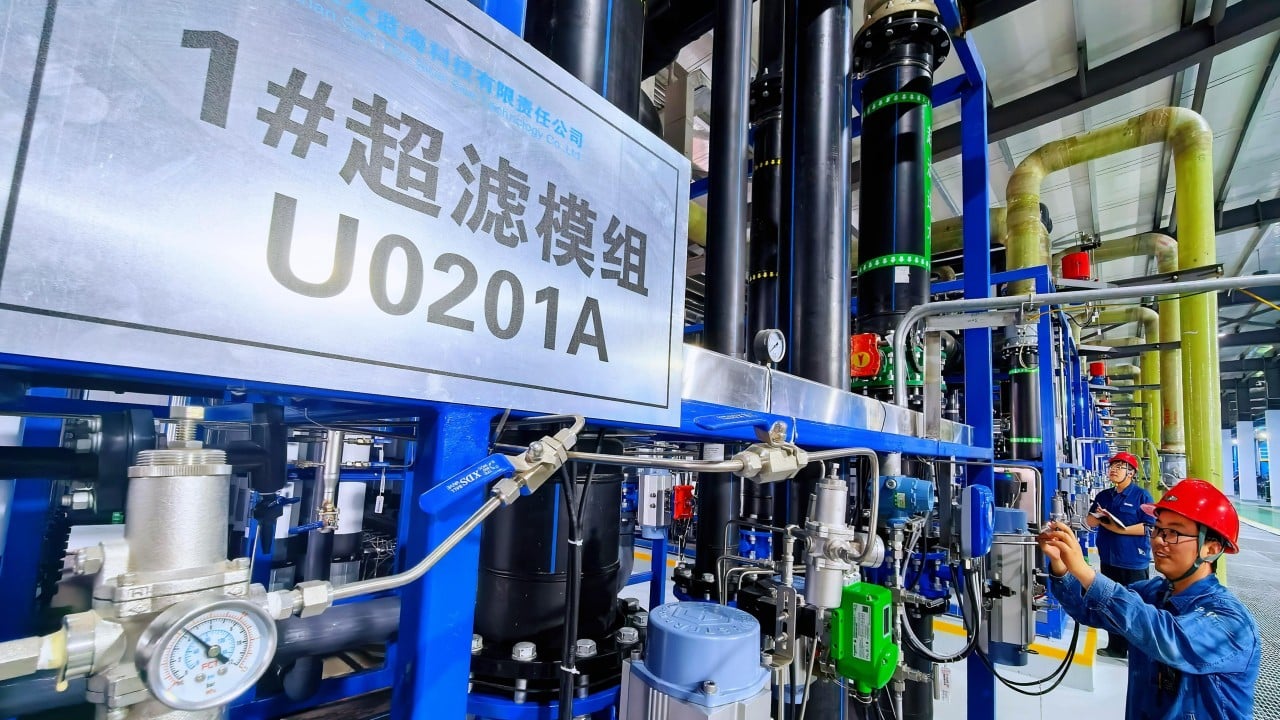
Imagine a chemical engineer named Chen, standing on a catwalk overlooking a facility that looks less like a factory and more like a minimalist sculpture. Chen has spent twenty years watching desalination plants choke on their own energy bills. He knows the math by heart. Energy is seventy percent of the operating cost of turning the ocean into drinking water. Cut the energy, and you unlock the coastlines of the world. Cut the waste, and you stop poisoning the very sea you are trying to survive on.
What Chen and his team achieved is not a minor optimization. It is an inversion of physics.
By reimagining the thermodynamics of reverse osmosis and thermal energy recovery, they managed to slash energy consumption by sixty percent. That is not a tweak. That is an order-of-magnitude leap. It changes the economics of survival for drought-stricken provinces where rivers have turned to bone dust and underground aquifers are ancient history.
Consider how they did it.
Instead of treating the high-pressure waste stream as an annoying byproduct to be discarded, they treated it as a battery. Energy recovery devices capture the ferocious kinetic force of the brine leaving the membranes and feed it back into the incoming seawater. It is the industrial equivalent of catching a falling safe and using its momentum to lift another one.
Yet, the true poetry of the breakthrough lies in what happens to the salt.
In a conventional plant, waste brine is a liability. In this new facility, it is an inventory.
Instead of dumping the hyper-concentrated brine back into the coastal ecosystem, the plant refines it. It strips out the impurities and harvests high-purity industrial salt. Think about that transition. A facility built to solve a shortage of water simultaneously produces a vital commodity for chemical manufacturing, neutralizing an environmental hazard while turning a cost center into a revenue stream.
It is a closed loop. A circle drawn in the sand against the rising tide of ecological collapse.
We are entering an era where scarcity will define our politics, our borders, and our humanity. The maps we grew up with are dissolving under the heat of a changing climate. Glaciers retreat. Snowpacks vanish. Wells that fed grandfathers run dry for their grandchildren. In this landscape of rising desperation, technology is often pitched as a silver bullet—a cold, sterile intervention designed by corporations that care nothing for the soil or the sea.
This plant tells a different story.
It whispers of a humility we have long lacked. It acknowledges that we cannot conquer nature with brute force; we must dance with her pressures. We must use her own weight against her, find value in her refuse, and learn to build systems that mimic the seamless efficiency of a living organism.
When Chen looks out over the discharge pipes today, the water churning away from the facility is not a toxic plume. It is managed. It is balanced. And inland, millions of people turn on their taps without wondering if the river upstream finally gave up the ghost.
The coast is still thirsty. The oceans are still vast, restless, and indifferent to our plight. But the barrier between us and survival has just dropped by sixty percent.
And somewhere in the dark, beneath the surface of the sea, the dead zone is starting to shrink.