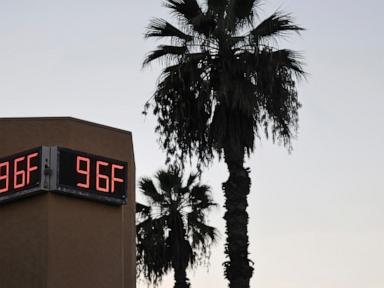
Atmospheric configurations currently driving dual-region meteorological extremes underscore the non-linear mechanics governing modern climate volatility. The co-occurrence of persistent thermal anomalies across the western landmass and localized baroclinic perturbations along the southern maritime perimeter illustrates a complex energetic transfer system. Understanding these phenomena requires moving past qualitative descriptions of bad weather and instead examining the governing thermodynamic equations, pressure differentials, and boundary-layer dynamics that dictate regional atmospheric behavior.
The Western Thermal Engine and Subsidence Mechanics
The prolonged high-temperature regimes established across the western sectors are fundamentally driven by upper-level ridging. This anti-cyclonic circulation forces large-scale air mass subsidence. As air descends down the troposphere, adiabatic compression increases its temperature while simultaneously reducing relative humidity.
This mechanism creates a positive feedback loop:
- Increased solar insolation warms the dry surface soil.
- Sensible heat flux dominates over latent heat flux due to low soil moisture availability.
- The heated surface radiates longwave energy back into the lower atmosphere, expanding the thermal dome.
The persistence of these ridges is maintained by Rossby wave breaking patterns that lock jet stream configurations into stagnant meridional flows. Without horizontal momentum transfer from transient mid-latitude cyclones, the thermal anomaly becomes stationary, exhausting local cooling capacities and creating sustained structural stress on regional infrastructure.
Maritime Perturbations and Latent Heat Release
Simultaneously, the southern maritime boundaries display high moisture availability interacting with localized low-pressure anomalies. Tropical and subtropical disturbances rely on latent heat flux as their primary energetic fuel source. Warm sea surface temperatures exceeding baseline thresholds evaporate moisture at high rates, which then condenses within convective updrafts.
The latent heat released during condensation warms the surrounding column of air, lowering surface pressure further and driving rapid cyclogenesis or disorganized convective clustering. Unlike the dry adiabatic compression seen in the western ridges, this southern dynamic operates on moist adiabatic lapse rates. The primary constraint on these maritime systems is vertical wind shear; high shear tears apart the organized vortex structures, while low shear allows for efficient vertical integration of energy and subsequent intensification.
Systemic Interconnectivity and Regional Bottlenecks
While separated geographically, these two regimes share a common boundary layer teleconnection mediated by the subtropical high-pressure belt. The positioning of the ridge acts as a steering mechanism for peripheral moisture plumes. When the western ridge weakens or retrogrades, it alters the trajectory of moisture transport corridors originating from southern disturbances, frequently resulting in abrupt flash-flood events in areas previously desiccated by heat.
Assessing the risk profile of these combined anomalies demands a shift from reactive forecasting to probabilistic modeling of boundary-layer saturation and soil moisture deficits. Infrastructure designed for historical climate baselines frequently fails under the dual pressure of prolonged thermal expansion and sudden hydraulic loading. Mitigation strategies must therefore account for maximum probable thermal stress thresholds alongside localized peak discharge rates, decoupling long-term structural resilience from short-term weather variability.