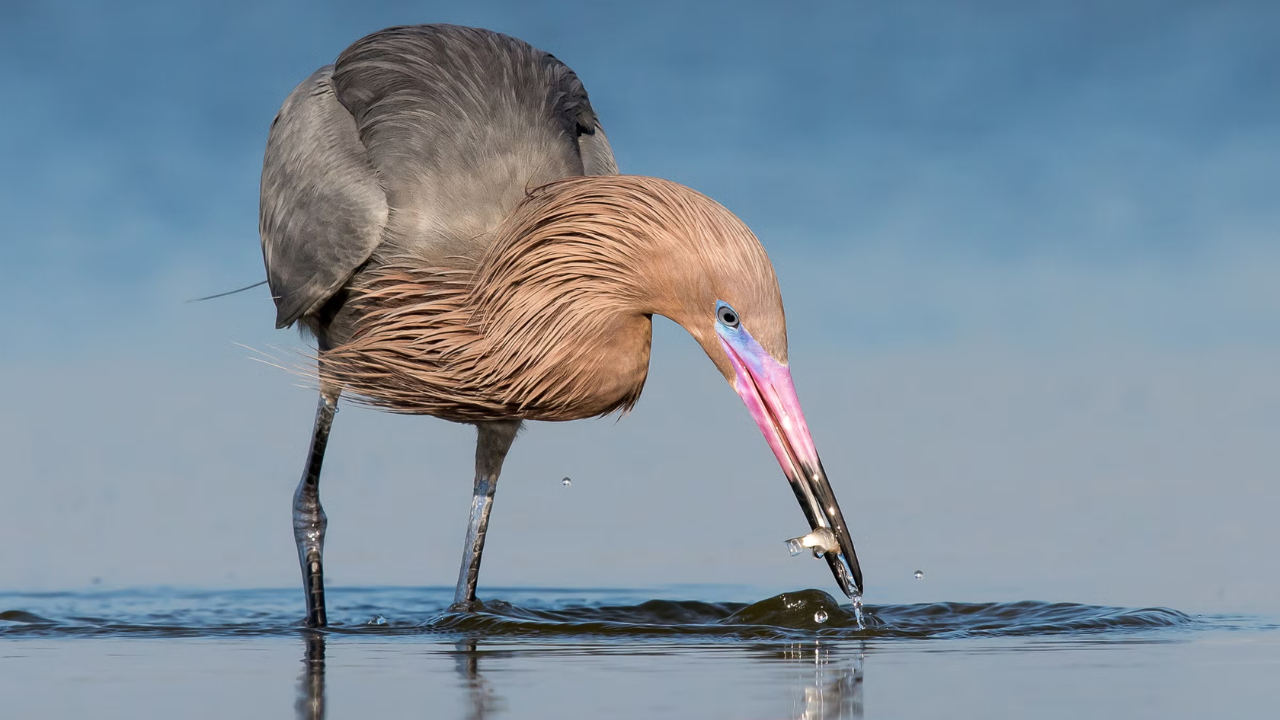
A century ago, the fashion industry nearly wiped out the reddish egret. Their striking plumes commanded astronomical prices, driving the species to the brink of local extinction across the Texas coast. Hunters slaughtered adults by the thousands, while poachers stripped nests of eggs.
Then came Green Island.
Tucked away in the hypersaline waters of south Texas's Laguna Madre, this 35-acre patch of land became the ultimate last stand. In 1923, Audubon Texas signed its first sanctuary lease with the Texas General Land Office to throw a protective ring around the refuge. It wasn't just a paper agreement. Real human beings had to stand guard in brutal conditions to keep the birds alive.
Why Green Island Worked When Everywhere Else Failed
Most islands dotted along the Laguna Madre are artificial creations, built from dredge spoil during the excavation of the Gulf Intracoastal Waterway shipping channel. Green Island formed naturally.
That natural formation created a fortress. The terrain is deeply inhospitable. It sits miles from the mainland, choked with viciously thorny vegetation like granjeno (spiny hackberry) and swarming with biting insects. Those harsh physical traits kept casual visitors away. More importantly, they blocked land-based predators from reaching the rookery.
Early conservationists recognized that this isolated tangle of brush was the only place left where the state's reddish egrets could find relative peace.
Living in a Two-Room Hut
Protecting the egrets wasn't a desk job. During the early decades of the sanctuary lease, coastal wardens lived on Green Island year-round.
A full-time family once hunkered down on the property inside a cramped, basic two-room wooden hut. Being a warden meant battling suffocating 90-degree heat, managing unruly brush, and constantly repairing wind-damaged docks. Every ounce of physical labor had to bend to the nesting schedule of the birds. If heavy maintenance disturbed the rookery, it waited.
Today, current Audubon Texas coastal wardens like Brian Beller maintain that legacy. Every spring, Beller clears the sole walking trail, removes fallen storm debris, and checks for invading predators. While the surrounding water acts as a moat, hungry coyotes, bobcats, and raccoons occasionally manage to swim across the lagoon. Wardens patrol regularly to intercept these animals before they can ravage the nests.
Architecture in the Bushes
Step onto Green Island today, and you step into a noisy, chaotic vertical apartment complex for coastal birds.
The island's dense canopy is neatly partitioned by species size:
- Top tier: Massive Great Blue Herons and Great Egrets claim the highest, sturdiest branches.
- Middle tier: Reddish Egrets, Roseate Spoonbills, and Black-crowned Night-Herons nest lower down in the thick cross-branches.
- Bottom tier: Tiny Snowy Egrets tuck themselves deep into the lowest, most concealed parts of the vegetation.
- Ground level: Glossy Ibis scatter across sandy openings, while Clapper Rails navigate the mangrove roots.
Not all neighbors are peaceful. A pair of crested caracaras often nests on the perimeter. While they occasionally prey on helpless heron chicks to feed their own young, wardens leave their nests alone because the caracaras are federally protected. Nature runs its course here, even when it is brutal.
The Modern Battle Against Rising Seas
Hunting is no longer the primary threat to the reddish egret. The guns and feather-buyers are gone. Climate change has taken their place.
Severe hurricanes like Hurricane Hanna have battered the sanctuary, destroying infrastructure like elevated observation towers used by scientists to monitor breeding success. Worse still is sea-level rise. Predictive computer models show that encroaching waters could submerge up to 15 acres of Green Island—effectively slicing its current size nearly in half.
Conservationists aren't panicking; they are adapting. Strategies now focus on expanding habitat networks across the Texas coast, enhancing artificial dredge islands, and managing vegetation so wading birds have backup sanctuaries when the waters rise.
What started as a desperate bet on a 35-acre patch of thorns in 1923 transformed the Texas Gulf Coast into the premier global stronghold for the reddish egret. Protecting a fragile ecosystem takes a century of stubborn, boots-on-the-ground dedication.
To see a virtual tour of these protected Texas rookery islands and learn more about the century-long conservation effort, watch Welcome to the Island Where Egrets Rule.