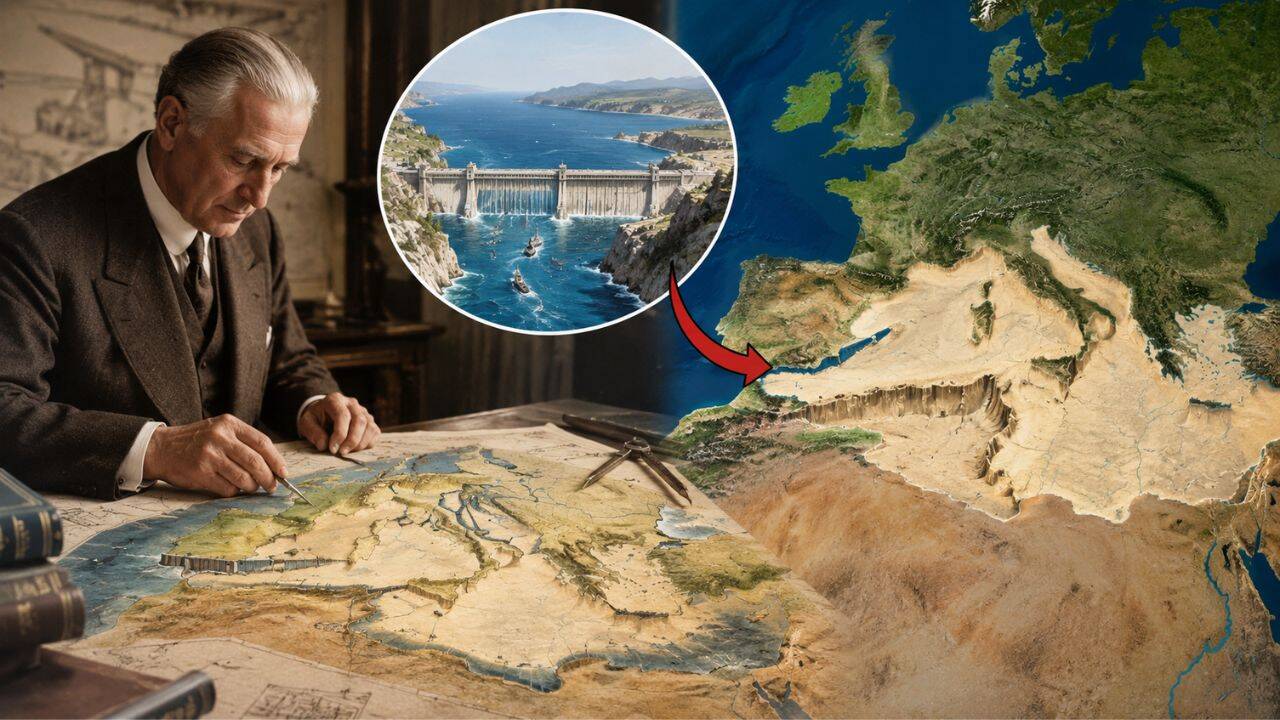
In 1928, German architect Herman Sörgel unveiled a radical proposal to dam the Strait of Gibraltar, partially drain the Mediterranean Sea, and merge Europe and Africa into a supercontinent named Atlantropa. His goal was straightforward on paper: solve Europe’s persistent energy shortages, create millions of acres of fertile farmland, and force geopolitical unity on a continent teetering toward war. By blocking the flow of the Atlantic Ocean, Sörgel calculated that natural evaporation would lower the sea level by up to 200 meters, unlocking vast stretches of new territory.
It was a staggering vision born of post-World War I anxiety. Europe was recovering from devastating conflict, facing severe energy deficits, and grappling with rapid population growth. Sörgel believed that traditional political diplomacy would inevitably fail to prevent another global war. His solution was purely structural engineering. If European nations pooled their resources to alter the planet’s geography, they would become so financially and technologically intertwined that war would become physically impossible.
The Mechanics of Engineering a Supercontinent
The technical blueprints of Atlantropa rested on massive infrastructure projects anchored by three strategic dams.
The primary barrier was a colossal dam across the Strait of Gibraltar, stretching over 14 miles. This structure was designed to shut off the Atlantic Ocean, which naturally replenishes the Mediterranean to offset its high evaporation rates. A secondary dam would block the Dardanelles, isolating the Black Sea. A third dam across the Strait of Messina would split the Mediterranean into two distinct basins: a western basin lowered by 100 meters and an eastern basin lowered by 200 meters.
[Image of hydroelectric dam]
Hydroelectric power sat at the heart of this design. Sörgel claimed the massive Gibraltar dam alone would house hydroelectric power plants capable of generating tens of thousands of megawatts continuously. Water rushing through the spillways would drive giant turbines, supplying cheap electricity to power industries across Europe and Africa.
The secondary benefit was land reclamation. As the water receded, approximately 660,000 square kilometers of new dry land would emerge from the seabed—an area larger than France. This newly exposed soil was intended to host huge agricultural settlements, housing projects, and industrial centers. To address the African continent, Sörgel proposed damming the Congo River to flood the Sahara, creating vast inland freshwater lakes that would irrigate desert wastelands and make them arable.
The Ecological Catastrophe Behind the Blueprint
While Sörgel’s plans won serious attention from intellectuals, engineers, and journalists throughout the 1930s, the underlying physics revealed catastrophic oversights.
Lowering the Mediterranean Sea would not produce arable farmland. The exposed ocean floor consisted largely of hyper-saline mud, salt flats, and rocky sediment. Without massive, economically impossible soil desalinization efforts, crops would not grow on the exposed seabed. Instead of lush farmland, Europe would have gained hundreds of thousands of square miles of sunbaked salt deserts.
The atmospheric consequences were equally grim. Evaporating water from the Mediterranean contributes significantly to rainfall patterns across Southern Europe and Northern Africa. Removing hundreds of thousands of cubic miles of surface water would severely disrupt regional weather systems. Southern Europe—specifically Spain, Italy, and Greece—would face severe desertification, higher temperatures, and prolonged droughts.
Coastal infrastructure would suffer immediate devastation. Major maritime cities that depended on sea access for trade and survival would find themselves stranded dozens of miles inland.
- Venice would sit above a marshy basin, cut off entirely from the Adriatic.
- Marseilles, Barcelona, and Naples would lose their harbors, collapsing regional maritime trade networks.
- The Suez Canal would become completely useless, severing one of the world's crucial commercial routes.
Furthermore, the weight of the water shifted by the project posed tectonic risks. Removing millions of gigatons of water pressure from the Mediterranean tectonic basin while adding immense pressure to surrounding landmasses could trigger unprecedented seismic activity along fault lines running through Italy and the Balkans.
Geopolitical Realities and the Fade of Atlantropa
Sörgel actively promoted Atlantropa for over two decades, founding the Atlantropa Institute to fund research and lobbying efforts. He pitched his idea to political leaders across Europe, including the Weimar government and later the Nazi regime.
The Nazis rejected Sörgel’s proposal outright. Their expansionist policy, known as Lebensraum, focused on military conquest to the East rather than massive engineering projects to the South. Additionally, Sörgel’s pacifist philosophy—the idea that nations would work as equals to manage the supercontinent—directly contradicted National Socialist ideology.
Following World War II, Sörgel attempted to revive the project, presenting it as a peaceful way to rebuild a shattered Europe. For a brief period during the late 1940s, the proposal regained traction among scientists and politicians eager for bold reconstruction ideas.
However, the dawn of the nuclear age quietly rendered Atlantropa obsolete. The development of commercial nuclear power offered an alternative source of abundant energy without requiring the physical alteration of continents. At the same time, the rise of international trade agreements proved that economic integration could occur without damming ocean straits.
When Herman Sörgel died in 1952 after being struck by a car while riding his bicycle, the Atlantropa movement died with him. The institute eventually disbanded in 1960, leaving behind a massive archive of maps, blueprints, and promotional pamphlets.
Atlantropa stands as an extreme case study in technocratic hubris. It assumed that human engineering could completely control complex natural ecosystems without unintended consequences. Sörgel sought to build peace through concrete, but his plan overlooked the basic realities of ecology, marine biology, and climate dynamics.