Every time you generate an image or ask a chatbot to draft an email, a server rack somewhere in Virginia or Texas draws a little more power from a grid that is far dirtier than Silicon Valley wants you to believe. We spend a lot of time talking about carbon footprints and net-zero targets, yet the physical air pollution pumping out of the US data center boom has quietly turned into a massive public health problem.
A landmark study from researchers at the University of California, Riverside, and Caltech recently put hard numbers to this exact issue, landing right alongside high-profile international climate talks where tech leaders rolled out shiny new "clean AI" pledges. The contrast couldn't be sharper. While executives shake hands on stage and promise sustainable artificial intelligence, their facilities are already generating thousands of premature deaths and billions of dollars in health damages across American communities.
I've tracked energy infrastructure and cloud expansion for years, and the gap between corporate sustainability reports and local air quality monitors has never been wider. Let's look at what the data actually says, why those clean AI pledges fall short, and what communities are paying for the AI gold rush.
The Hidden Health Cost of US Data Center Pollution
When most people hear "data center emissions," they think about carbon dioxide warming the planet twenty years from now. That's only half the story. The UC Riverside and Caltech research focused on criteria air pollutants—specifically fine particulate matter (PM2.5), sulfur dioxide, and nitrogen oxides—that hit human lungs immediately.
These pollutants don't just float away harmlessly. They trigger asthma attacks, worsen cardiovascular disease, and lead to premature mortality in neighborhoods sitting downwind of power plants and backup generators. According to the researchers' modeling, the public health burden from US data center electricity consumption and backup power already costs the American economy billions of dollars annually in healthcare expenses and lost productivity. If the current trajectory of AI server construction holds steady through 2030, those annual health costs could easily rival the total damage caused by some of the country's heaviest manufacturing sectors.
Here is why the numbers are climbing so fast. Training a single frontier AI model requires tens of thousands of specialized GPUs running at peak capacity for months on end. Unlike traditional web hosting, which experiences predictable peaks and valleys throughout the day, AI training runs are relentless, flat-line power draws. Utilities can't simply spin up new solar farms overnight to meet that demand. Instead, they keep aging coal and natural gas peaker plants running longer, pushing toxic particulates directly into regional airsheds.
The Diesel Generator Problem Nobody Mentions
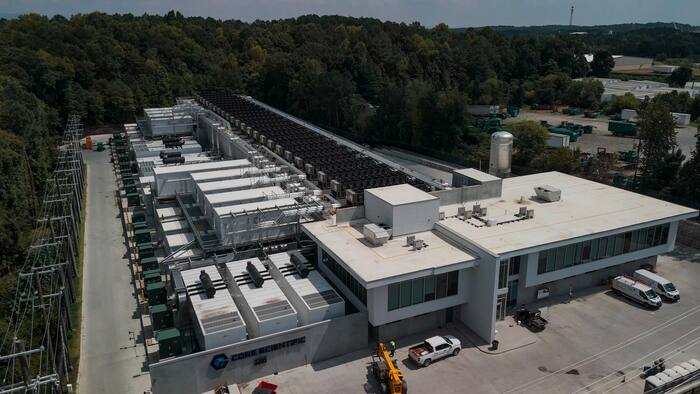
Even facilities that boast about buying 100% renewable energy on paper still rely on rows of massive diesel backup generators to guarantee 99.999% uptime. You won't see those generators featured in glossy PR videos, yet they sit outside almost every hyperscale warehouse in Northern Virginia's "Data Center Alley."
Tech companies don't just fire up these engines during rare grid blackouts. Federal and state air quality permits allow operators to run routine maintenance tests every single month, burning thousands of gallons of diesel fuel right next to suburban schools and residential subdivisions. During peak summer heatwaves, when the regional electrical grid strains under air conditioning loads, grid operators sometimes ask data centers to switch over to their onsite diesel generators to relieve pressure on the wires. In those moments, a cloud facility becomes an unregulated local power plant pumping nitrogen oxides and diesel soot straight into the neighborhood.
Why Clean AI Pledges at Climate Talks Miss the Mark
Against this backdrop of rising local pollution, delegates and tech executives at international climate summits have pushed voluntary "clean AI" pledges. On the surface, these agreements sound great. Signatories promise to improve hardware efficiency, invest in next-generation nuclear and geothermal energy, and use artificial intelligence to optimize electrical grids and accelerate climate science.
Honestly, it's classic corporate misdirection. Voluntary pledges give companies tremendous public relations cover while demanding zero binding accountability for the pollution happening right now.
The biggest flaw in almost every corporate clean energy claim comes down to accounting tricks—specifically, unbundled Renewable Energy Credits (RECs). Here is how that works in practice. A tech giant builds a massive, power-hungry AI campus in a state heavily reliant on coal and natural gas, like Ohio, West Virginia, or parts of the Midwest. Because the local grid is dirty, that data center is physically powered by fossil fuels every hour of the day. To claim "100% clean energy" in its annual report, the company buys cheap RECs generated by a wind farm in Texas or Oklahoma.
The math looks tidy on a spreadsheet. In the real world, the wind power in Texas never reaches the servers in Ohio, and the residents living near the Ohio coal plant still breathe in the sulfur dioxide and particulate matter generated to keep those AI models running. Until tech companies commit to 24/7 hourly carbon-free energy matching on the exact same local grid where their servers operate, clean AI pledges remain mostly marketing theater.
The Rebound Effect in AI Efficiency
Another major talking point at climate talks is chip efficiency. Executives love pointing out that modern AI accelerators perform vastly more calculations per watt than hardware from five years ago. That's factually true, yet it ignores a basic principle of energy economics called the Jevons Paradox.
When a resource becomes cheaper and more efficient to use, total consumption doesn't drop—it explodes. Making AI inference ten times more energy-efficient hasn't reduced data center electricity demand. Instead, it convinced software companies to cram generative AI features into every search bar, word processor, customer service bot, and social media feed on the planet. Efficiency gains are being completely swallowed by sheer volume.
Where the Pollution Hits Hardest
Data center pollution isn't distributed evenly across the country. Hyperscale developers cluster their facilities where land is cheap, fiber-optic cables converge, tax breaks are generous, and water is accessible. That clustering creates intense regional sacrifice zones.
Look at Loudoun and Prince William counties in Northern Virginia, which handle a massive share of global internet traffic. The concentration of facilities there has forced regional utilities to propose billions of dollars in new high-voltage transmission lines and delay the retirement of fossil fuel generators. Residents have pushed back against the constant low-frequency hum of cooling fans and the proliferation of diesel generator permits, turning local zoning board meetings into standing-room-only battles.
Similar patterns are playing out across other major hubs:
- Phoenix, Arizona and Dallas, Texas: Extreme summer temperatures force cooling systems to work overtime, driving up both electricity demand from gas-heavy grids and massive water evaporation.
- Columbus, Ohio and Council Bluffs, Iowa: Rapid hyperscale expansion in the Midwest leans heavily on grids that still draw substantial power from coal-fired plants, leading to higher per-megawatt rates of sulfur dioxide and fine particulate emissions.
- The Pacific Northwest: Historically prized for cheap, clean hydroelectric power, grids in Oregon and Washington are now hitting capacity limits, forcing utilities to import fossil-generated electricity from neighboring states to satisfy new data center contracts.
What makes this especially frustrating is how little transparency local communities get before construction starts. Developers frequently hide behind non-disclosure agreements and shell companies during land acquisition and zoning approvals. By the time residents realize a million-square-foot server farm is going up across the street, the air permits are already signed.
How Tech Companies Can Actually Clean Up AI
We don't have to shut down AI development to fix this, nor should we pretend the technology doesn't have real value. We just need to stop letting tech giants socialize their health and environmental costs while privatizing the profits. Real solutions exist right now, and some forward-thinking engineers are already pushing for them.
First, companies must abandon annual REC matching in favor of 24/7 time-and-location-matched clean power. Google and Microsoft have both piloted hourly matching programs in select regions, proving the accounting and procurement models work. If a company wants to build a gigawatt-scale AI campus in Virginia, it needs to fund and connect enough clean generation and grid-scale battery storage on the PJM Interconnection grid to cover every single hour of its load.
Second, operators need to ditch diesel backup generators. The technology to replace them isn't futuristic; it's sitting on the market today. Industrial-scale lithium-iron-phosphate batteries, hydrogen fuel cells, and cleaner renewable diesel blends can handle backup power duties without spewing carcinogens into local neighborhoods during monthly tests.
Third, software developers need to stop using massive frontier models for simple tasks. Using a multi-hundred-billion-parameter model to summarize a three-sentence email or classify basic text is like driving a semi-truck to pick up a carton of milk. Deploying smaller, task-specific models locally on user devices—or routing queries to lightweight cloud models—can slash inference energy consumption by up to 90% with zero noticeable drop in quality.
What You Can Do Right Now
You don't have to wait for international climate delegates or federal regulators to get their act together. Whether you work in tech, manage corporate IT budgets, or simply live in a region targeted for server farm expansion, you have direct leverage.
If you're a developer, product manager, or business leader choosing AI vendors, start asking hard questions during procurement. Demand location-based emissions data rather than market-based REC numbers, and audit your software stack to replace bloated frontier API calls with smaller, fine-tuned open-weight models wherever possible. If you're a resident in a growing tech corridor, show up to local utility commission hearings and county zoning meetings when new industrial substations or backup generator air permits come up for public comment. Demand mandatory air quality monitoring around hyperscale campuses and push local officials to require clean backup power before granting lucrative property tax exemptions.