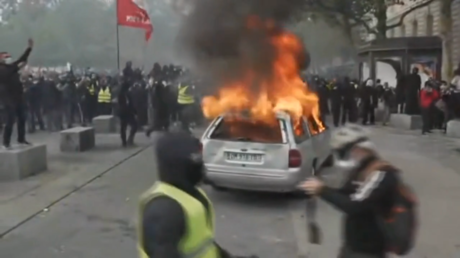
Tear gas in France isn't a rare shock anymore. It's a recurring ritual whenever wages, public services, and street politics collide.
If you've watched clips of blue-lit clouds rolling across boulevards in Paris, Lyon, Marseille, Nantes, or Bordeaux over the past several weeks, you already know the visual shorthand. Sirens, flying canisters, hurried retreats, and shaky smartphone footage flooding social feeds within minutes. Yet a viral clip rarely explains why a march that starts over paychecks or school funding suddenly turns into chemical crowd control.
Behind the smoke sits a collision between economic strain, union strikes, student walkouts, and a bitter fight over police powers. Most quick-hit video roundups stop at the spectacle. Honestly, that leaves out half the story.
Why Tear Gas Shows Up Across France
Tear gas is standard-issue crowd control for French riot police, deployed when officers judge that a march has crossed into unlawful territory, broken away from an approved route, or begun generating projectiles, barricades, or property damage. Authorities routinely frame chemical dispersants as a way to clear flashpoints without escalating immediately to heavier physical force.
Still, deployment rarely happens in a vacuum. During the autumn wave of demonstrations stretching across October and November 2026, clashes broke out in multiple cities alongside nationwide strikes and weekend rallies. In some instances, police reported groups veering off agreed routes or confronting officers with fireworks, rocks, or street fires. In others, bystanders, students, and even musicians caught near a square described clouds drifting into areas where peaceful demonstrators were still gathered.
That gap between official explanations and street-level accounts is precisely why video clips hit so hard. A 20-second clip shows choking smoke and running crowds. It doesn't show what happened ten minutes earlier at the front of the march, or what happened three blocks away after a splinter group broke off.
What Is Actually Driving the Protests
People don't pour into the streets week after week over a single grievance. The current unrest pulls together pressures that have been building for months across households, classrooms, and public offices.
- Cost of living and wages: High everyday expenses and stagnant pay have pushed public-sector unions and private workers alike into coordinated walkouts. Talks with Prime Minister Sébastien Lecornu over public-sector pay followed an earlier minimum-wage adjustment for private-sector workers, yet union leaders argued the measures fell short of fixing real household strain.
- Schools and student frustration: High school and university students have staged blockades and marches over classroom conditions, funding, and educational standards. When young people feel their schooling and future prospects are slipping, street protests become a way to force national attention.
- Political anger and next year's election: Many marchers aren't just arguing about this month's budget. They're looking ahead to next year's presidential election, voicing frustration toward President Emmanuel Macron's government while warning against political extremes.
Put those together and you get a volatile mix. Trade unions can mobilize hundreds of thousands of people on a strike day, while smaller, more confrontational groups often test police lines at the edges of rallies.
The Police Bill Flashpoint
One detail makes this wave of protests especially sharp: anger over policing itself has become a central issue on the banners and chants. Demonstrators and civil rights groups have pushed back hard against proposed legislation governing when police officers and gendarmes can use firearms on duty, with critics warning it could weaken accountability and opponents in parliament arguing it protects officers from unfair legal assumptions.
Lawyers representing injured protesters have also pointed to eye, hand, and limb injuries during recent demonstrations, signaling legal battles ahead alongside street politics. Meanwhile, Interior Ministry figures and police accounts have highlighted officer injuries, arrests, and severe damage during violent flare-ups. Both sides claim they're defending basic safety, and neither trusts the other's version of events.
What Viral Protest Videos Miss—and Get Wrong
Short-form clips are great for spotting movement in real time. They're terrible at giving you full context.
In fast-moving crowds, two things happen constantly. First, decontextualization: a clip filmed at dusk in one neighborhood gets paired with commentary about a march that happened hours earlier across town. Second, rumor amplification: during chaotic clashes, false claims about severe injuries or deaths can spread online before authorities or credible outlets verify what happened.
From what I've seen covering and tracking protest coverage over the years, the biggest mistake readers make is treating a single viral video as proof of an entire day's events. A peaceful march of tens of thousands can have a quiet, orderly afternoon and a chaotic twenty minutes at one intersection. Conversely, a rowdy clash in one city doesn't mean every other city is burning.
How to Read Protest Footage Smartly
If you come across new clips from France—or any major unrest—a few simple habits save you from falling for bad framing:
- Check the timestamp and location: Look for street signs, transit lines, daylight versus nightfall, and independent verification before assuming a video is brand new.
- Separate the crowd from the clash: Ask whether you're looking at the main union or student march, a targeted blockade, or a small group breaking away from the route.
- Compare multiple sources: Pair eyewitness video with reporting from established news agencies such as Reuters, Al Jazeera, or CBC News and official statements to see where accounts overlap and where they clash.
- Watch the policy track, not just the smoke: Street clashes grab eyes, yet wage negotiations, parliamentary votes, and court actions determine what actually changes afterward.
Tear gas clears the air eventually, sometimes in minutes, sometimes after hours of tension. The deeper arguments over wages, public services, and policing take much longer to settle—and that's why the cameras keep coming back.
Reuters coverage of police firing tear gas at French school protests gives a concise visual look at how clashes have unfolded during recent student demonstrations in France.