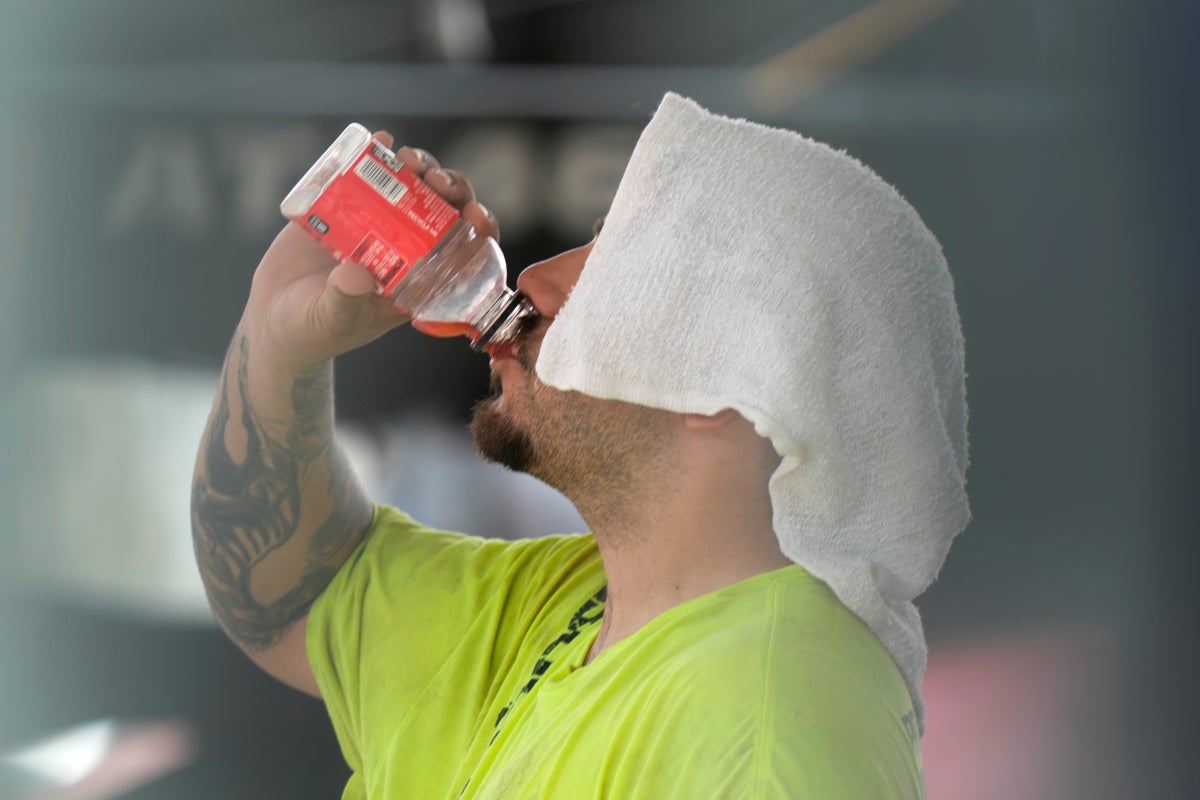
The air inside the concrete apartment block doesn’t move. It just sits there, heavy and thick, smelling slightly of baked asphalt and old dust. It is 9:00 PM on a Tuesday, late June, and the thermometer on the wall reads 92 degrees. Outside, the sky has faded to a bruised, bruised purple, but the ground refuses to give up the heat it drank in all day.
For hypothetical millions across the American Midwest and East Coast, this is the reality of the week leading up to Independence Day. The holiday is supposed to be about smoke and celebration, the snap of a cold soda can, and the smell of lighter fluid on charcoal. This year, it feels more like a survival drill.
A massive heat dome has parked itself over the heart of the country. It isn't just a headline; it is a physical weight.
The Chemistry of a Heavy Sky
To understand why this feels different, you have to look at the numbers behind the sweat. We often talk about the temperature as a solitary figure—95, 100, 103. But the real enemy is the humidity. When moisture saturates the air, the human body loses its primary superpower: evaporation.
Think of your skin as a radiator. When you sweat, the air carries that moisture away, cooling you down. But when the relative humidity pushes past 60 percent at high temperatures, the air is already full. It can’t take any more of your water. The sweat just sits there. Your internal thermostat keeps cranking, but the heat has nowhere to go.
The National Weather Service uses the Heat Index to measure this exact misery. When the forecast says 98 degrees with a heat index of 110, that isn't a theoretical calculation. It is a biological warning. It means your body feels like it is trapped in an oven that is trying to steam cook you from the outside in.
Medical professionals look at a specific metric called the wet-bulb temperature. If that number hits 95 degrees Fahrenheit (35 degrees Celsius) with 100 percent humidity, even a perfectly healthy human being sitting in the shade with plenty of water cannot survive for more than a few hours. The body simply cannot shed heat fast enough. We aren't quite there yet for most of the country, but we are flirting with the edges of what the human frame can endure without mechanical intervention.
The Neighborhood Gridlock
Consider what happens next when an entire region plugs in.
Imagine a neighborhood where every single air conditioning unit kicks on at the exact same moment. The humming sound becomes a low, vibrating roar that defines the summer. Deep inside the local electrical substation, transformers are cooking. They need the cool night air to drop their internal temperatures, but the night air isn't cooling down. The low temperatures are staying in the mid-80s.
This is where the infrastructure begins to fray. The grid isn’t just carrying electricity; it is fighting a war against thermal dynamics. When a transformer blows, it isn't just the lights that go out. The lifeline goes out. For an elderly person on the fourth floor of a brick building, that fan or window unit is the only thing keeping their core temperature below the danger zone.
The danger isn’t distributed evenly. If you have a central AC system and a leafy backyard, a heatwave is an expensive inconvenience. Your electricity bill will be staggering, but you will survive. If you work roofing on a suburban strip mall, or if you depend on public transit and have to wait forty minutes at a concrete bus stop with no awning, the heatwave is a predatory threat. It hunts the vulnerable.
The Evolution of the Summer Feast
We have a collective memory of what the Fourth of July is supposed to look like. It is Norman Rockwell with a sunburn. But that memory was built in a different climatic era.
Historically, extreme heatwaves were spikes—sharp, brutal anomalies that lasted two or three days before a cold front swept down from Canada to break the spell. Now, these systems are stagnant. The jet stream, which used to move weather patterns along like a conveyor belt, is looping and sluggish. It traps these high-pressure domes in place for a week, ten days, two weeks at a time.
The heat accumulates. It bakes into the brickwork, the sidewalks, and the soil. Every day builds on the misery of the day before.
This shift forces a quiet rewrite of our traditions. Parades that used to march at noon are being pushed to the early morning or canceled entirely because the horses can’t handle the asphalt and the high school band members keep fainting into their tubas. The evening fireworks, long the crown jewel of the holiday, face a double jeopardy. The heat dries out the brush, turning every spark into a potential wildfire trigger, while the heavy, humid air traps the smoke low to the ground, turning the celebration into a choking smog.
Redefining the Safety Net
So how do we navigate a holiday where the outdoors feels hostile?
The answer isn't just staying inside and turning the dial down. It requires an inventory of our communities. In many cities, public libraries and cooling centers have become the new town squares. They are no longer just places to borrow books; they are literal sanctuaries where people who cannot afford the surge in utility prices can sit in the cool air for eight hours without having to buy a cup of coffee.
We also have to change how we look at each other. Heat exhaustion doesn't announce itself with a scream. It is quiet. It looks like confusion. It looks like a person sitting on a park bench who has stopped sweating entirely because their body has run out of fluid. It looks like a slow down in speech, a slight stumble, a pale complexion despite the blistering sun.
Checking on a neighbor isn't just a polite gesture anymore; it is a vital wellness check.
The old advice—drink water, wear light clothing, avoid the midday sun—feels inadequate against the scale of modern summers. We need a psychological shift. We have to treat extreme heat with the same respect and fear that we reserve for a blizzard or a hurricane. You wouldn't host a backyard barbecue during a category one storm, yet millions of us will still stand over a 400-degree grill this week, drinking dehydrating beverages, simply because the calendar says we should.
The sun will rise tomorrow, and the sky will be that same pale, washed-out blue that signals another day of triple-digit indexes. The asphalt will soften underfoot. The air will feel like a wet wool blanket pressed against the face.
We will still find ways to celebrate. We will gather around pools, crowd into air-conditioned movie theaters, and eat watermelon over the kitchen sink. But the joy will be tempered by a new kind of awareness. The sparkler will burn down, its bright smoke rising into a night that refuses to cool, a stark reminder that the elements we once took for granted are rewriting the rules of the season.