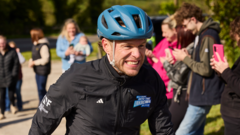
The crowd at the finish line sees the neon vest and the familiar, boy-next-door grin. They see Olly Murs, the man who soundtracked a thousand weddings and summer parties, crossing a threshold of physical exhaustion for a charity cause. It looks like a victory lap. It looks easy because he’s spent a career making everything look easy. But the reality of a celebrity endurance challenge isn’t found in the cheering sections or the polished social media updates. It’s found in the third hour of a grueling trek when the cameras aren’t clicking, when the lactic acid turns your thighs to lead, and when the only thing keeping you moving is the ghost of a person you couldn’t save.
We often treat celebrity charity work as a PR exercise. We assume it’s a tax break wrapped in a photo op. We are cynical because we’ve been burned by empty gestures before. Yet, when you strip away the management teams and the brand deals, you are left with a man standing on a trail, facing the same relentless gravity and punishing miles as anyone else. There is no "fame" button to press when your lungs start to burn.
The Weight of the Invisible Pack
Every person running for a cause carries two packs. One is physical, filled with hydration bladders and protein bars. The other is invisible. It is weighted with the names of those lost to mental health struggles, the faces of friends who didn't make it to thirty, and the heavy silence of those still suffering in the shadows. For Olly, this isn't just a physical test. It is an act of public mourning and private atonement.
Consider a hypothetical young man named Sam. Sam lives in a small town, works a job he finds draining, and struggles to talk to his mates about the "black dog" that follows him home every night. Sam watches a clip of a man he admires—someone successful, wealthy, and seemingly happy—pushing himself to the brink of collapse to raise money for a suicide prevention helpline. In that moment, the distance between the stage and the street vanishes. The struggle becomes a shared language. When a public figure breaks a sweat for a cause like Brain Trust or a mental health initiative, they aren't just raising money. They are legitimizing the pain of people like Sam.
The stakes are higher than the total on a donation page. We are currently facing a global crisis of connection. Statistics tell us that suicide remains one of the leading causes of death for men under fifty. Logic dictates that we need more funding, more beds, and more doctors. But logic doesn't always reach a person sitting in a dark room at 3:00 AM. Storytelling does. Action does.
The Anatomy of the Long Haul
Physical pain is a strange equalizer. It doesn't care about platinum records. During a charity challenge, the body eventually enters a state of rebellion. Your brain starts sending frantic signals to stop. It tells you that you’ve done enough. It reminds you that the "total raised" is already impressive. This is where the narrative shifts from a sporting event to a psychological war.
Imagine the sensation of salt stinging your eyes while your knees click with every step on uneven pavement. The air feels thin. The cheering of the crowd at the start line is a distant memory, replaced by the rhythmic, heavy thud of your own heart. This is the "middle mile" where most people quit. It’s the space where you have to decide why you’re actually there.
- The First Phase: Adrenaline and ego. You feel fast. You feel watched. You wave to the cameras.
- The Second Phase: The realization of the distance. The silence settles in. Your body begins to ache in places you didn't know you had muscles.
- The Third Phase: The wall. This is where the "why" matters more than the "how."
In this third phase, the celebrity is gone. There is only a human being trying to honor a promise. When Olly Murs takes on these challenges, he is navigating this exact internal geography. He is moving through the pain to signal to the world that some things are worth hurting for.
Beyond the Ribbon Cutting
The problem with the way we report on these events is that we focus on the finish line. We focus on the oversized check and the sweaty hug. We rarely talk about the Tuesday morning three months later when the buzz has died down and the charity still needs to answer the phones.
Money is the fuel, but awareness is the engine. A donation is a one-time transaction; a shift in perspective is a permanent change. By putting his body on the line, a public figure forces a conversation into the mainstream that usually stays whispered in GP waiting rooms. They use their platform to act as a lightning rod, drawing the energy of the public toward a storm that most would rather ignore.
We often get the concept of "charity" backward. We think it’s about the person with plenty giving to the person with nothing. In reality, these challenges are about the person with a voice speaking for the person who has been silenced. It’s a recognition that we are all, at some point, one bad day away from needing that helpline.
The Human Cost of Staying Human
It is exhausting to be an "icon." There is a pressure to remain upbeat, to be the "Troublemaker" singer who always has a quip ready for the cameras. Stepping into the arena of high-stakes charity work requires a different kind of vulnerability. It requires showing the world that you are tired, that you are grieving, and that you are capable of being broken by the weight of the world’s problems.
This isn't about a PR "win." A win is a smooth interview. A win is a chart-topping single. A grueling, multi-day physical challenge is a risk. It’s a risk of injury, a risk of public failure, and a risk of emotional exposure. Yet, it’s exactly this risk that makes the effort resonate. We don't want to see perfect people doing perfect things. We want to see people we recognize struggling for something that matters.
As the sun sets on another challenge, the crowds eventually go home. The neon vests are packed away. The blisters begin to heal. But for the people watching—the Sams of the world—the image that remains isn't the singer on a stage under a spotlight. It’s the man on the road, teeth grit, breathing hard, refusing to stop until the job is done.
The true measure of the journey isn't found in the miles logged on a GPS watch. It is found in the quiet realization that none of us has to carry our invisible packs alone. The road is long, and the hills are steep, but there is someone ahead of us, clearing the path, making sure the light stays on for whoever comes next.
In the end, the sweat dries and the muscles recover, but the message remains carved into the pavement: you are seen, you are heard, and you are worth the struggle.