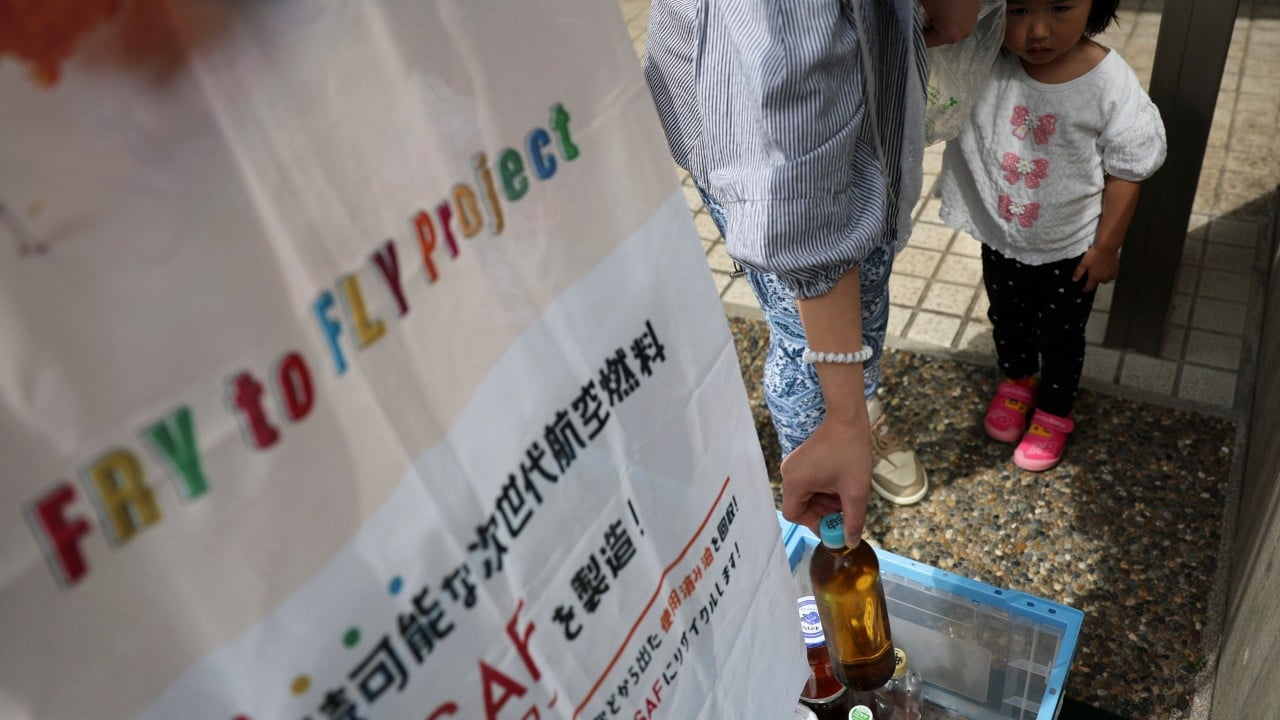
Aviation has a carbon problem, and the industry has found its favorite security blanket: Sustainable Aviation Fuel, or SAF. Specifically, the media is currently infatuated with the narrative that Japan is solving its looming jet fuel crisis by collecting used cooking oil from ramen shops and households. It sounds like a perfect circular economy fairytale. You fry some tempura, pour the grease into a collection bin, and use it to power a Boeing 777 from Tokyo to Los Angeles.
It is a beautiful story. It is also an mathematical impossibility. Meanwhile, you can read other events here: The Anatomy of Craft Beer Consolidation and Flagship Brand Decay.
The current consensus among airlines, government bureaucrats, and optimistic environmental journalists is that crop-based and waste-derived biofuels will seamlessly replace petroleum jet fuel. Japan has even set a mandate: 10% of aviation fuel used by international flights utilizing Japanese airports must be SAF by 2030.
But the math does not care about mandates. The obsession with turning used cooking oil into jet fuel is not a revolutionary solution. It is a dangerous distraction that delays the structural overhaul global transport actually needs. We are burning millions of dollars pretending that french fry grease can sustain global globalization. It cannot. To see the complete picture, check out the detailed article by Investopedia.
The Tyranny of the Feedstock Limit
To understand why this strategy is fundamentally flawed, you have to look at the chemistry and the supply chain, not the marketing brochures. SAF made from used cooking oil or animal fats falls under the HEFA category (Hydroprocessed Esters and Fatty Acids).
I have spent years analyzing energy density matrices and supply logistics for industrial transport. The biggest lie told in the green tech sector is that waste streams are infinite. They are not. They are strictly capped by human consumption.
Let us look at the raw numbers. Japan consumes roughly 2.5 million tons of edible oils annually. Even if every single drop of that oil was recovered perfectly—with zero waste, zero leakage, and zero logistical friction—it would still represent a fraction of what the domestic aviation industry requires. In reality, only a fraction of that oil is recoverable from commercial kitchens and households.
According to data from the International Air Transport Association (IATA), global aviation demand requires hundreds of millions of tonnes of fuel annually. If you gathered every ounce of used cooking oil on the planet today, it would meet less than 5% of global jet fuel demand.
By centering a national energy strategy on an inherently limited waste stream, Japan is creating an artificial scarcity bubble. Predictably, the price of used cooking oil is skyrocketing. Trading firms are aggressively outbidding each other for literal garbage. European and American buyers are already importing Asian waste oil, creating a absurd, carbon-intensive global shipping loop where we burn bunker fuel across oceans just to transport grease to make "green" jet fuel.
The Displacement Effect Nobody Talks About
When a resource becomes scarce because of a government mandate, market dynamics do not magically disappear. They adapt in ways that usually hurt the environment.
Before the aviation industry decided used cooking oil was the holy grail of greenwashing, that oil already had a job. It was not sitting in landfills. In Japan and across Asia, used cooking oil is heavily utilized in the chemical industry, for manufacturing soaps, and crucially, as a vital component in animal feed.
When airlines buy up the supply of used cooking oil to meet their 10% statutory mandates, what happens to the animal feed manufacturers? They do not stop producing feed. They switch to the next cheapest, most readily available lipid source. In most cases, that means virgin palm oil.
This is the displacement effect, and it completely invalidates the net-zero calculations used by airlines. If using a gallon of cooking oil in a jet engine forces an agricultural firm to buy a gallon of palm oil from deforested land in Southeast Asia, the net carbon impact is deeply negative. Yet, on the airline's corporate ESG ledger, their flight is marked as "sustainable." It is a shell game.
The Refining Tax and the Energy Return Illusion
Even if you ignore the feedstock limits and the displacement effect, the physical conversion process of turning old grease into aviation-grade kerosene is an energy-intensive nightmare.
Jet fuel must meet strict international standards, such as ASTM D1655. It needs to remain fluid at -47°C without freezing, possess high energy density, and not degrade engine seals. Turning heterogeneous, degraded lipids containing impurities, water, and free fatty acids into a pristine, ultra-pure hydrocarbon requires immense amounts of hydrogen and heat.
[Used Cooking Oil/Fatty Acids] + [High-Pressure Hydrogen] + [Catalyst + Heat]
       │
       ▼ (Hydrotreating & Cracking)
[Paraffins + Propane + Water + CO2]
       │
       ▼ (Isomerization & Fractionation)
[Sustainable Aviation Fuel (SAF)] + [Renewable Diesel/Naphtha]
This process, hydrotreating and isomerization, consumes massive quantities of hydrogen. Currently, over 95% of the world’s hydrogen is "gray" hydrogen, derived from steam methane reforming of natural gas. When you factor in the fossil fuels burned to gather the oil, the gray hydrogen used to crack it, and the energy required to refine it, the Energy Return on Investment (EROI) plummets.
We are essentially using fossil fuels to upgrade waste fat into a less efficient fuel, all to protect the legacy architecture of the turbine engine.
Why synthetic e-fuels are the only real alternative
If waste oil is a dead end, what is the alternative? The industry points toward e-fuels, or synthetic kerosene, made by combining captured carbon dioxide with hydrogen split from water using renewable electricity.
This is technically viable, but the economic reality is a cold shower for investors. The capital expenditure required to build industrial-scale direct air capture (DAC) plants and green hydrogen electrolyzers is astronomical. The power required to run these facilities is even worse. To produce enough e-fuel to power Japan's domestic aviation fleet alone would require a massive portion of the country's entire planned renewable energy grid.
You cannot scale e-fuels while your grid is still heavily reliant on coal and liquid natural gas. It makes zero thermodynamic sense to use fossil-fuel generated grid electricity to create synthetic fuel for planes. You would prevent far more carbon emissions by simply routing that renewable energy directly into the grid to shut down coal plants.
Dismantling the Frequently Asked Questions
Corporate public relations departments have weaponized specific arguments to protect their SAF investments. Let us dismantle them directly.
Can we not just grow specific energy crops on marginal land to fill the gap?
This is the second-generation biofuel myth that refuses to die. There is no such thing as "marginal land" on a scale that matters for global aviation. Any land that can support massive, industrial-scale agriculture is either currently feeding humans, acting as a natural carbon sink, or lacking the water infrastructure required to sustain high-yield oil crops like jatropha or camelina. Turning agriculture toward feeding machines rather than people in an era of unpredictable climate shifts is a geopolitical hazard.
Is an incremental 10% blend reduction better than doing nothing at all?
Not if that 10% blend costs billions in subsidies, distorts other industrial supply chains, drives up food production costs via the displacement effect, and gives consumers the false impression that flying has become guilt-free. Incrementalism gives a dying paradigm a longer lease on life. It prevents the radical, painful restructuring that high-speed rail and carbon-taxation frameworks could achieve.
Will scale not eventually drive the cost of SAF down to parity with fossil jet fuel?
No. Standard technology scaling laws apply to electronics and software where marginal costs approach zero. They do not apply to physical commodities constrained by land, water, and thermodynamic limits. The inputs for SAF—waste fats, green hydrogen, captured carbon—are structurally expensive and will remain so. Petroleum jet fuel is cheap because it is incredibly energy-dense and requires minimal processing by comparison. SAF will always be a premium product, and mandates will simply result in permanently higher ticket prices for travelers.
The Actionable Truth for the Aviation Sector
Stop pretending we can fly at 2019 volumes without a massive environmental penalty. The strategy of substituting the lifeblood of transport without changing the underlying system is a failure.
If governments actually want to decarbonize transit, they must stop subsidizing the waste-oil gold rush. The playbook needs to change immediately:
- Enact Aggressive, Flat Carbon Taxes on Jet Fuel: Remove all tax exemptions for international aviation fuel. Let the market experience the true environmental cost of flight.
- Cap and Trade Airline Capacity: Implement a strict carbon allocation framework that forces airlines to compete on efficiency rather than volume. If flights become more expensive and less frequent, demand will naturally shift toward low-emission alternatives.
- Heavy Infrastructure Redirection: Divert the billions currently earmarked for SAF production subsidies into building intercity high-speed maglev and electric rail networks. Over 40% of domestic flights in regions like Japan and Europe can be replaced entirely by rail systems powered directly by a decarbonizing grid.
The illusion that we can maintain our current lifestyle by tweaking the fuel mixture is comfortable, but it is a lie. The cooking oil crisis in Japan is not the start of a green revolution. It is the final, desperate scramble for a resource that cannot scale to save us. Stop looking for answers in the fryer.