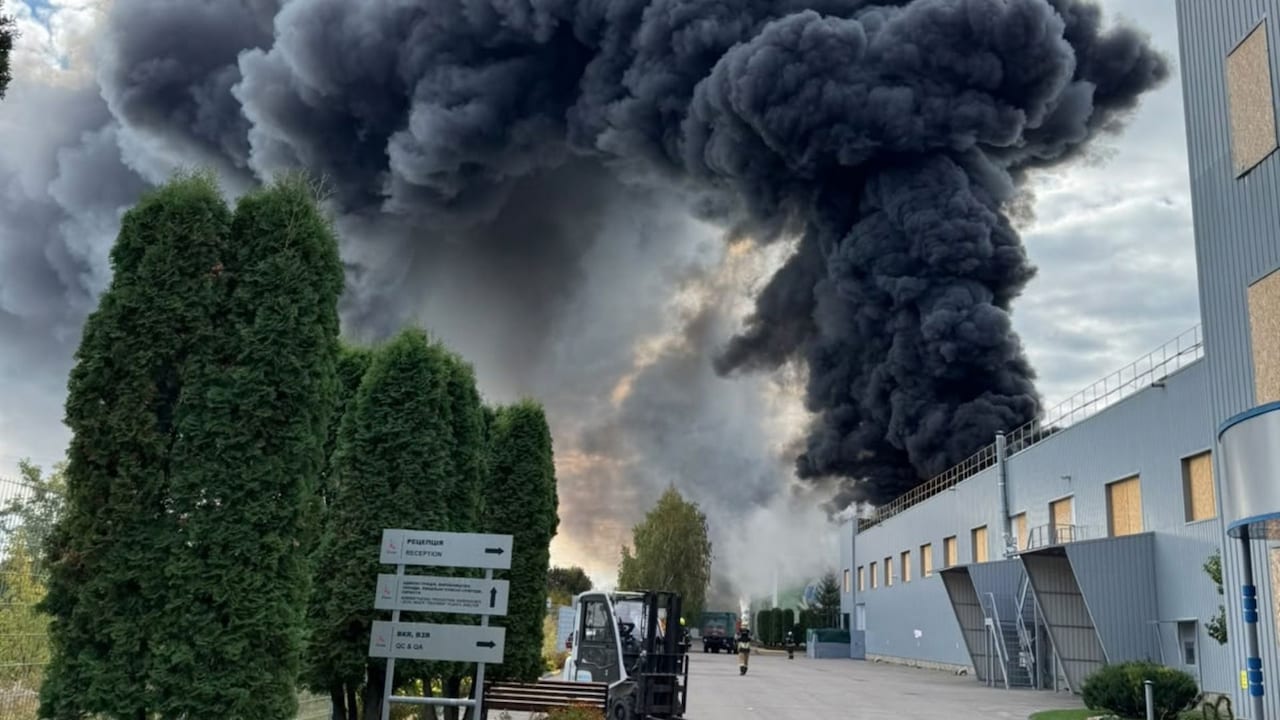
Geopolitical conflict alters industrial economics by targeting critical nodes in transnational supply chains rather than traditional military installations. The destruction of an Indian-owned pharmaceutical manufacturing and distribution facility in Ukraine during recent drone attacks illustrates a critical risk vector: the exposure of foreign direct investment in active conflict zones and the fragility of regional pharmaceutical logistics. When manufacturing infrastructure collapses under kinetic strikes, the immediate casualty is not merely local employment or physical capital; it is the continuity of specialized supply lines that feed regional healthcare systems.
Evaluating this event requires moving past standard news reporting to examine three structural dimensions: the asset risk profile of multinational investments in volatile regions, the operational vulnerability of pharmaceutical cold chains and localized production hubs, and the systemic propagation of supply shocks across international borders.
The Exposure Matrix of Cross Border Pharmaceutical Assets
Foreign investment in transitional economies often relies on cost arbitrage, specialized labor availability, and bilateral trade agreements. However, these calculations routinely omit tail risks associated with territorial sovereignty disputes and active military engagements.
- Asset Immobility: Pharmaceutical facilities are capital-intensive operations characterized by specialized cleanrooms, bioreactors, chromatography equipment, and validated HVAC systems. Unlike software or component assembly, these physical assets cannot be evacuated or rapidly relocated. Once targeted or collateralized in a strike zone, the capital is entirely stranded.
- Regulatory Entanglements: Plants operating under specific national jurisdictions are bound by local Good Manufacturing Practice (GMP) certifications and licensing agreements. When geopolitical boundaries shift or infrastructure is degraded, the legal and regulatory validity of the production output evaporates instantly.
- Personnel Retention: High-value manufacturing requires specialized chemical engineers, quality assurance validators, and pharmacovigilance experts. In conflict zones, human capital disperses rapidly, creating an operational deficit that persists long after physical repairs might theoretically begin.
The strategic error made by foreign investors often lies in treating geopolitical risk as a static insurance variable rather than a dynamic operational variable. Standard business continuity plans account for power outages, labor strikes, or localized fires, but they systematically fail to model total asset annihilation and sustained airspace denial.
Operational Fragility in Localized Production Hubs
The facility in question served as a distribution and localized processing bridge for Indian pharmaceutical exporters entering Eastern European markets. India supplies a substantial portion of the global generic drug volume, functioning as a primary pharmacopoeia provider for developing and transitional economies. Decentralizing distribution through regional hubs is standard risk mitigation on paper, intended to reduce transit times and navigate regional tariffs.
In practice, centralization of inventory within a single geographic node creates a localized single point of failure.
- Inventory Concentration: Warehousing finished formulations and active pharmaceutical ingredients (APIs) in a single distribution center maximizes efficiency while eliminating safety buffers. When that center is compromised, the downstream shortage is immediate.
- Logistics Choke Points: Modern supply chains depend on predictable transit corridors. Drone attacks and artillery duels transform transport routes into active hazard zones, halting freight forwarding, customs clearance, and cold-chain maintenance.
- Substitution Friction: Pharmaceutical formulations are not interchangeable commodities. Substituting a destroyed product line requires regulatory re-approval, bioequivalence testing, and manufacturing line validation, a process that takes months or years rather than days.
Consequently, the loss of a single plant cascades into regional supply deficits, forcing healthcare providers to scramble for secondary sources that may already be operating at capacity.
Macroeconomic Fallout and International Trade Dynamics
The intersection of Indian pharmaceutical manufacturing and Eastern European distribution highlights the vulnerability of South-North and South-South economic corridors. India's export-driven pharmaceutical model relies on open maritime and overland trade routes. When regional conflicts disrupt these nodes, the economic feedback loop affects both the host nation and the exporting enterprise.
[API & Generic Production (India)]
       │
       ▼ (Long-Range Logistics)
[Regional Distribution Hub (Ukraine)] ──(Kinetic Interruption)──> [Complete Asset Loss & Inventory Zero]
       │
       ▼ (Downstream Impact)
[Regional Healthcare Shortages & Capital Write-Off]
This dynamic forces a fundamental reassessment of risk-adjusted return on investment (RoI) for pharmaceutical firms expanding into emerging or contested markets. The traditional calculus—balancing lower operational costs against moderate political risk—must now incorporate the probability of complete capital loss and severe brand equity erosion resulting from supply failures.
Strategic Realignment for Multinational Manufacturers
Mitigating future vulnerabilities requires a shift from efficiency-driven supply chain design to resilience-driven architectures. Organizations operating in geopolitically sensitive environments must implement rigorous stress-testing protocols.
- Distributed Redundancy: Shift away from single-node regional hubs toward decentralized, smaller-scale manufacturing footprints that can absorb the loss of any single facility without halting regional distribution.
- Dynamic Inventory Buffering: Maintain strategic reserves of finished products outside the immediate conflict theater, coupled with agile cross-licensing agreements that allow alternative manufacturing partners to ramp up production of critical molecules on short notice.
- Real-Time Risk Modeling: Integrate kinetic and geopolitical intelligence directly into enterprise resource planning (ERP) systems, enabling automated trigger thresholds for inventory
Supply Chain Vulnerability Analysis The Destruction of Pharmaceutical Infrastructure in Active Conflict Zones
business, news
Geopolitical conflict invariably alters commercial operating environments, but the physical destruction of specialized manufacturing assets introduces acute structural shocks to localized medical supply chains. The recent destruction of an Indian-run pharmaceutical production facility in Ukraine via drone strikes exemplifies the severe friction points that emerge when foreign direct investment intersects with active warfare. Assessing this event requires moving past standard news reporting to evaluate the operational risks, asset replacement economics, and supply chain dependencies governing cross-border pharmaceutical investments in high-risk zones.
The Risk Architecture of Foreign Direct Investment in Conflict Zones
Cross-border capital allocation into emerging or transitional economies relies on risk-adjusted return calculations that frequently underweight tail-risk events such as military destruction. When an industrial asset is integrated into a multinational manufacturing footprint, its loss initiates a cascading series of operational disruptions that extend far beyond the immediate physical perimeter.
Operational exposure in these regions is dictated by three primary variables:
- Asset immobility: Specialized chemical synthesis and sterile fill-finish pharmaceutical facilities cannot be relocated rapidly. The physical infrastructure requires precise environmental controls, cleanroom certifications, and validated equipment streams that take months or years to commission.
- Geographic concentration: If a manufacturing node represents a single point of failure for specific formulations or regional distribution vectors, any disruption halts the associated supply lineage completely.
- Personnel continuity: Retaining technical expertise, quality assurance personnel, and operational management under constant security duress creates severe human capital bottlenecks.
The kinetic destruction of a manufacturing facility converts a localized security incident into a systemic commercial liability. The loss of human life represents an irrecoverable tragedy, while the destruction of physical capital triggers an immediate valuation adjustment for the operating entity and forces downstream buyers to seek alternative procurement channels.
The Economic Mechanics of Pharmaceutical Supply Chain Redundancy
Modern pharmaceutical manufacturing operates on efficiency metrics that prioritize low inventory holding costs and optimized capacity utilization. However, lean operational models possess zero tolerance for structural shocks. When a primary production node is eliminated, the economic consequences manifest through three distinct mechanisms:
The immediate friction is capacity displacement. Global pharmaceutical manufacturing networks operate near high capacity utilization thresholds to maximize return on capital expenditure. Finding immediate alternative capacity for specialized formulation, active pharmaceutical ingredient synthesis, or sterile packaging is rarely straightforward. Contract manufacturing organizations typically operate on long-term schedules, meaning unallocated capacity is scarce.
The second friction is regulatory friction. Shifting production from one facility to another requires regulatory validation, tech transfer documentation, and bioequivalence testing. Even under emergency provisions, qualifying a secondary or tertiary manufacturing site introduces a temporal lag that can last from several months to multiple years depending on the jurisdiction and the complexity of the drug product.
The third friction is input cost inflation. As supply tightens due to the removal of a competitive production asset, remaining suppliers gain pricing power. Buyers face higher acquisition costs, expedited shipping expenses, and the financial burden of auditing new vendor networks. The loss of a production facility thus acts as an inflationary impulse across the affected product categories.
Strategic Asset Recovery and Mitigation Frameworks
Organizations operating industrial assets in regions with elevated geopolitical volatility must adopt robust contingency architectures to insulate their supply chains from catastrophic disruption. Traditional risk management that focuses solely on financial hedging or localized property insurance is insufficient when kinetic warfare destroys underlying productive capacity.
Effective operational strategy requires geographic diversification of critical manufacturing steps. Dual-sourcing or multi-sourcing active pharmaceutical ingredients and finished doses ensures that the loss of a single plant does not paralyze commercial operations. Furthermore, maintaining strategic buffer inventories of finished products near destination markets provides a critical temporal bridge while replacement manufacturing is secured.
Capital allocation models must also incorporate systemic risk premiums that account for the total replacement cost of specialized assets in hostile environments, including the friction of regulatory re-validation and market share erosion during extended downtime. Organizations must continuously audit their supplier tiers to identify single points of failure before external shocks expose them.
The destruction of cross-border industrial infrastructure underscores the fragility of globalized production when geopolitical stability deteriorates. Future capital investments in high-risk territories will increasingly demand hyper-modular facility designs, localized redundancy, and accelerated regulatory qualification pathways to survive the operational realities of modern conflict.