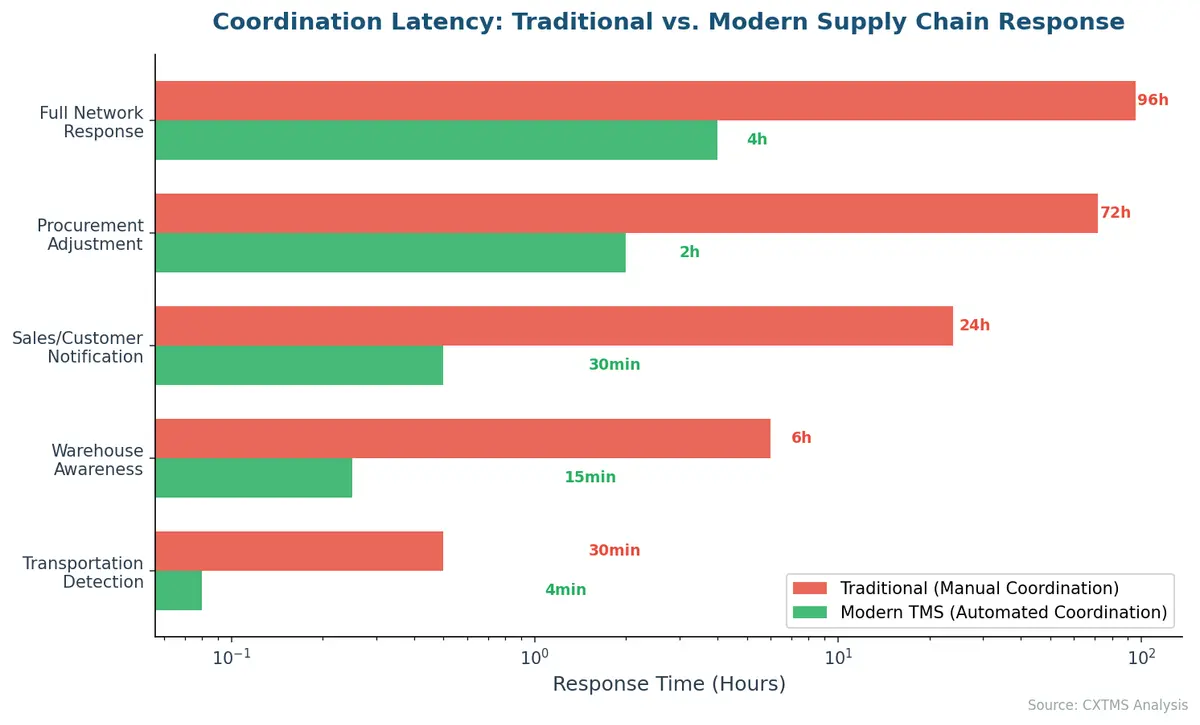
Reducing lead time by two months for a primary raw ingredient in industrial manufacturing is not an incremental adjustment; it represents a fundamental reconfiguration of inventory positioning, supplier synchronization, and demand visibility. When Cadbury achieved this compression for a core chocolate-bar input—typically cocoa butter, liquor, or specialized dairy derivatives—they did not merely speed up transport. They eliminated systemic buffers that masking agents and high carrying costs had rendered obsolete.
The Cost Function of Industrial Ingredient Latency
Global confectionary production operates on long planning horizons because agricultural supply chains are inherently volatile. Yield variations, port congestion, customs clearance, and multi-tier refining steps create a high-variance timeline. Traditional supply chain management treats this variance by absorbing it with inventory. Safety stock acts as a financial shock absorber, converting time uncertainty into capital inefficiency.
The mathematical cost of a two-month delay extends far beyond warehousing fees. Working capital trapped in transit or stagnant inventory incurs an opportunity cost dictated by the weighted average cost of capital. Furthermore, perishable or semi-perishable inputs like cocoa derivatives degrade over extended storage periods, risking flavor profile drift, moisture absorption, and oxidation.
When lead times shrink by sixty days, the balance sheet changes immediately. The operational mechanics driving this compression require examining the tripartite structure of industrial procurement: structural tiering, information latency, and physical routing.
Structural Tiering and Supplier Synchronization
The primary bottleneck in ingredient supply chains is multi-tier friction. A manufacturer rarely purchases raw agricultural commodities directly from the farm gate; inputs pass through aggregators, primary processors, traders, and secondary refiners before reaching the factory floor. Each handoff introduces a queuing delay and an information blackout.
To compress lead time, an enterprise must bypass intermediate holding points through vertical integration or synchronous scheduling agreements.
Traditional Tiering: Farm -> Aggregator -> Trader -> Refiner -> Factory (High Latency)
Synchronized Model:  Farm/Origin -> Dedicated Refiner -> Factory (Compressed Latency)
By establishing direct operational linkages with primary processing origins, Cadbury removed intermediate storage loops. In agricultural supply chains, ingredients often sit at regional consolidation hubs waiting for full container loads or scheduled shipping windows. Eliminating these dead zones requires shifting from push-based batch shipping to pull-based continuous flow.
This transformation relies on upstream visibility. If the manufacturer shares near-term production schedules directly with the origin processor, the processor can align roasting, conching, or fractionation schedules with actual consumption velocity rather than historical forecasts.
Information Latency Versus Physical Velocity
Supply chain speed is frequently constrained by administrative processing rather than logistical transit times. Customs documentation, quality assurance sign-offs, and bill-of-lading verifications frequently account for weeks of idle time.
The structural decoupling of physical movement from documentation flow is the primary mechanism for lead time reduction. Modern supply chain engineering implements pre-clearance protocols and automated quality verification at origin. When a batch of ingredient feedstock is certified at the processing source through standardized digital telemetry, destination quality checks shift from gatekeeping inspections to audits.
This shifts the workflow from sequential processing to parallel processing:
- Sequential Model: Physical shipment arrives -> Quarantine -> Lab testing -> Customs clearance -> Release to production. Total elapsed time: 14 to 30 days.
- Parallel Model: Origin telemetry verified -> Electronic customs filing in transit -> Direct-to-line offloading upon arrival. Total elapsed time: Under 48 hours.
By treating data as a leading indicator of physical location, planners can schedule factory lines for incoming inputs before the cargo vessel docks or the freight rail arrives.
Inventory Positioning and Regional Buffer Rationalization
A common misconception in supply chain optimization is that reducing lead time allows for the complete elimination of safety stock. In practice, lead time compression changes the location and form of inventory rather than its absolute necessity.
When lead times are long and volatile, safety stock must be held as finished goods or near-finished intermediate inputs close to the regional market to prevent stockouts. This is an expensive inventory posture because processed chocolate or intermediate liquor has a high unit cost compared to raw, unrefined commodity inputs.
Cutting two months off the inbound lead time for a key ingredient allows Cadbury to shift the inventory decoupling point further upstream. Capital is reallocated from expensive regional finished-goods buffers to cheaper, more fungible raw material pools closer to origin, or eliminated entirely through velocity gains.
Implementation Vulnerabilities and Operational Constraints
No operational restructuring is without trade-offs. Compressing lead times by sixty days introduces structural fragilities that management must actively monitor:
- Loss of Schedule Flexibility: Leaner supply chains rely on frozen production schedules. Last-minute product reformulations or volume surges are harder to absorb when upstream buffers are minimized.
- Transportation Mode Shifts: Achieving radical lead time reductions often requires transitioning from slow, cost-effective maritime shipping to faster, premium freight vectors, increasing per-unit logistics expenditures.
- Concentration Risk: Synchronous supplier models often require consolidating volume with fewer, highly capable vendors, increasing vulnerability to localized regional disruptions, weather anomalies, or labor strikes.
Mitigating these vulnerabilities requires treating lead-time reduction not as a one-time project, but as an ongoing calibration of risk tolerance against working capital efficiency.
Strategic Execution Framework
To institutionalize these gains across a global manufacturing footprint, industrial operators must execute a systematic operational protocol:
- Map the End-to-End Latency Audit: Quantify every touchpoint, handoff, and storage interval from origin farm to factory intake, separating physical transit time from administrative waiting time.
- Establish Origin-Level Quality Trust: Implement digital quality certification at the processing source to eliminate destination quarantine delays.
- Synchronize Demand Signals: Replace batch-order procurement with consumption-linked scheduling shared directly with Tier-1 processors.
- Recalibrate Safety Stock Thresholds: Adjust working capital allocations downward to reflect the reduced variance and shorter replenishment cycle, ensuring cash is not unnecessarily trapped in transit.
The competitive advantage gained from shaving two months off a critical ingredient supply line is durable only if the underlying institutional discipline remains intact. Speed in industrial procurement is not a function of moving faster; it is the systematic elimination of waiting.