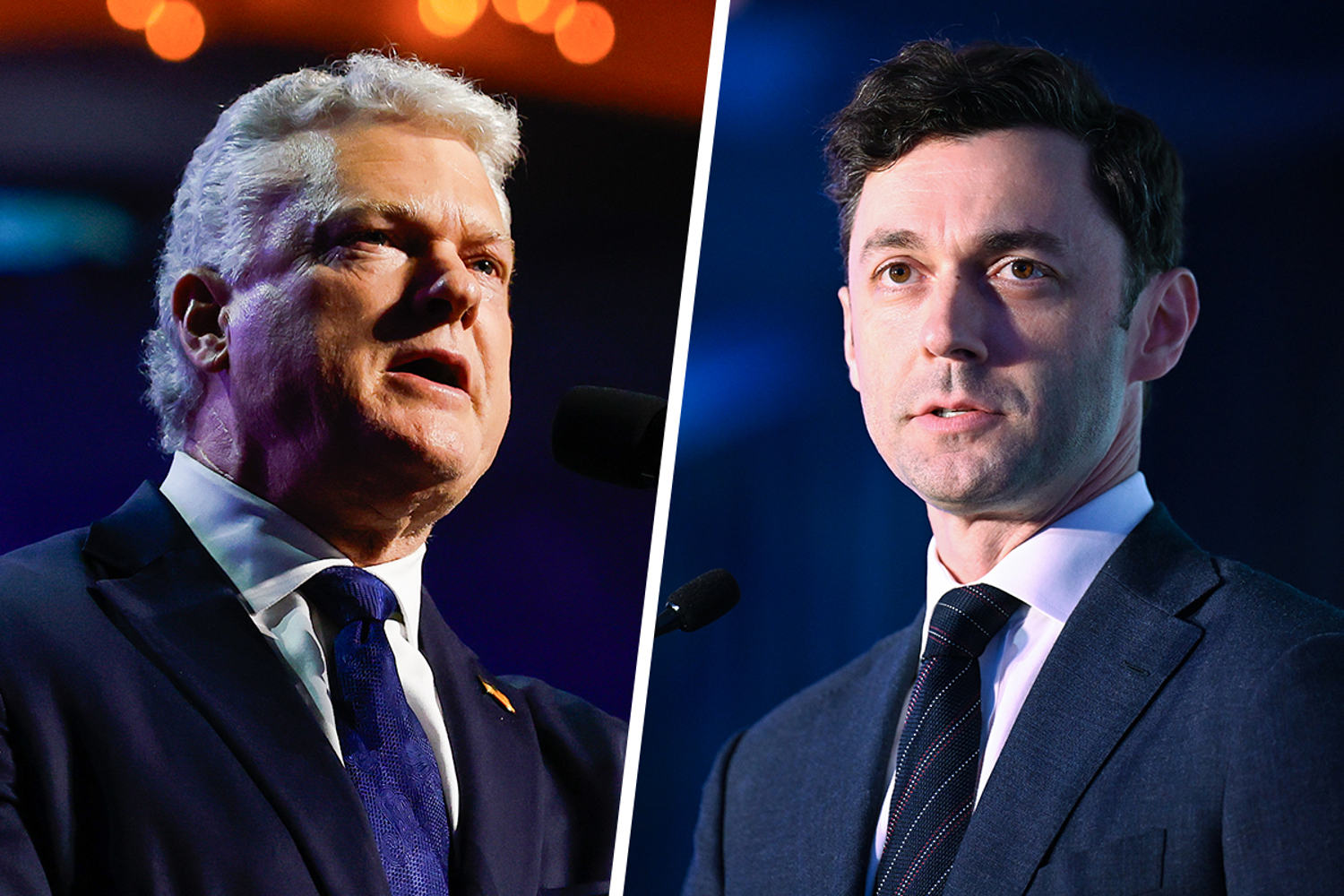
The October 8, 2026, U.S. Senate debate between Democratic incumbent Jon Ossoff and Republican challenger Mike Collins at Assembly Studios in Atlanta was not a conventional policy discussion. It operated as a high-stakes stress test of two competing political attribution models: retrospective inflation blame versus prospective tariff incidence. Surface-level political reporting frames such encounters as standard partisan clashes over Trump- and Biden-era legacies. That framing misses the underlying strategic architecture. Both candidates executed deliberate framing operations designed to shift voter focus across different time horizons—one anchoring on past macroeconomic pain, the other on immediate supply-chain friction and executive overreach.
Understanding why this specific clash unfolded the way it did requires stripping away the campaign rhetoric and examining the incentive structures, economic mechanisms, and electoral trade-offs governing a purple-state Senate race in a midterm cycle.
The Attribution Asymmetry in Economic Messaging
In any midterm election where voters experience cumulative price-level fatigue alongside active trade disruption, candidates face an attribution problem. Voters feel the squeeze on household balance sheets, yet the causal chain linking federal policy to retail prices involves multi-quarter lags. In the Doraville/Atlanta matchup, Ossoff and Collins resolved this ambiguity through opposing temporal strategies.
The Retrospective Fiscal Anchor
Collins deployed a backward-looking attribution model, tying persistent cost-of-living pressures directly to Biden-era legislative packages—specifically citing "Bidenomics" and climate-related spending bills that Ossoff supported during his first term.
The operational logic of this approach relies on anchoring bias and loss aversion:
- Baseline Establishment: Voters evaluate current prices against a pre-2021 mental benchmark rather than current wage-growth trajectories.
- Legislative Traceability: Roll-call votes on major spending packages provide clear, binary targets for attack ads, whereas global supply-chain normalization or monetary tightening by the Federal Reserve are diffuse and difficult to explain in a 30-second debate rebuttal.
- Liability Insulation: By framing current economic friction as the residual tail of prior Democratic fiscal expansion, Collins attempted to insulate the sitting Republican administration from responsibility for ongoing price volatility.
This strategy encounters a structural bottleneck when applied to Georgia's economy. Georgia is a logistics, manufacturing, and port-dependent state. While retrospective inflation arguments resonate with suburban and rural households focused on grocery and energy bills, they offer no forward-looking mechanism to protect export-oriented sectors from retaliatory trade measures.
The Prospective Tariff Incidence Model
Ossoff countered with a forward-looking, microeconomic incidence argument, focusing heavily on the consumer and commercial impacts of Trump-era tariffs. Rather than defending every line item of Biden-era fiscal policy, Ossoff shifted the causal locus to active executive trade policy.
In standard trade economics, the tax incidence of an import tariff falls predominantly on domestic importers and end consumers when supply chains lack immediate domestic substitutes. Ossoff’s debate strategy operationalized this principle:
- Direct Pass-Through Mechanism: Tariffs act as an upstream consumption tax on intermediate inputs and finished retail goods. Unlike historical legislative spending, whose inflationary impact has already been absorbed into the price level, new or expanded tariffs represent an active, ongoing price shock.
- Infrastructure Vulnerability: Georgia’s economy relies heavily on the Port of Savannah and Hartsfield-Jackson Atlanta International Airport as global freight hubs. Broad-based tariffs reduce container throughput, compress logistics margins, and expose Georgia agriculture—particularly poultry, pecans, and cotton—to foreign retaliatory duties.
- Agency Assignment: By linking Collins directly to the administration's tariff regime, Ossoff converted an abstract macroeconomic debate into a question of local economic defense.
Collins defended the tariffs as a mechanism to enforce fairer competition with China and protect domestic industry, yet struggled to quantify immediate offsets for Georgia ports or consumers during the exchange. In debate dynamics, an unquantified long-term industrial benefit rarely neutralizes a concrete, immediate cost argument.
The Four Pillars of Debate Positioning
To evaluate the structural effectiveness of both campaigns during the first debate, their arguments can be categorized into four distinct operational pillars. Each pillar represents a trade-off between base mobilization and swing-voter persuasion.
1. Trade and Industrial Policy
- Collins Position: Unconditional alignment with executive tariff authority as a geopolitical and industrial tool against China.
- Ossoff Position: Opposition to broad tariffs framed as a regressive tax on Georgia families and a direct threat to state logistics infrastructure.
- Electoral Trade-Off: Collins maximized alignment with the Republican national platform, eliminating primary-style flank risk, but ceded the pro-trade business constituency in metro Atlanta.
2. Healthcare and Regulatory Infrastructure
- Collins Position: Emphasis on market-driven deregulation and reducing federal intervention in healthcare financing.
- Ossoff Position: Defense of federal healthcare funding subsidies and targeted scrutiny of local infrastructure strains, including data center expansion and grid capacity.
- Electoral Trade-Off: Healthcare funding remains a high-salience defensive issue for Democrats in suburban counties where hospital closures and insurance premiums directly affect middle-income turnout.
3. National Security and Executive War Powers
- Collins Position: Full backing of the February joint U.S.-Israeli bombing raids targeting Iranian nuclear capabilities, framed as decisive deterrence.
- Ossoff Position: Questioning the strategic endgame, escalation risks, and congressional authorization parameters surrounding military intervention in Iran.
- Electoral Trade-Off: Foreign intervention divides the modern electorate along non-traditional lines. Collins appealed to traditional hawkish sentiment, while Ossoff tapped into war-weariness among younger voters and populist-leaning independents skeptical of Middle Eastern entanglements.
4. Institutional Integrity and Ballot Access
- Collins Position: Promotion of the SAVE Act—requiring documentary proof of citizenship for voter registration—alongside continued ambiguity regarding the certification of the 2020 presidential election.
- Ossoff Position: Framing the SAVE Act as an administrative barrier to eligible voters while attacking Collins over past rhetoric, associations, and institutional norms.
- Electoral Trade-Off: Election administration rules function primarily as base-turnout mechanisms. However, revisiting 2020 election disputes carries severe diminishing returns among Georgia’s decisive bloc of ticket-splitting suburban moderates, who have consistently penalized candidates perceived as preoccupied with past grievances over current governance.
The Principal-Agent Dilemma in Modern Senate Campaigns
A recurring structural tension throughout the debate was the principal-agent problem facing Republican challengers in wave or midterm environments. In political science, a Senate candidate (the agent) must represent the specific geographic and economic interests of their state (the principal) while maintaining alignment with their national party leader.
Ossoff systematically exploited this tension by framing Collins not as an independent legislative actor, but as an automatic proxy for Donald Trump. By asserting that Collins would endorse any executive directive regardless of its local impact on Georgia, Ossoff forced his opponent into a binary trap:
- If Collins breaks with the White House on tariffs or specific executive actions to protect Georgia industries, he risks depressing turnout among core populist voters who view loyalty to the president as the primary criterion for support.
- If Collins maintains 100% alignment, he validates Ossoff’s framing that Georgia loses an independent voice in the Senate capable of checking executive overreach or protecting state-specific economic interests.
During the October 8 debate, Collins consistently chose option two—prioritizing party-line cohesion across tariffs, Iran strikes, and election legislation. While operationally safe for maintaining base enthusiasm, this choice narrowed his path to the median voter in Cobb, Gwinnett, and North Fulton counties.
Conversely, Ossoff managed his own principal-agent exposure—specifically his voting record during the Biden administration—by decoupling his current brand from national Democratic figures. By anchoring on localized constituent services, institutional oversight, and anti-corruption themes, Ossoff sought to establish an independent incumbent identity rather than running as a defender of the prior administration's full legislative record.
Information Asymmetry and The Question-Evasion Penalty
Debates rarely alter voter preferences through policy white papers; they shift sentiment through signaling. Voters use a candidate’s handling of difficult questions as a heuristic for competence and trustworthiness under pressure.
In the aftermath of the first debate, Ossoff’s campaign immediately targeted Collins’s perceived evasion on three specific fronts: the mechanics of tariff relief, the strategic scope of the Iran conflict, and past statements regarding election integrity. From a communications engineering standpoint, highlighting evasion serves a dual purpose:
- Cognitive Friction: When a candidate pivots away from a direct question—such as answering a query on 2020 election validity with a talking point on 2022 inflation—the audience registers the mismatch. Even voters sympathetic to the candidate's broader platform perceive the pivot as a lack of candor.
- Pre-Framing Subsequent Matchups: By publicly cataloging unanswered questions between the first debate on October 8 and the Atlanta Press Club debate on October 13, an incumbent raises the reputational cost of repetition. Moderators and viewers become primed to watch for the exact same deflection, turning a minor rhetorical dodge into a structural narrative of accountability avoidance.
Limitations of Debate-Centric Electoral Analysis
Evaluating a Senate race solely through debate performance introduces severe analytical blind spots. Campaign strategists and political observers frequently over-index on debate moments while underestimating structural determinants:
- Turnout Differential vs. Persuasion: Georgia’s electorate is highly polarized, with a shrinking pool of genuinely undecided voters. Debate exchanges primarily influence differential turnout—enthusiasm gaps that determine whether soft partisans show up—rather than wholesale ideological conversion.
- Asymmetric Resource Allocation: Debate performance cannot compensate for structural deficits in fundraising, field organization, or paid media saturation. An incumbent with superior financial reserves can amplify a single favorable 15-second debate clip across digital and broadcast channels millions of times, whereas an underfunded challenger’s strongest counterpunch may never reach low-propensity voters outside the live broadcast audience.
- Macro-Environment Gravity: Midterm elections remain heavily governed by nationalized referendum dynamics. While candidate quality and debate execution create a margin of variance—often 2 to 4 percentage points in battleground states—they operate within boundaries set by national approval ratings and macroeconomic indicators.
Strategic Imperatives for Battleground Debate Execution
For campaigns operating in high-parity, demographically shifting battlegrounds like Georgia, the October 2026 Senate clash demonstrates that legacy partisan scripts fail when confronted with localized economic friction. To maximize electoral yield in subsequent cycles, campaign strategists must execute three adjustments:
- Replace Retrospective Blame with Mechanism-Based Mitigation: Attacking a prior administration's spending loses marginal utility once a new administration controls policy levers. Challengers defending incumbent executive policies—such as tariffs or military strikes—must articulate concrete mitigation mechanisms for local industries rather than relying on broad ideological justifications.
- Enforce Selective Policy Differentiation: In swing states, total alignment with a national party leader creates an exploitable principal-agent vulnerability. Candidates must identify at least two high-visibility policy areas where they visibly diverge from party orthodoxy in defense of state-specific economic or infrastructure interests, establishing credible independence before entering a debate stage.
- Convert Evasion into Multi-Cycle Accountability Traps: Rather than treating a debate as a standalone media event, campaigns must treat the first debate as a diagnostic exercise. Every unanswered question or rhetorical pivot must be isolated, quantified, and deployed as the central framing device for subsequent debates and paid media buys, forcing the opponent either to concede ground or repeat a visibly evasive posture under heightened scrutiny.