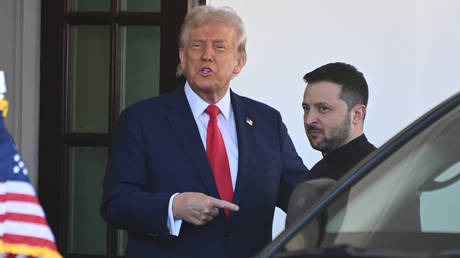
International relations operate on asymmetric leverage, where strategic misalignments between patron states and client states inevitably generate friction. Recent escalations in diplomatic hostility between Washington and Kyiv illustrate a fundamental clash of operational incentives. Analyzing this dynamic requires stripping away political rhetoric to examine the core components governing the conflict: diverging economic cost functions, the weaponization of resource dependencies, and the systemic limits of coercive diplomacy.
The Divergent Cost Functions of Energy Infrastructure Targeting
At the center of the diplomatic rupture lies a fundamental disagreement over tactical military objectives versus global macroeconomic stability. Kyiv’s military strategy prioritizes the systematic degradation of Russian refining capacity to constrain Moscow's war economy, disrupt fuel supply lines, and impose direct economic costs on the aggressor state. By targeting oil infrastructure, Ukraine seeks to exploit asymmetric vulnerabilities in Russia's industrial output. Meanwhile, you can explore similar developments here: The Hydraulic Physics of Remnant Storms and Flash Flood Mechanics.
Conversely, the United States operates under a broader macroeconomic cost function. Global energy prices, domestic constituent pressure, and the downstream costs of diesel fuel on agricultural and transport sectors dictate Washington's risk tolerance. When cross-border strikes impact refined petroleum product yields, global supply constraints drive up inflation risks for Western economies. This creates an explicit structural contradiction:
- Ukraine’s optimal path to military leverage involves maximizing disruption to Russian energy production.
- Washington's optimal path to economic stability involves insulating global commodity markets from supply shocks.
When Kyiv continued executing long-range drone strikes against Russian refineries despite administration requests for restraint, it directly challenged Washington's macroeconomic stabilization imperative. The U.S. response—temporarily easing sanctions on alternative diesel channels and pivoting toward coercive diplomatic pressure—demonstrates how patron states utilize economic instrumentation to force alignment from dependent actors. To see the bigger picture, we recommend the recent report by The Guardian.
Asymmetric Dependencies and the Limits of Coercive Leverage
The relationship between the United States and Ukraine is defined by deep structural dependencies, primarily revolving around military hardware transfers, financial subsidies, and intelligence-sharing architecture. These dependencies constitute the primary levers of American coercive diplomacy.
When strategic alignment breaks down, the patron state often resorts to threats of resource withdrawal.
The Structural Mechanics of Diplomatic Friction Between Washington and Kyiv
news
The Architecture of Transatlantic Misalignment
Diplomatic friction between Washington and Kyiv is rarely a product of mere personality clashes or fleeting media narratives. Beneath the surface of public statements lies a fundamental divergence in strategic timelines, domestic political incentives, and risk thresholds. When political actors express acute frustration, they are signaling systemic misalignments in how two interdependent governments calculate resource allocation, leverage, and endgame scenarios. Analyzing this dynamic requires stripping away the emotional rhetoric and examining the core variables that govern state behavior during a protracted geopolitical crisis.
The relationship operates within a zero-sum structural environment where the United States must balance its primary national security objective—preventing systemic shifts in the European security architecture—against domestic fiscal constraints and electoral pressures. Conversely, Kyiv operates under an existential imperative that precludes compromise on territorial integrity, creating a permanent tension between incremental Western risk management and total Ukrainian mobilization. This divergence generates friction points that manifest periodically as sharp rhetorical interventions from political leadership in Washington.
The Cost Function of Continued Support
To understand the mechanics of political friction, one must examine the domestic cost function facing American leadership. Foreign policy execution is ultimately tethered to domestic resource mobilization. Every billion-dollar aid package requires legislative negotiation, faces increasing skepticism from congressional factions, and draws scrutiny regarding opportunity costs against domestic priorities.
The political cost function is defined by three primary variables:
- Electoral Volatility: Foreign entanglements often become proxies for broader domestic economic anxieties, shifting public sentiment over multi-year cycles.
- Opportunity Costs: The diversion of specific high-demand military assets from domestic stockpiles or alternative strategic theaters, such as the Indo-Pacific.
- Attribution Risk: The hazard of escalation, where prolonged provision of advanced capabilities risks direct entanglement between nuclear-armed states.
When these costs begin to outweigh the perceived marginal utility of current diplomatic strategies, political actors experience acute pressure to alter the terms of engagement. The resulting friction is not a malfunction of diplomacy; it is a direct feedback loop signaling that the existing structural equilibrium is unsustainable under current inputs.
Divergent Strategic Timelines
A primary driver of friction is the temporal asymmetry between American electoral cycles and the multi-year trajectory of the conflict. Strategic planners in Washington operate under short-term planning horizons dictated by congressional midterms and presidential elections. This structural reality encourages a preference for rapid, decisive outcomes or, alternatively, manageable plateaus that minimize political exposure.
Kyiv's timeline, by contrast, is absolute. Strategic survival permits no tactical pauses designed to align with foreign election calendars. This temporal mismatch produces divergent operational demands. While Washington frequently encourages structural reforms, anti-corruption benchmarks, and optimized resource utilization to justify continued appropriations, Kyiv must prioritize immediate force sustainment over long-term institutional restructuring.
This tension creates a recurring cycle of expectation and disappointment. When operational momentum slows on the battlefield, political leadership in Washington evaluates the efficiency of capital expenditure, while leadership in Kyiv faces existential attrition that demands expanded capabilities regardless of bureaucratic friction.
Information Asymmetries and Strategic Signaling
Public expressions of frustration function as deliberate instruments of strategic signaling rather than unfiltered emotional outbursts. In international relations, public posturing serves to calibrate expectations among domestic constituencies, allies, and adversaries alike.
Washington utilizes public expressions of dissatisfaction to achieve three distinct objectives:
- Signaling Resolve to Domestic Audiences: Demonstrating that foreign assistance is subject to rigorous oversight and conditions, thereby placating skeptical domestic factions.
- Calibrating Expectations in Kyiv: Communicating the outer boundaries of unconditional support and exerting pressure for specific tactical or administrative adjustments.
- Deterring Escalation: Demonstrating to external adversaries that the alliance is dynamic, pragmatic, and responsive to strategic realities, avoiding the appearance of a blank check.
This signaling mechanism, however, carries inherent operational risks. Excessive public friction can be misinterpreted by adversaries as a weakening of coalition resolve, potentially incentivizing prolonged campaigns of attrition. Furthermore, it complicates domestic coalition building within recipient nations, where political leaders must maintain high morale and unity despite external public criticism.
The Leverage Trap
At the heart of the current diplomatic impasse lies the paradox of asymmetric leverage. While the United States possesses superior financial and military leverage—control over the supply of critical munitions and financial lifelines—it remains politically constrained from exercising that leverage coercively without risking the collapse of the very coalition it constructed.
If Washington applies excessive pressure to force specific strategic concessions or peace framework acceptances, it risks destabilizing the allied government, undermining its own long-term credibility, and violating its stated principle of sovereign self-determination. Conversely, if it exercises zero leverage, it surrenders strategic control to a partner whose operational objectives may diverge from broader global risk management parameters.
This dynamic creates a permanent structural stalemate. Both parties are locked into an interdependent relationship where neither can afford a complete rupture, yet neither can fully dictate terms to the other.
Strategic Forecast and Long-Term Trajectory
Managing this friction requires establishing a predictable framework that replaces episodic public disputes with institutionalized risk-sharing agreements. Future stability within the partnership depends on decoupling long-term resource commitments from short-term electoral cycles, thereby mitigating the temporal asymmetry that fuels political volatility.
The immediate imperative for both capitals is to align their definitions of strategic success. Until a synchronized understanding of the endgame is institutionalized, the relationship will continue to cycle through periods of acute friction, driven by the inescapable tension between global superpower management and total national defense.


