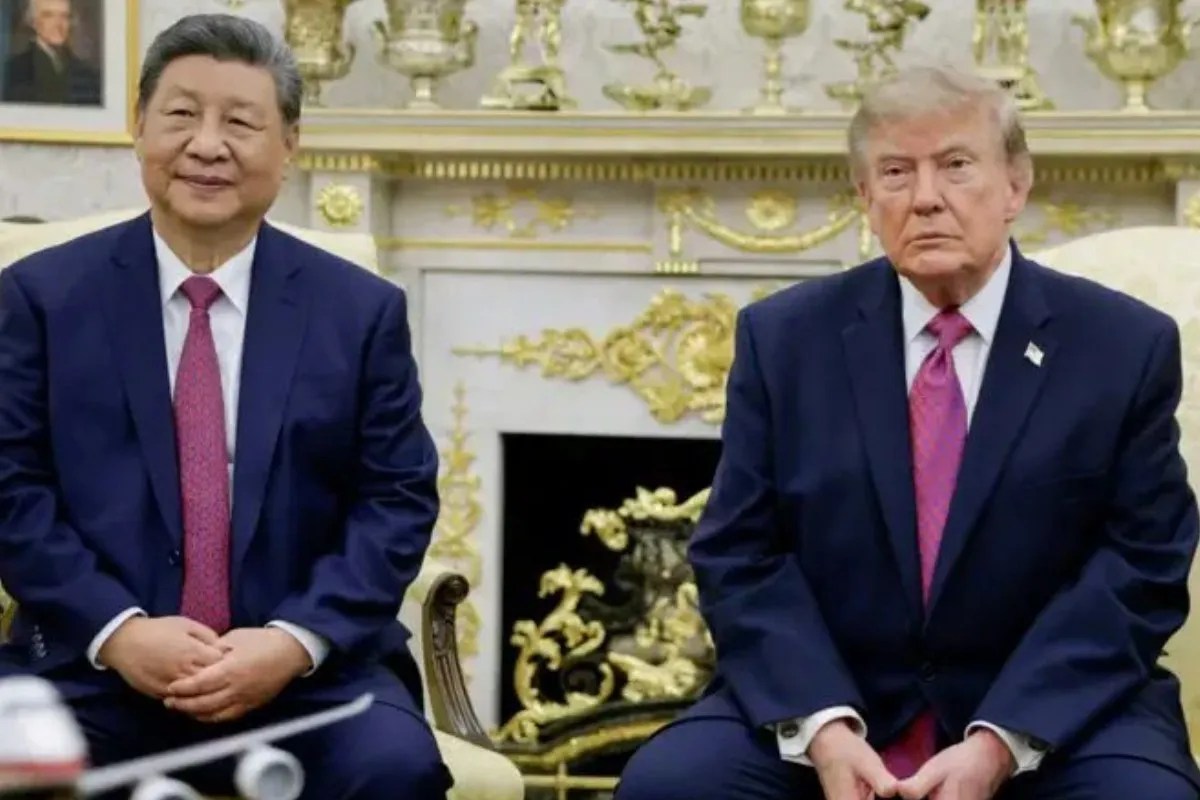
High-level diplomatic summits between major sovereign powers routinely generate significant media noise while masking the underlying structural constraints that govern bilateral relations. When leadership meets to address trade balances, advanced computing architectures, and geopolitical flashpoints, public communications frequently emphasize ceremonial cordiality. Beneath the surface narrative of mutual cooperation, however, lies a complex matrix of technological competition, supply chain dependencies, and strategic divergence. Deconstructing recent high-level engagements between Washington and Beijing reveals the concrete parameters defining the modern superpower rivalry, moving past superficial rhetoric to examine the actual mechanisms of statecraft.
The Nomenclature Shift and Strategic Signaling in Advanced Computing
The official adoption of the term Super Intelligence or SI by American negotiators marks a distinct departure from standard technical vocabulary. For decades, global policy frameworks, academic literature, and industrial roadmaps utilized the designation artificial intelligence. The deliberate rebranding championed by the executive branch serves a dual purpose. First, it rejects the implication of artificiality, framing the technology as an authentic, supreme capability that defies containment. Second, it establishes a distinct linguistic boundary that differentiates standard commercial machine learning models from sovereign frontier capabilities.
This linguistic adjustment coincides with the formalization of the United States-China Super Intelligence Dialogue. Institutionalizing this bilateral mechanism creates a formal channel for exchanging assessments regarding systemic risks, safety evaluations before model deployment, and catastrophic failure scenarios. Yet, the structural asymmetry of the underlying technological ecosystem remains entirely unaddressed by diplomatic terminology.
American officials maintain an estimated technological lead of twelve to twenty-four months in frontier hardware manufacturing, semiconductor lithography, and high-performance computing clusters. Washington has made explicit that domestic development cycles will experience no deceleration to accommodate international parity demands. Beijing, conversely, approaches these bilateral channels through the lens of institutional recognition, seeking to constrain unilateral export controls and secure long-term access to advanced silicon supply chains. The establishment of an incident communication channel for advanced computing crises provides a rudimentary safety valve, but it functions entirely independently of the commercial race for hardware dominance.
Macroeconomic Trade Friction and the Extended Truce
Beneath technological negotiations lies the fragile architecture of global trade. The decision to extend the existing economic truce by two months provides temporary stability to bilateral commerce, deferring the expiration date while maintaining a complex schedule of tariffs. The core mechanism governing this truce involves conditional suspensions on targeted tariff categories, centered on approximately thirty billion dollars of reciprocal trade flows.
The structural friction points persist across three primary vectors:
- Agricultural market access and guaranteed import volumes for U.S. commodities.
- Rare earth element export quotas and critical mineral supply chain security.
- Regulatory enforcement mechanisms regarding cross-border corporate investments.
While American trade representatives continuously press for guaranteed procurement targets for agricultural products and raw materials, Chinese economic planners tie compliance to the complete roll-back of reciprocal punitive tariffs. The establishment of a bilateral board of investment signals an intent to manage cross-border capital flows through bureaucratic oversight, yet public readouts from both capitals reveal stark disparities in how each side prioritizes these commercial commitments. Beijing frequently omits specific quantitative purchasing targets from its domestic domestic policy summaries, preserving domestic policy autonomy while satisfying the diplomatic imperative to maintain open channels.
Energy Security and Resource Extraction
Energy policy represents a critical intersection where domestic political imperatives collide with international market realities. Bilateral discussions have increasingly incorporated fossil fuel trade commitments, most notably demonstrated by structured agreements concerning coal procurement. U.S. policy frameworks prioritize export expansion to achieve domestic energy dominance metrics, while importing nations evaluate such agreements against domestic grid stability and decarbonization timelines.
The inclusion of specific purchasing commitments—such as projected imports of tens of millions of metric tons of coal over multi-year horizons—highlights the transactional nature of modern trade diplomacy. However, the absence of these energy metrics in official Chinese readouts points to a fundamental divergence in transparency requirements. For Washington, quantitative energy deliverables serve as domestic indicators of export success. For Beijing, physical commodity flows are managed according to domestic industrial demand and strategic inventory reserves rather than external political announcements.
This dynamic operates within the broader shadow of active regional conflicts, particularly in the Middle East. Geopolitical instability in oil-producing regions places continuous upward pressure on global energy prices, constraining the diplomatic utility of energy leverage. When petroleum supply chains face disruption, traditional supplier-consumer dynamics distort, forcing both economies to navigate volatile commodity markets independently regardless of bilateral energy pacts.
Institutionalizing Bureaucratic Communication Channels
The transition from volatile, ad-hoc confrontation to institutionalized crisis management is the primary operational outcome of recurring bilateral summits. Personal diplomacy between heads of state establishes political intent, but the durability of international stability relies entirely on working-level bureaucratic engagement. The creation of dedicated communication lines for technological incidents and trade disputes represents an effort to mitigate the risk of accidental escalation.
These communication channels operate under severe structural limitations. Bureaucratic channels can prevent immediate misunderstandings or manage tactical crises, but they cannot resolve fundamental contradictions in national security doctrines. When core interests diverge—such as regional security architectures, maritime trade routes, or technological supremacy—working-level dialogues function primarily as containment mechanisms rather than vehicles for compromise.
Strategic Execution and Operational Forecast
Future trajectory mapping requires abandoning the assumption that diplomatic summits signal ideological convergence. The institutionalization of dialogue channels does not signify a reduction in strategic competition; rather, it indicates a mutual recognition that unregulated hostility imposes unacceptable systemic costs on both economies.
Policy execution moving forward requires monitoring three discrete empirical indicators rather than political rhetoric:
- Track the operational status of the computing incident hotline to determine whether it functions during real-world security stress tests.
- Measure actual physical shipments of critical minerals and rare earths against agreed regulatory thresholds to verify supply chain compliance.
- Analyze quarterly customs data for agricultural and energy commodities to separate public diplomatic commitments from actual market transactions.
Strategic stability between the world's primary economic actors will not be achieved through grand ideological reconciliation. It will be maintained through continuous, highly constrained friction management, where every agreement is continuously tested against national security imperatives and domestic political survival.



