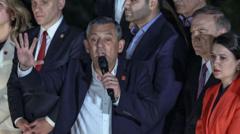
The 36th Civil Chamber of the Ankara Regional Court of Justice’s ruling to invalidate the Republican People’s Party’s (CHP) November 2023 congress represents a fundamental shift in Turkey’s governance model. By declaring the election of party leader Özgür Özel null and void and ordering the reinstatement of former chairman Kemal Kılıçdaroğlu, the judiciary has transitioned from a mechanism of horizontal accountability to an instrument of vertical executive control over opposition leadership structures. This intervention cannot be fully understood through the conventional vocabulary of "democratic backsliding." Instead, it requires a precise dissection of two distinct dynamics: the structural mechanics of judicial administration over political parties and the immediate macroeconomic cost function imposed on Turkey's fragile stabilization program.
The Tripartite Architecture of Political Neutralization
The ouster of Özel is not an isolated judicial event; it is the capstone of a deliberate, multi-layered strategy designed to fragment and neutralize the political opposition following its significant gains in the 2024 municipal elections. This architecture operates across three distinct vectors. Recently making news in this space: The Cold Capitulation of Latin America.
1. The Municipal Trustee Vector
Since October 2024, the executive branch has systematically weakened the CHP's local governance networks using terrorism and corruption investigations as legal leverage. The process began with the removal and replacement of Ahmet Özer, the mayor of Istanbul’s Esenyurt district, with a government-appointed trustee.
This model has since escalated into a broader campaign. At least 25 opposition mayors have been removed from office, and 20 remain imprisoned. By targeting municipalities such as Adana, Antalya, and Adıyaman, the state effectively disrupts the financial and administrative foundations of the opposition, altering local resource allocation and severing the link between electoral outcomes and administrative power. Further details on this are covered by Reuters.
2. The Formidable Challenger Sidelining Vector
The primary structural threat to the ruling Justice and Development Party (AKP) is Istanbul Mayor Ekrem İmamoğlu, who has been detained since March 2025.
Imprisoning the opposition's presumptive 2028 presidential candidate serves a dual purpose: it removes a popular electoral threat from the field while forcing the CHP into a continuous state of crisis management. This shifts their focus from building a national platform to mounting basic legal defenses.
3. The Intra-Party Fracturing Vector
The appeals court ruling exploits existing internal divisions within the CHP. By forcing the reinstatement of Kılıçdaroğlu—a leader who presided over the devastating 2023 general election defeat and who recently published statements demanding the party "purge" itself—the court injects structural instability directly into the opposition hierarchy.
[State Legal Apparatus]
       │
       ├─► 1. Municipal Trustee Vector (Disrupts local finances & governance)
       ├─► 2. Challenger Sidelining Vector (Detains top electoral threats like İmamoğlu)
       └─► 3. Intra-Party Fracturing Vector (Annulls congresses to spark internal crises)
The absolute nullity ruling creates an administrative deadlock. Because the 2023 congress has been invalidated, every subsequent policy decision, candidate nomination, and emergency meeting authorized under Özel’s tenure faces potential legal challenges. This traps the country's oldest political party in an endless loop of litigation.
The Macroeconomic Cost Function of Political Engineering
The immediate consequence of this judicial intervention was a severe shock to Turkey's financial markets, exposing the deep friction between tactical political maneuvers and the requirements of macroeconomic stability.
The market reactions clarify the exact economic trade-offs of this strategy:
- Equity Market Contraction: The Borsa Istanbul (BIST 100) dropped 6%, triggering market-wide circuit breakers. Banking shares led the sell-off with an 8% decline, signaling that institutional investors anticipate a sharp rise in country risk premiums.
- Currency Depredation and Reserve Depletion: The Turkish lira fell to a record low against the dollar. To prevent an unraveled depreciation, the Central Bank of the Republic of Turkey (CBRT) intervened by selling billions of dollars from its foreign currency reserves.
- Monetary Policy Bottlenecks: This sudden volatility disrupts the economic program championed by Vice President Cevdet Yılmaz. Prior to the ruling, the central bank was trying to manage inflation without suffocating growth. JPMorgan’s projection of an emergency interest rate hike highlights the structural bottleneck: the state must now choose between raising borrowing costs or risking rapid dollarization as domestic actors flee the lira.
When the judiciary intervenes directly in political party leadership, it signals to foreign capital that property rights, contract enforcement, and institutional stability are secondary to executive preservation. Consequently, the risk premium on Turkish sovereign debt rises, increasing the cost of capital and undermining efforts to lower inflation.
The Institutional Shift in Administrative Law
From a legal standpoint, this ruling alters the relationship between state institutions and voluntary political organizations. Political scientist Berk Esen notes that since Turkey transitioned to a multi-party electoral system in 1946, courts have occasionally banned entire political parties for constitutional violations, but they have not micro-managed internal leadership changes to reverse an election.
By adjusting the internal leadership of the main opposition party via judicial decree, the state establishes an important precedent: administrative courts can now act as final arbiters for internal party democracy. This effectively neutralizes the ballot box as an independent mechanism for leadership changes.
If a party's internal voting process can be nullified retroactively due to unspecified irregularities, then any opposition victory can be quietly undone after the fact through compliant judicial channels.
Strategic Outlook and Market Scenarios
The confrontation between the CHP and the state apparatus will likely follow one of two structural paths over the next fiscal quarter:
Scenario A: Accelerated Escalation and Market Adjustments
The CHP maintains its resistance, keeping its leadership inside its Ankara headquarters while filing an appeal with the Supreme Court of Appeals. If the higher court upholds the nullity ruling, the opposition faces structural fragmentation. Kılıçdaroğlu’s reinstatement would likely trigger internal power struggles, fracturing the center-left coalition and reducing their competitiveness for any early elections before 2028.
In this scenario, capital flight will likely accelerate, forcing the CBRT to implement a restrictive rate hike that slows GDP growth.
Scenario B: De-escalation Through Legal Delay
The Supreme Court of Appeals accepts the CHP’s objection, delaying a final decision to avoid immediate social unrest and further capital flight. This approach keeps the threat of leadership nullification active, hanging over the opposition like a legal sword of Damocles.
This gives the executive branch continuous leverage over the CHP's legislative strategy and candidate selection, all while avoiding the immediate market shocks of an outright judicial ouster.
The immediate operational priority for foreign asset managers, risk analysts, and corporate entities in Turkey is to hedge against prolonged currency volatility and potential capital controls. The assumption that Turkey’s orthodox economic team could insulate monetary policy from domestic political maneuvers has proven incorrect.
Going forward, institutional strategies must treat Turkish regulatory, legal, and monetary policies not as independent variables, but as direct extensions of executive political calculations.