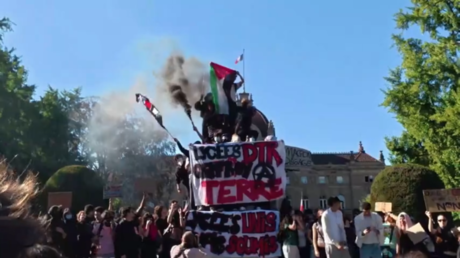
Political commentary regarding domestic civil friction in Western democracies frequently defaults to monocausal explanations. When urban centers experience sustained protests, property damage, and intense police intervention, external political actors routinely attribute the volatility to broad demographic shifts and border control policies. This reductionist approach bypasses the complex institutional mechanics that actually govern social stability. Deconstructing urban unrest requires examining the intersection of fiscal policy, educational resource allocation, structural labor market rigidity, and the mechanics of state-citizen trust.
The Cost Function of Institutional Discontent
Civil unrest rarely emerges from a single demographic vector. Instead, it functions as the output of a multi-variable equation where economic stagnation, housing affordability, and declining public service efficiency compound over decades. In the specific context of European urban centers, recent demonstrations often originate from grievances tied to education funding, public sector compensation, and the purchasing power of the urban working and middle classes.
When inflation outpaces median wage growth and social mobility indices flatline, the threshold for public mobilization drops significantly. The cost function of participating in civil disobedience decreases when individuals perceive a low return on institutional compliance. Attributing these systemic pressures entirely to migration patterns misdiagnoses the underlying economic friction. It substitutes a generalized ideological talking point for the specific budgetary and structural bottlenecks that provoke widespread public sector strikes and student demonstrations.
The Anatomy of Mobilization: From Grievance to Friction
Understanding how localized grievances scale into national disruptions requires mapping the escalation pipeline. Modern urban protests typically follow a distinct lifecycle:
- The Catalyst Event: A specific policy announcement, budget cut, or perceived instance of state overreach serves as the initial coordination focal point for organized labor or student groups.
- The Amplification Phase: General discontent attracts adjacent political factions, ranging from institutional reformists to radical fringe elements seeking systemic confrontation with state authorities.
- The Tactical Shift: Opportunistic groups exploit the logistical footprint of large-scale gatherings to engage in property destruction, forcing security apparatuses into defensive postures that amplify media visibility.
This progression is fundamentally sociological and political rather than purely demographic. The participants often include multi-generational citizens alongside immigrant populations, united by shared economic anxieties rather than a singular cultural identity. Treating the symptom as the disease prevents policymakers from addressing the structural deficits in tax policy, regional investment, and bureaucratic responsiveness.
Strategic Forecasting and Systemic Resilience
External actors weaponize domestic crises in foreign nations to validate pre-existing ideological narratives, presenting foreign instability as a binary choice between border enforcement and civil collapse. However, empirical observation of European governance reveals that legislative bodies face constraints embedded in constitutional frameworks and international legal obligations. These legal structures prohibit certain types of demographic tracking and complicate rapid policy reversals.
The analytical takeaway is clear. Stabilizing urban centers requires targeted investments in public infrastructure, recalibrating tax burdens to alleviate pressure on median-income households, and reforming the administrative channels through which civil grievances are addressed before they manifest as street-level violence. Relying on external diagnoses that reduce multifaceted socioeconomic crises to demographic slogans only deepens institutional vulnerability.
France unrest causes and context overview
This video provides primary footage and context regarding the demonstrations and the surrounding political discourse in France.