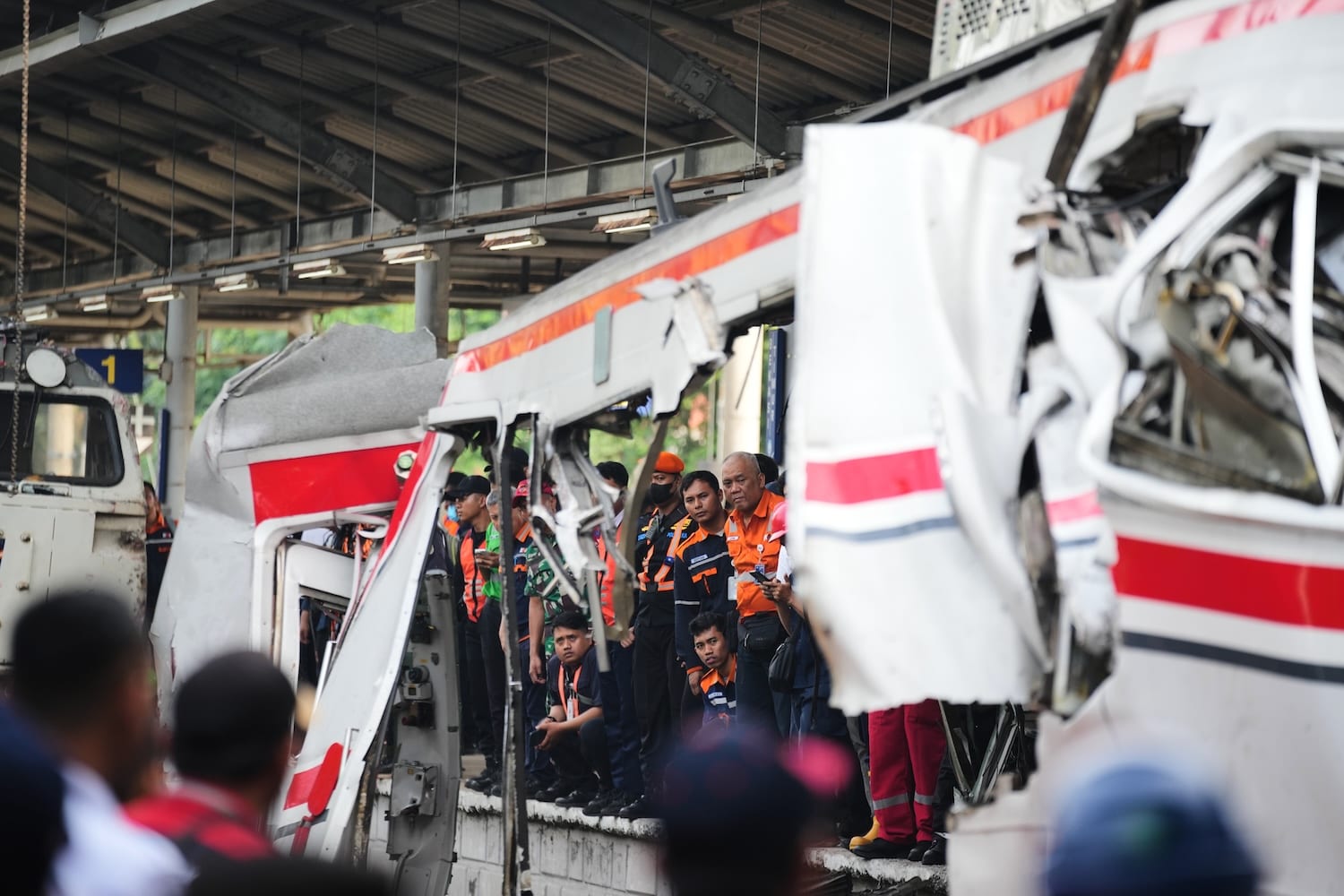
The collision between a Commuter Line train and a Pertamina fuel truck at the Bintaro grade crossing represents a catastrophic failure of three interlocking systems: physical infrastructure, regulatory enforcement, and emergency kinetic response. While the immediate casualty count—seven fatalities and eighty-one injuries—serves as the primary metric of the tragedy, the underlying cause is not a singular "accident" but a predictable outcome of high-frequency rail operations intersecting with unmanaged logistical bottlenecks. To understand why a women-only carriage became a crush zone, one must analyze the physics of the impact and the systemic negligence of the crossing’s design.
The Kinematics of the Bintaro Impact
The severity of the crash is rooted in the mass-velocity relationship of the two vehicles. A fully loaded fuel tanker carries immense chemical potential energy, but its primary threat in the initial seconds of a collision is its structural resistance. When the electric multiple unit (EMU) struck the truck, the lead carriage—specifically designated for female passengers—bore the brunt of the kinetic energy transfer.
The "crush zone" in rail design is intended to absorb energy, yet the sudden ignition of the truck’s cargo transformed a mechanical impact into a thermal event. The derailment and subsequent fire were not separate incidents but a continuous energy release. Because the lead carriage was the point of primary contact, the deceleration forces were highest for those inside, leading to the three passengers being trapped within the mangled frame of the women-only coach.
The Triple Constraint of Grade Crossing Safety
Grade crossings in densely populated areas like South Jakarta operate under a "Triple Constraint" model. When one of these three variables fails, the probability of a fatal intersection reaches near-certainty over a long enough temporal scale.
- Mechanical Reliability of Barriers: The physical gates must descend with enough lead time to clear the tracks. In the Bintaro incident, reports indicate a delay between the alarm and the physical barrier's closure, or a failure of the truck to respect the existing signals.
- Traffic Flow Velocity: High-density urban traffic creates "gridlock traps" where a vehicle enters a crossing but cannot exit due to stationary traffic on the far side.
- Operator Reaction Time: The Braking Distance of a loaded commuter train at 60-80 km/h exceeds the visual line-of-sight at many Jakarta bends.
The intersection at Bintaro is a known failure point where these three variables frequently misalign. The "women-only" carriage, positioned at the front and rear of the train for ease of access and safety from harassment, paradoxically becomes the highest-risk zone during a head-on or rear-end collision. This spatial allocation ignores the physics of impact in favor of social utility.
Operational Bottlenecks and Emergency Response Latency
The derailment of the 1131 Serpong-Tanah Abang line exposed significant gaps in the emergency response framework of PT KAI and the Jakarta provincial government. The extraction of trapped victims from the lead carriage was delayed by two factors: the intense heat from the fuel fire and the lack of specialized hydraulic cutting equipment on-site in the immediate aftermath.
Structural integrity in modern carriages is designed to prevent "telescoping"—where one car slides into another—but it is not designed to withstand sustained high-temperature thermal exposure from external fuel sources. The melting point of aluminum alloys and the combustion of interior synthetic materials create a toxic environment that reduces the "golden hour" of survival to minutes.
The Cost Function of Infrastructure Modernization
The persistence of grade crossings in Jakarta is a result of a skewed cost-benefit analysis. The capital expenditure required to build flyovers or underpasses is high, but the "Externalized Cost" of maintaining grade crossings includes:
- Actuarial Loss: The economic value of lost lives and long-term disability for the 81 injured.
- Operational Downtime: Total stoppage of the Serpong line, impacting tens of thousands of commuters and disrupting the regional economy.
- Asset Depreciation: The total loss of multi-million dollar rolling stock and fuel logistics equipment.
When these costs are quantified, the investment in a grade-separated crossing (an underpass) yields a positive ROI within less than a decade. The Bintaro tragedy is a data point proving that the current "barrier-and-siren" model is obsolete for the current traffic density of the Jabodetabek area.
Risk Asymmetry in Gender-Segregated Carriages
The placement of women-only carriages at the extreme ends of the train creates a "Safety Asymmetry." While intended to protect a vulnerable demographic from social risks, it ignores mechanical risks.
In a standard collision, the "Crumple Zone" is the first 5-10 meters of the train. By mandating that women sit in these zones, the rail operator is unintentionally concentrating a specific demographic in the highest-fatality area of the vehicle. A more rigorous safety strategy would involve mid-train segregation, placing the protected carriages in the "Neutral Zone" where kinetic energy is dissipated by the coupling systems of the surrounding cars.
Structural Recommendations for PT KAI and Regulators
The transition from a reactive to a proactive safety posture requires a fundamental shift in how rail-road intersections are managed.
- Implement Integrated Signaling: Barriers should be linked to GPS-based train tracking. If a vehicle is detected on the tracks via induction loops or cameras, an emergency signal must be transmitted directly to the train's cabin, bypassing the need for visual confirmation by the driver.
- Abolish Grade Crossings in High-Density Corridors: The Bintaro intersection must be permanently closed to vehicular traffic and replaced with a flyover. The "bottleneck effect" at this specific location is a physical certainty that will cause future collisions if the geometry of the road is not altered.
- Redesign Carriage Allocation: Moving the women-only sections to the center of the train would distribute the risk profile more evenly across the passenger base and utilize the train's inherent structural damping.
- Automatic Fire Suppression Systems: Commuter trains operating in areas with high fuel-truck traffic require external thermal shielding or enhanced fire suppression in the driver's cab and lead carriages.
The failure at Bintaro is not a mystery; it is the result of applying 20th-century infrastructure to 21st-century density. The seven lives lost are a metric of the gap between current operational reality and necessary engineering standards.
The strategic imperative for the Jakarta rail network is the immediate elimination of the "Intersection Risk." Until the tracks are physically separated from the road network, every commuter train entering a grade crossing is operating within a margin of error that is too slim for human safety. The focus must shift from "improving driver awareness" to "engineering out the possibility of contact."
The final strategic play is clear: PT KAI must prioritize the Underpass Initiative as a core safety mandate rather than a secondary infrastructure project. Failing to do so ensures that the next kinetic event is not a matter of "if," but "when."