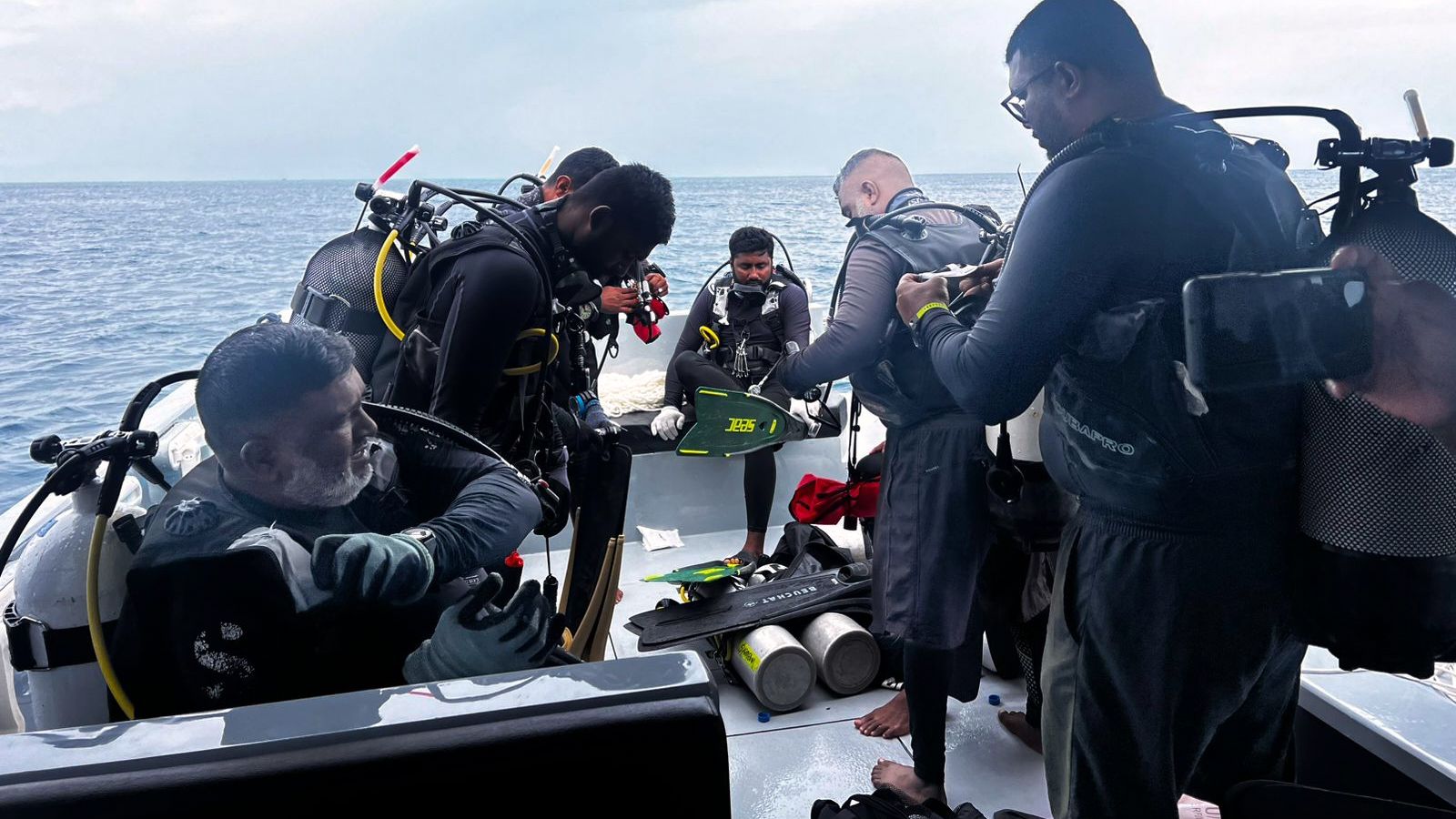
The fatalities involving five Italian divers at the Kuda Giri cave system represent a catastrophic convergence of environmental illusions and equipment deficits rather than a singular point of failure. In technical overhead environments, survival is a function of gas management, navigational redundancy, and psychological stability. When these three pillars collapse simultaneously, the "No Way Out" scenario becomes a mathematical certainty. This analysis deconstructs the specific mechanics of the "sand wall illusion," the breakdown of the "Rule of Thirds" in gas planning, and the systemic failure of guide-to-client ratios in high-risk underwater topologies.
The Optical Trap Mechanics of the Sand Wall Illusion
The primary environmental catalyst in this incident was the "sand wall illusion," a phenomenon specific to silty, low-flow cave systems. Unlike open-water environments where light attenuation provides a vertical reference, cave interiors rely on artificial light reflecting off solid surfaces. For a closer look into similar topics, we suggest: this related article.
- Particulate Suspension: When a group of divers enters a confined space, fin kicks disturb the fine sediment (silt) on the cave floor. This creates a "silt-out," reducing visibility to near zero.
- Reflective Disorientation: The suspended sand particles reflect dive lights directly back into the diver's mask, creating a white-out effect.
- The False Exit: In the Kuda Giri system, the specific geometry of the cave walls combined with the particulate density created a visual barrier that appeared identical to a solid wall. Divers, searching for the exit, perceived the silty water as the cave boundary and the actual exit—obscured by the same silt—as a solid mass.
This illusion triggers a cognitive bypass where the diver stops trusting their instruments (compass and line) and begins navigating based on flawed visual cues. In a panic state, the brain prioritizes perceived "open space," which, in a silt-out, is often the deepest part of the cave where the silt hasn't yet settled.
The Equipment Gap and Redundancy Deficit
The Italian team lacked the fundamental technical gear required for "overhead" penetration. Standard recreational gear is designed for a direct vertical ascent to the surface; it is fundamentally incompatible with caves. To get more details on the matter, extensive coverage is available on Travel + Leisure.
The Missing Continuous Guideline
The most critical equipment failure was the absence of a continuous guideline from open water to the deepest point of penetration.
- The Primary Tie-off: A line must be secured outside the cave in open water.
- Secondary Attachments: Constant tension must be maintained to prevent the line from drifting into "line traps" (narrow cracks where a diver can't follow the string).
Without a physical connection to the surface, a diver in a silt-out has a 0% statistical probability of finding an exit before gas depletion. The Kuda Giri divers were relying on visual memory, which is the first faculty to fail under hypercapnic stress.
Gas Management and the Rule of Thirds
The divers were reportedly using single-cylinder recreational configurations. In cave diving, the "Rule of Thirds" is the non-negotiable minimum:
- One-third for penetration.
- One-third for exit.
- One-third for emergencies (assisting a buddy or managing a delay).
Using recreational limits in a cave environment removes the safety buffer. When the group encountered the sand wall illusion, they had already consumed their "return" gas, leaving them with no margin for the 15–20 minutes required to navigate a zero-visibility exit.
Human Factors and Group Dynamics in High-Stress Enclosures
The presence of five divers in a single cave chamber created a "Silt-Loading Multiplier." The volume of disturbed sediment scales exponentially with the number of divers. Five divers moving in a confined space will create a total silt-out in under 60 seconds.
The Guide-to-Client Bottleneck
A single guide leading four clients into a cave is a structural violation of safety ratios. In an overhead environment, a guide must be able to maintain physical contact or close visual proximity to every member. Once visibility dropped:
- The guide could no longer monitor the gas levels of the clients.
- The "herd effect" took over, where divers followed the person in front of them rather than checking their own navigation.
- The physical size of five divers trying to turn around in a narrow corridor increased the turbulence, further worsening the silt-out.
Hypercapnia and Carbon Dioxide Buildup
As panic sets in, respiration rates increase. In a cave, this leads to hypercapnia (CO2 buildup). High levels of CO2 cause "air hunger," which triggers a primitive flight response. Divers often spit out their regulators or ascend rapidly into the cave ceiling, further disorienting themselves. This physiological state explains why the divers were found in a cluster; they were likely following a "perceived" leader into a dead-end pocket of the cave.
The Geometry of the Kuda Giri Trap
The Kuda Giri cave is not a simple tunnel; it features "blind pockets" and "false chimneys."
- Vertical Displacement: The cave system has varying ceiling heights. Divers under stress tend to float upward.
- The Ceiling Trap: In Kuda Giri, the upper sections of the cave contain "pockets" that do not lead to the surface. Divers who ascended to escape the silt became trapped in these pockets.
- Flow Dynamics: The lack of current in this specific Maldives system meant the silt remained suspended for hours. Unlike a high-flow spring in Florida, where the current clears the "bad water," the Kuda Giri system became a static tomb of opaque water.
Risk Mitigation Framework for Tropical Cave Excursions
The transition from "cavern diving" (staying within sight of natural light) to "cave diving" (total darkness/overhead) is where the mortality rate spikes for recreational tourists. To prevent a recurrence of the Kuda Giri tragedy, the following operational changes are required for dive operators:
- Mandatory Line Deployment: No overhead penetration beyond the "light zone" without a reel and continuous line.
- Dual-Orifice Regulators or Independent Sets: Divers must have redundant breathing sources. If one regulator fails or a diver runs out of gas, the "buddy" must have a dedicated long-hose to share air while navigating a narrow exit.
- Acreage-to-Diver Ratio: Limiting cave entries to two divers plus one guide to minimize silt disturbance.
- Visual Light Alarms: Using high-intensity strobes at the cave exit to penetrate light silt, providing a visual "beacon" that can be seen even when the "sand wall" begins to form.
The Kuda Giri incident was not an act of God or an unpredictable current. It was a failure to respect the physics of overhead environments. The "sand wall" is only deadly to those who have not laid a physical line to the world outside it. For the travel industry, the lesson is clear: recreational certifications do not grant immunity to the laws of cave ballistics. Future expeditions must treat any overhead structure—no matter how shallow—as a technical environment requiring technical redundancies.


