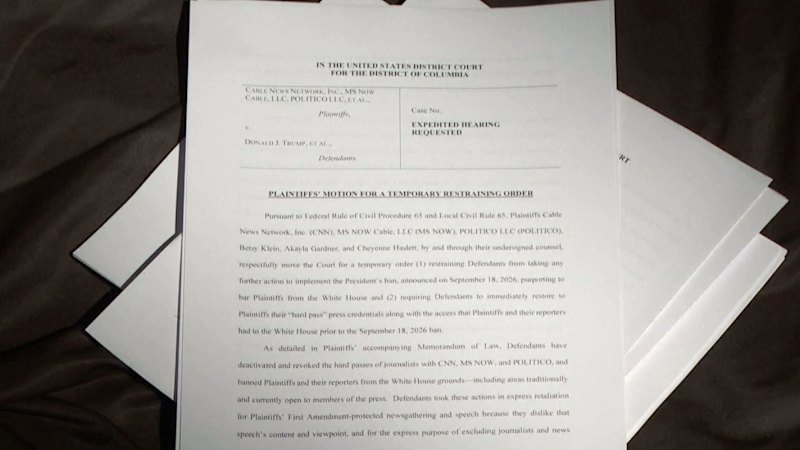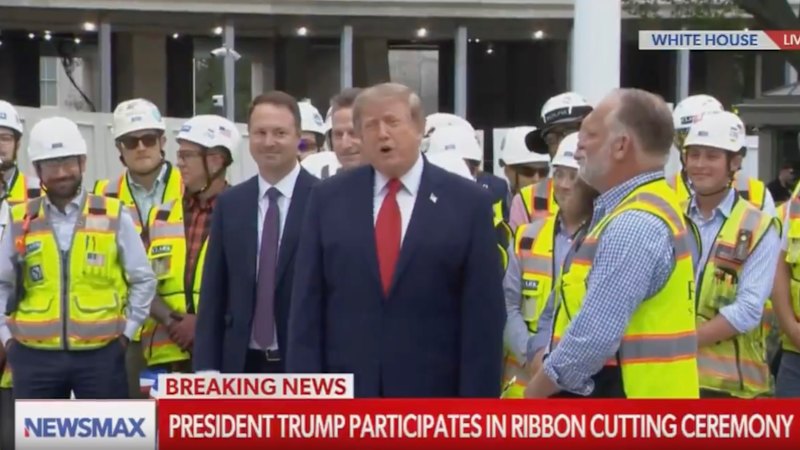
Political strategies designed to restrict institutional access often trigger unintended operational consequences that degrade the very communicative objectives they seek to achieve. When the executive branch implements selective bans on designated media organizations, the resulting disruption extends beyond legal and constitutional questions into the mechanical physics of public communication. The modern administrative state relies on a complex infrastructure of broadcast pools, acoustic engineering, and multi-tiered distribution channels. Altering any single node within this network creates cascading systemic failures.
The Architecture of the White House Press Pool
The executive branch does not operate in an acoustic vacuum. Presidential public addresses, outdoor ceremonies, and impromptu briefings depend upon an established logistical framework known as the press pool. This system operates through centralized resource pooling, where a rotating subset of television networks, print journalists, and wire services capture, amplify, and distribute audio and video feeds to the broader media ecosystem.
When specific news organizations are excluded from physical access to executive grounds, secondary behavioral reactions occur across the broader media apparatus. In response to targeted bans, allied or neutral broadcasting networks frequently suspend participation in cooperative pool coverage as an act of solidarity or institutional self-preservation. This boycott disrupts the standard hardware and audio engineering chain required to capture clean speech in acoustically volatile environments, such as open-air lawns flanked by active helicopter rotors or heavy machinery.
Without the integrated infrastructure managed by the collective press pool, unilateral executive events suffer from severe signal-to-noise ratio degradation. Audio capture relies on specialized microphones, centralized audio splitters, and sound engineers positioned directly adjacent to the speaker. When these operational roles are left unstaffed due to boycotts or exclusion orders, public feeds default to ambient recording devices. The resulting audio distortion renders the speaker functionally inaudible, transforming an intended broadcast mechanism into an inert transmission.
The Economic and Informational Cost Function
Information dissemination operates under strict economic laws of distribution and friction. Executive communication strategies calculate the marginal value of message control against the marginal cost of audience reach. Implementing an exclusionary media policy introduces structural friction that alters this equation.
Total Information Reach = (Direct Access * Pool Multiplier) - Institutional Friction
When access is restricted, the pool multiplier collapses. The administration trades broad-spectrum distribution through established commercial networks for narrowcasting through proprietary channels or sympathetic alternative outlets. However, alternative channels frequently lack the technical redundancy and syndicated distribution power of the primary pool.
- Signal Degradation: The loss of professional audio engineering leads to unedited, garbled transmissions that undermine the professional presentation of the executive.
- Amplification Shift: Independent media entities redirect their investigative bandwidth toward the legality and procedural ethics of the exclusion itself, crowding out the intended policy message.
- Judicial Intervention Risk: Exclusionary policies trigger immediate legal challenges under administrative procedure and constitutional doctrines, introducing high legal defense costs and binding injunctions that create operational uncertainty.
The Mechanics of Legal and Operational Reversals
Exclusionary actions taken without rigorous statutory backing inevitably encounter judicial friction. Courts evaluate administrative actions based on established standards of due process and viewpoint neutrality. When an executive office explicitly cites content-based justifications—such as designating specific reporting as unfavorable—for revoking press credentials, it creates an evidentiary record that complicates legal defense.
The legal mechanism typically follows a predictable trajectory:
- Emergency filings by media coalitions seeking temporary restraining orders or preliminary injunctions.
- Judicial skepticism regarding national security or space-limitation rationales when applied selectively to long-standing credentialed entities.
- Reinstatement orders that force a return to baseline operational parameters, accompanied by heightened public scrutiny and diminished political capital.
Attempting to bypass these judicial constraints by escalating restrictions—such as extending bans from indoor briefing rooms to mobile transit environments like presidential aircraft—broadens the plaintiff class and strengthens the legal argument for systemic viewpoint discrimination. This escalatory loop consumes administrative resources without securing a sustainable communicative advantage.
Strategic Forecast
The intersection of executive communication and media access points toward a permanent structural stalemate. Future administrations attempting to leverage access control as a disciplinary tool will encounter diminishing returns. As media distribution decentralizes and legal frameworks adapt to protect institutional access nodes, exclusionary tactics will continue to yield immediate technical failures—such as compromised audio and fractured broadcast pools—while generating severe legal liabilities that outweigh short-term message control. Strategic communication must rely on message architecture rather than physical suppression to achieve durable public outcomes.