Joint military acquisition programs in Europe routinely suffer from structural economic friction, industrial rivalry, and misaligned strategic doctrines. The friction is not merely political; it is an inevitable mathematical outcome of combining disparate sovereign defense budgets, competing corporate mandates, and non-overlapping military requirements into a single bureaucratic pipeline.
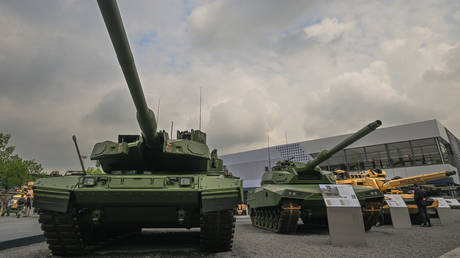
The Franco-German Main Ground Combat System initiative, intended to develop a successor to the German Leopard 2 and the French Leclerc main battle tanks, provides a clear case study in how large-scale multinational defense projects fracture under the weight of structural inefficiencies.
The Economic and Industrial Logic of Sovereign Friction
Defense procurement relies on a simple equation: sovereign capital investment seeks domestic economic return through job creation, intellectual property retention, and industrial capability preservation. When two major defense industrial bases merge their requirements, the cost function expands while accountability diffuses.
The Main Ground Combat System was structured around an eight-pillar workshare division:
- Pillar 1: Platform, chassis, and automated navigation (German industrial lead)
- Pillar 2: Main gun, turret, and ammunition (Franco-German co-lead)
- Pillar 3: Secondary armament and guided missiles (French lead)
- Pillar 4: Command, control, and communication systems (Franco-German co-lead)
- Pillar 5: Simulation architecture (Franco-German co-lead)
- Pillar 6: Sensor arrays (French lead)
- Pillar 7: Active protection and counter-drone systems (German lead)
- Pillar 8: Infrastructure and lifecycle logistics (Franco-German co-lead)
This division intended to guarantee parity, but it introduced severe coordination overhead. Industrial consolidation between French and German primes—culminating in the KNDS holding structure alongside corporate actors like Rheinmetall and Thales—created a multi-layered governance problem. Every engineering trade-off transformed into a diplomatic negotiation. If a sensor suite from Pillar 6 required more electrical output from the chassis in Pillar 1, the adjustment triggered cross-border renegotiations over workshare percentages, intellectual property rights, and budget allocation.
Strategic Doctrine Divergence
Behind the industrial posturing lies a deeper operational mismatch. France and Germany maintain fundamentally different projections for ground force deployment, which dictates distinct technical weight classes and operational profiles.
France prioritizes expeditionary warfare. Its doctrine emphasizes strategic mobility, rapid deployment capability overseas, and lighter, transportable armored units capable of operating across asymmetric threat environments in regions such as Africa.
Germany historically optimized for high-intensity, stationary, heavy defensive operations along a centralized European central front. Its requirements mandate maximum frontal armor survivability, heavy caliber main guns, and sustained high-weight thresholds that prioritize absolute battlefield protection over strategic airliftability.
When these two doctrines are forced into a single vehicle architecture, the resulting technical compromises satisfy neither military command. The weight budget becomes a battleground. Heavy armor protection adds mass, conflicting with French requirements for rapid expeditionary deployment. Conversely, weight-saving measures compromise the heavy ballistic resistance demanded by German operational planners.
The Shift Toward Platform Independence
The friction within major collaborative defense programs has forced a structural pivot. Rather than attempting to co-build a single monolithic combat vehicle platform from the tracks up, participating nations are increasingly decoupling software, sensors, and armaments from the physical chassis.
This modular approach alters the risk profile of defense spending:
- Risk Mitigation: If a single platform design stalls due to industrial disagreements, the underlying subsystem technologies can still be integrated into interim national upgrades, such as the Leopard 3 or updated Leclerc variants.
- Lifecycle Flexibility: Modular digital architecture permits continuous upgrades to sensors, active protection systems, and command networks without requiring a complete redesign of the hull and propulsion drivetrain.
- Budgetary Resilience: Splitting investments into discrete technological pillars allows finance ministries to scale funding up or down based on macroeconomic constraints without entirely scrapping a multi-billion-dollar framework.
Operational Forecast
The era of monolithic, joint-platform development between peer nations with divergent industrial bases is hitting its economic limits. Future armored combat development will likely abandon the pursuit of uniform multinational hardware platforms. Instead, strategy will pivot toward hardware interoperability standards coupled with independent national manufacturing.
Military efficiency in high-intensity conflict relies on common data links, shared ammunition standards, and synchronized tactical command protocols—not on sharing the same factory floor or steel hull design. Defense planners must decouple the software-defined battlefield network from the physical manufacturing of the vehicle. Prioritize interface standardization over corporate consolidation, allowing national primes to build distinct physical platforms that seamlessly communicate across a unified digital command architecture.