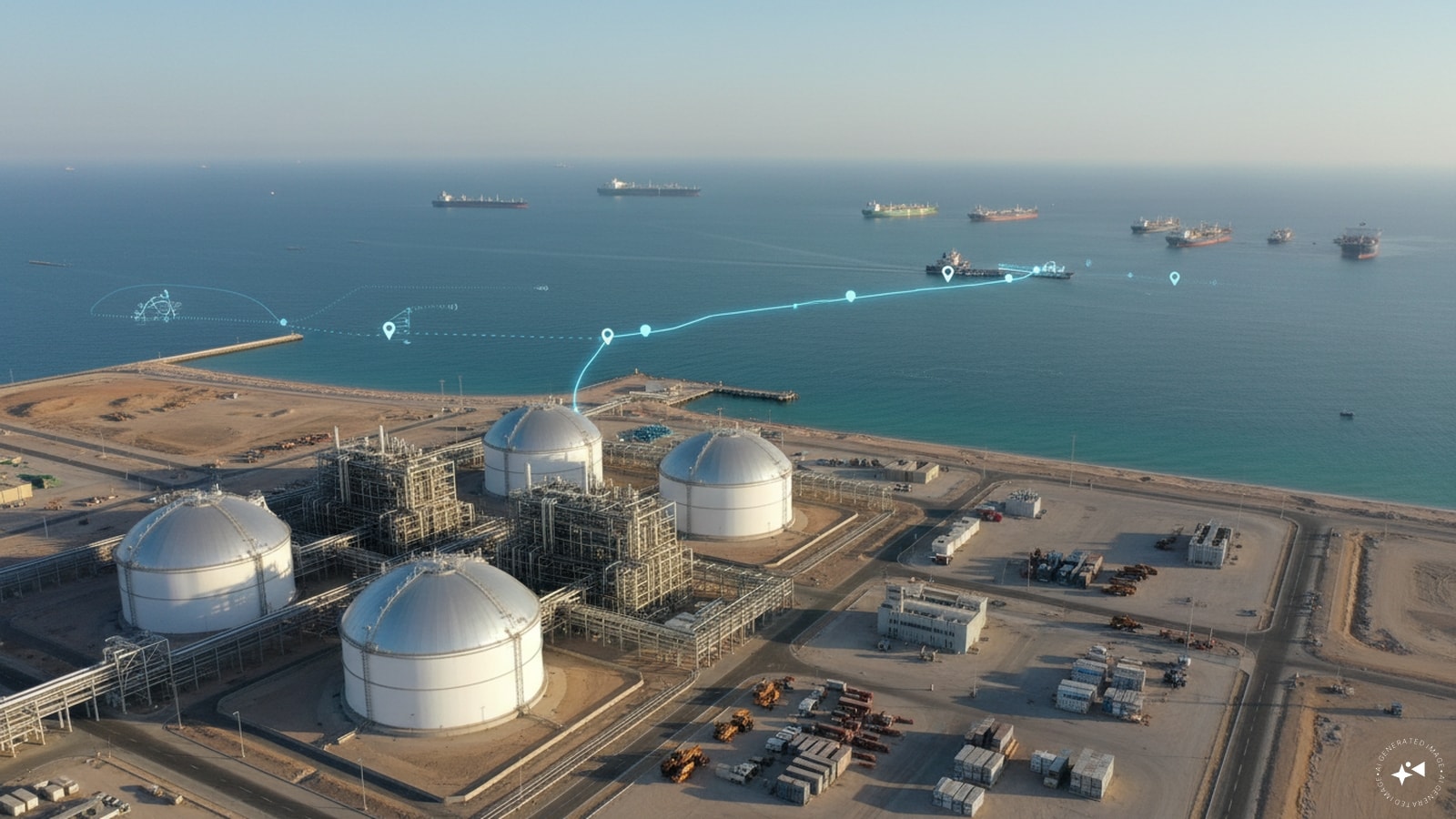
Geopolitical chokepoints operate as single-variable failure points for highly centralized commodity networks. When maritime traffic through the Strait of Hormuz encounters systemic disruption, the operational models of major hydrocarbon exporters face an immediate stress test. For QatarEnergy, the intersection of active maritime blockades, targeted infrastructure strikes at the Ras Laffan complex, and a multi-billion-dollar capacity expansion schedule creates a complex resource allocation problem. Deconstructing this crisis requires looking past headline volatility to examine the structural mechanics of capital deployment, supply chain substitution, and long-term asset amortization under duress.
The Cost Function of Chokepoint Vulnerability
Standard energy market analysis evaluates production capacity purely by nameplate volume: the aggregate metric of million tonnes per annum (mtpa). However, nameplate metrics ignore the spatial distribution of processing facilities relative to maritime egress corridors. Meanwhile, you can explore other events here: The Quiet Strangulation of the Modern World.
The Qatari expansion strategy—encompassing the North Field East (NFE) and North Field South (NFS) projects—was architected to scale national output from 77 million tonnes per year to 142 million tonnes per year. This design assumes an unconstrained marine logistics chain. When the physical egress vector is compromised, the economic equation reverses:
- Inventory Accumulation Pressure: Without outbound tanker transit, storage facilities reach saturation thresholds rapidly, forcing upstream wellhead curtailment.
- Fixed Cost Amortization Drag: Mega-projects rely on continuous capital expenditure recovery. Halting production while maintaining debt service obligations degrades project net present value (NPV).
- Physical Asset Vulnerability: Concentrated processing hubs like Ras Laffan create high-value targets where localized kinetic impacts disable double-digit percentages of national liquefaction capacity simultaneously.
When roughly 17 percent of domestic liquefaction capacity is disabled alongside an enforced blockage of the Hormuz transit corridor, the capital expenditure cycle hits an operational ceiling. Cash flows dedicated to future train construction must be reallocated toward structural repair, force majeure legal management, and alternative portfolio hedging. To see the bigger picture, check out the recent analysis by Investopedia.
Portfolio Hedging via Third-Party Arbitrage
A sophisticated state-backed enterprise cannot simply absorb downstream supply vacuums without risking long-term market share erosion among key Asian and European utilities. To mitigate the structural deficit caused by export halts, QatarEnergy executed an aggressive counter-cyclical procurement strategy: acquiring third-party liquefied natural gas volumes from non-Gulf basins, specifically through long-term supply agreements with North American operators such as Cheniere Energy.
This mechanism reveals a distinct operational maneuver:
- Asset Substitution: By purchasing U.S. Gulf Coast volumes slated for delivery out into the next decade, the firm maintains commercial relationships with displaced buyers.
- Geographical Arbitrage: Hedging localized Middle Eastern production losses with Atlantic basin supply chains allows the firm to capture structural price spreads across international trading hubs.
- Timeline Mismatch Absorption: Because North American supply additions carry multi-year lead times (e.g., deliveries ramping up toward the next decade), this maneuver functions as an insurance policy against extended regional instability rather than an immediate spot-market patch.
The risk profile of this strategy centers on execution speed and contract enforcement. Long-term purchase commitments lock the enterprise into fixed pricing formulas that may diverge sharply from spot benchmarks if maritime routes reopen faster than anticipated.
The Staggered Sequencing Dilemma
Expansion projects of the scale of North Field East and North Field South cannot be paused or accelerated via simple digital switches. They involve long-lead procurement items, cryogenic heat exchangers, specialized turbomachinery, and heavy engineering contracts signed years in advance.
The dilemma facing technical leadership involves resource cannibalization:
- Engineering Bandwidth Allocation: The workforce and specialized contractors required to commission upcoming trains (such as the targeted 2027 and 2028 startup windows) are frequently the exact personnel required to execute complex repairs on damaged infrastructure at Ras Laffan.
- Capital Expenditure Rework: Diverting capital to repair gas-to-liquids (GTL) conversion units and disabled LNG trains directly competes with the capital demands of unbuilt upstream infrastructure.
- Contractual Sequencing Penalties: Delaying engineering milestones risks triggering contractual default clauses or cost-escalation penalties with international EPC (Engineering, Procurement, and Construction) contractors.
Consequently, the timeline for reaching the 142 mtpa target is no longer a function of purely internal construction efficiency. It is bounded by the velocity of regional diplomatic resolution and the physical security guarantees of maritime transit lanes.
Strategic Capital Re-Routing
To stabilize operational metrics under prolonged maritime uncertainty, executive decision-making must transition from linear expansion modeling to dynamic contingency planning. The strategic playbook requires three simultaneous adjustments:
- Decoupling Production Milestones from Regional Egress: Prioritize the commissioning of international joint ventures (such as North American assets) to maintain cash-flow generation independent of Middle Eastern shipping lanes.
- Modularizing Repair Sequences: Decouple the repair timelines of damaged domestic processing units from the broader expansion footprint of unbuilt trains to prevent total project paralysis.
- Dynamic Supply-Chain Arbitrage: Utilize long-term off-take agreements from secure global partners to honor downstream commitments while domestic export terminals operate under restricted capacity constraints.
The ultimate trajectory of state-backed mega-projects under geopolitical duress depends entirely on the agility of capital re-allocation. Organizations that successfully pivot from domestic centralization to diversified global portfolio management will absorb chokepoint shocks without sacrificing long-term market dominance.