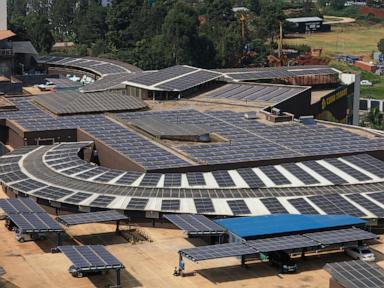
African energy markets face a structural contradiction. Sub-Saharan solar adoption is accelerating under chronic grid failures and structural power deficits, yet the continent remains bound to an external manufacturing monopoly. While national utilities and private developers import gigawatts of photovoltaic hardware annually, domestic industrial policy struggles against a defining economic reality: China controls the upstream tiers of the global solar supply chain. Dissecting this dependency requires examining the economic mechanics of overcapacity, the cost functions of localized module assembly, and the precise choke points that prevent African nations from capturing higher-value industrial nodes.
The Economics of Chinese Industrial Overcapacity
To understand the flood of photovoltaic hardware entering African ports, one must examine the capital allocation cycles within East Asian manufacturing. Between 2022 and 2024, state-directed credit and provincial land subsidies fueled a fourfold expansion of polysilicon and wafer production capacity inside China. This aggressive capital expenditure generated profound industrial oversupply, driving module prices down precipitously.
As Western jurisdictions erected trade barriers, anti-dumping duties, and localized content requirements to protect domestic manufacturing bases, Chinese exporters redirected surplus volume toward developing markets. Sub-Saharan import volumes surged accordingly. Customs metrics indicate that monthly shipments routinely dwarf historical installation baselines, creating a massive influx of equipment priced at a fraction of historical benchmarks.
For African finance ministers and utility executives operating under severe capital constraints, this hardware glut offers an irresistible value proposition. Procurement costs have dropped to levels that make distributed solar instantly competitive against diesel generation and centralized grid tariffs. However, this immediate economic relief masks a deeper structural vulnerability. The pricing environment is an artifact of an external industrial crisis rather than a sustainable market equilibrium. When Chinese domestic consolidation or international trade shifts absorb this excess capacity, African markets will face a radically altered cost function.
The Three Tiers of Photovoltaic Manufacturing Value
A critical error in contemporary policy discourse is treating solar manufacturing as a monolithic category. The photovoltaic value chain is vertically stratified into distinct tiers, each requiring exponentially higher capital expenditure and technological complexity:
- Upstream Tier: Polysilicon refining, ingot pulling, and wafer slicing. This stage demands immense capital intensity, specialized chemical processing, and continuous, low-cost baseline power.
- Midstream Tier: Solar cell fabrication. This requires advanced semiconductor processing, cleanroom infrastructure, and precision doping technology.
- Downstream Tier: Module assembly and framing. This segment is heavily automated, less capital-intensive, and primarily involves stringing and encapsulating manufactured cells into deployable panels.
Emerging African production hubs—such as assembly plants in Nigeria, South Africa, and Egypt—operate almost exclusively within the downstream tier. These facilities import fully fabricated solar cells, predominantly from East Asian suppliers, and convert them into finished modules.
Consequently, local assembly captures only a minor fraction of total gross value added. The high-value components—the silicon wafers and photovoltaic cells that dictate conversion efficiency and degradation rates—are entirely imported. This dynamic limits technology transfer and leaves domestic production vulnerable to supply disruptions of intermediate inputs.
The Capital and Infrastructure Cost Function
Scaling past simple module assembly to establish an integrated domestic solar manufacturing sector encounters severe economic friction. The viability of component production depends on strict scale thresholds. Economic models from the Department of Mineral Resources and Energy in South Africa suggest that commercial viability for integrated wafer and cell production requires a sustained domestic and regional demand floor of at least one gigawatt annually. While continental demand exceeds this threshold in aggregate, it is fragmented across dozens of sovereign regulatory environments, lacking a unified procurement mechanism.
Furthermore, the structural cost of capital across sub-Saharan Africa creates an immediate disadvantage. Industrial facilities of this scale require continuous, uninterrupted electricity and reliable logistics networks. In environments characterized by erratic grid stability, high logistics overhead, and borrowing rates often exceeding double digits, the return on capital for heavy manufacturing is severely depressed. Competing against foreign entities backed by subsidized sovereign credit is mathematically improbable without aggressive trade shielding or direct state subsidization.
Strategic Interventions for Regional Integration
To transition from terminal consumer status to active industrial participation, African policymakers must abandon the pursuit of full vertical autarky. Replicating the entire Chinese supply chain is economically unfeasible. Instead, strategy must focus on targeted regional integration and infrastructure optimization.
The first imperative is the establishment of harmonized regional trade standards under frameworks like the African Continental Free Trade Area. Fragmented markets of 50 to 300 megawatts are economically dead on arrival; a consolidated regional market exceeding five gigawatts of predictable annual demand changes the investment calculus entirely.
The second imperative involves structuring foreign direct investment contracts to mandate genuine know-how transfer rather than turnkey equipment imports. When foreign manufacturers establish facilities to bypass Western tariffs, host nations must enforce localized research and development partnerships, vocational engineering pipelines, and supply chain integration metrics that pull local raw material processors—such as African silicon and mineral producers—into the ecosystem.
The ultimate objective is not insulation from global markets, but strategic leverage. By anchoring domestic industrial policy to the downstream deployment boom while gradually securing midstream cell production capabilities, select African economies can capture sustainable economic value from the ongoing global energy transition.