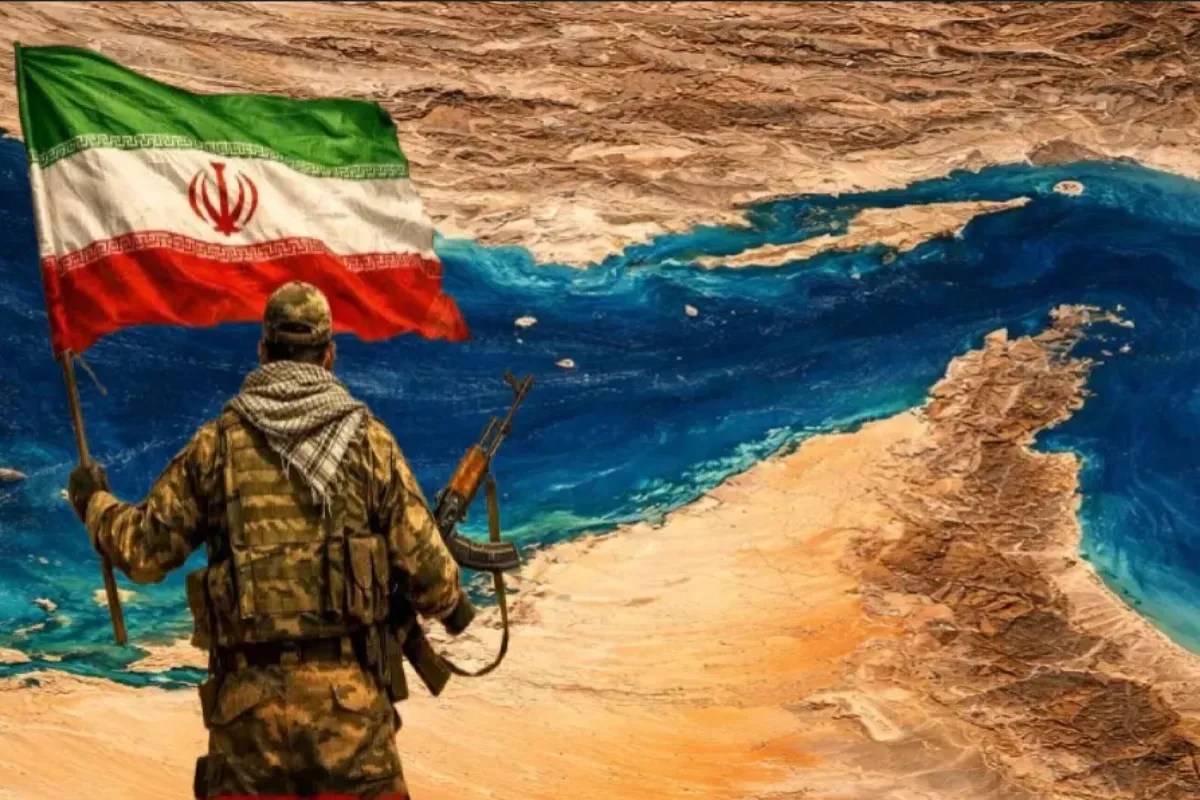
Tehran loves a microphone. Every few months, military brass stand behind podiums draped in flags, flashing charts of the Persian Gulf, and declaring absolute sovereignty over twenty-one miles of bottlenecked water. The lazy consensus in global media swallows this whole. Analysts nod sagely, warning that a single command from the Islamic Revolutionary Guard Corps can choke off the global economy overnight, sending oil prices into orbit and bringing superpowers to their knees. It is a neat, terrifying narrative. It is also completely wrong.
The Myth of Absolute Control
Let us dissect the core misconception right away. Physical proximity is not strategic power. Standing next to a door with a heavy padlock does not mean you own the building when the roof has already caved in. Iran treats the Strait of Hormuz like a toll booth on a deserted highway. They believe holding the key to the gate gives them eternal dominance over international trade. But energy markets have evolved past the crude vulnerabilities of the nineteen-seventies. When you threaten to cut off the flow of hydrocarbons, you do not starve your adversaries; you accelerate their departure from your product permanently.
Consider the sheer structural arrogance required to claim absolute control over a body of water shared by sovereign neighbors who despise your foreign policy. Oman, the United Arab Emirates, and Saudi Arabia have coastlines, shipping lanes, and strategic interests that directly contradict Tehran's self-aggrandizing claims. The maritime boundaries in the Persian Gulf are defined by international law, not by the unilateral declarations of a sanctioned regime shouting from a podium.
The Economics of National Suicide
Imagine a scenario where Tehran actually acts on its bluster and attempts to mine or close the channel permanently. For about seventy-two hours, cable news anchors panic. Futures contracts spike. Tanker insurance rates hit the stratosphere at Lloyd's of London, where war risk underwriters price in every ounce of geopolitical theater. Then, cold reality sets in.
Saudi Arabia and the United Arab Emirates have spent billions engineering bypass routes like the Habshan Fujairah oil pipeline and the East-West Petroline, sidestepping the Persian Gulf entirely. They can pump millions of barrels daily straight to the Red Sea or the Gulf of Oman, laughing at any blockade attempt.
More importantly, every barrel of oil kept off the market by Iranian intimidation is a direct gunshot to Tehran's own temple. Iran does not possess a diversified tax base, a thriving manufacturing sector, or a modern industrial engine. It is a classic petro-state running on borrowed time, smuggled currency, and subsidized bread. Cut off export revenues, and within weeks, foreign currency reserves evaporate, public sector wages vanish, and the streets fill with citizens who care far less about regional hegemony than buying basic food items. Threatening to shut down your own checkout counter to spite the store manager is not strength. It is financial self-immolation.
The Professional Reality of Modern Maritime Security
I have spent years tracking commodity flows and geopolitical risk across volatile corridors. I have watched defense consultants foam at the mouth over speedboats mounting heavy machine guns in narrow waters. Here is what they miss: asymmetric naval harassment is a nuisance, not a checkmate.
A swarm of fast attack craft can create scary headlines for morning talk shows, but they cannot withstand modern naval countermeasures if a real kinetic conflict escalates. More crucially, the insurance industry—the invisible nervous system of global trade—adjusts pricing instantly. Risk is priced, hedged, and routed around. By the time regional authorities finish their fiery press conferences, logistics firms have already rerouted tankers or adjusted supply chains. The target you think you are holding hostage has already changed the locks.
Dismantling the Propaganda Machine
Why does Tehran keep playing this broken record? Because domestic survival requires external bogeymen. When inflation is rampant, the currency is sliding into a historic abyss, and youth unemployment is staggering, nothing unites a fractured populace quite like the theater of defiance against a distant empire.
The rhetoric of total control is an internal sedative. It projects strength outward precisely because the internal foundations are rotting. Western analysts who take these threats at face value are falling for state-sponsored theater designed to manufacture a deterrent that no longer functions in the real world.
The Diversification Trap
Let us look at the structural shift in global energy demand. Major economies are not sitting ducks waiting for the next Middle Eastern bottleneck crisis. Over the past decade, capital expenditure has systematically flowed into renewables, domestic shale production in North America, and long-term supply contracts that minimize exposure to the Persian Gulf.
China, Iran's primary economic lifeline, has spent years diversifying its energy imports. Beijing relies heavily on overland pipelines from Central Asia and Russia, alongside maritime supplies from West Africa and South America. While Chinese refiners happily buy discounted Iranian crude when sanctions slip, Beijing has zero interest in a prolonged Persian Gulf war that halts its own energy imports. If Tehran tries to shut the strait, it alienates its single remaining superpower patron faster than it hurts Washington.
Every time Tehran rattles its sabers over Hormuz, it hands a massive marketing victory to North American drillers and green energy advocates. You cannot coerce customers who are actively building exits from your market. Threatening a monopoly works only when the buyer has no alternative. When alternatives exist, intimidation is just a subsidized marketing campaign for your competitors.
The Reality of Regional Deterrence
Let us address the military calculus directly. The conventional wisdom assumes that Western navies are helpless in shallow, confined waters against asymmetrical swarming tactics. That perspective belongs in a twentieth-century military textbook.
Modern electronic warfare, autonomous surface drones, satellite surveillance, and precision strike capabilities mean that any serious attempt to permanently shut down the strait would be met with a swift, asymmetric dismantling of Iran's coastal infrastructure. The military leadership in Tehran knows this. That is why the strategy remains stuck in a loop of harassment, mine-laying posturing, and fiery statements—loud enough to dominate morning news cycles, but carefully calibrated just short of the threshold that triggers total systemic destruction.
The Cost of Inactive Reform
What happens when an industry or a nation buys into its own mythology? It stagnates. By convincing itself that geography is destiny, the Iranian establishment has avoided the agonizing structural reforms required to build a modern economy.
Why fix tax collection, modernize manufacturing, or integrate into global financial networks when you believe you can simply turn a valve and bend the world to your will? This mindset is an economic death sentence. While other regional players pivot toward technology, artificial intelligence, logistics hubs, and financial diversification, Tehran remains anchored to a commodity whose geopolitical shelf life is expiring.
A Contrarian Blueprint for the Future
If you want to understand where energy markets are heading, stop watching the speedboats in the Persian Gulf. Watch the pipeline expansions in the Arabian Peninsula. Watch the capital allocation shifts in Asian economies securing long-term non-Middle Eastern contracts. Watch the domestic ledgers of a state trying to subsidize fuel for eighty million people while its export revenues face structural caps.
The narrative of absolute chokehold control is a relic of a bygone era. The world is moving past the strait, past the tankers, and past the petro-diplomacy of the last century.
Power is not measured by how loudly you can shout across a strip of water. It is measured by how easily the world can live without you when you stop shouting. Tehran imagines it holds the keys to global commerce. In reality, it is standing guard over an empty room, shouting warnings at a door everyone else has already walked around.