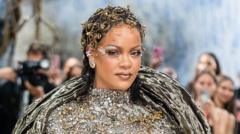
Every time A$AP Rocky mumbles something to a paparazzi camera about Rihanna being in the studio, the internet loses its collective mind. Music journalists spin up breathless think pieces about the long-awaited return of pop royalty. Fans bookmark Spotify playlists and hyperventilate over every grainy Instagram story.
It is an absolute waste of energy.
The lazy consensus in entertainment media is that Rihanna is simply a musician taking an exceptionally long coffee break between records. We are told she is dealing with writer's block, perfectionism, or the standard creative friction of an artist calibrating her next masterpiece. This is a comforting delusion for people who refuse to look at a balance sheet.
Rihanna is not a musician who happens to sell makeup. She is a multi-billionaire conglomerate builder who used pop music as a massive, subsidized customer acquisition funnel for her real empire. Expecting her to drop a standard twelve-track studio album anytime soon is like asking Jeff Bezos to step back down to manager of a local bookstore because you miss the early days of online book shipping.
Let us look at the mechanics of modern celebrity monetization. For decades, the standard playbook for a global pop star was simple: tour to sell records, sell records to secure brand endorsements, repeat until retirement. Music was the primary product. Merchandise and perfumes were secondary revenue streams tacked on to keep the cash flowing between album cycles.
Fenty Beauty flipped that equation entirely.
When Rihanna launched her cosmetics line under LVMH's Kering-incubated umbrella, she did not just drop a vanity project. She exploited a massive, glaring market failure. Legacy beauty brands spent decades ignoring women of color, treating deep and complex skin tones as an afterthought with a token two or three dark shades hidden at the bottom of a dusty display rack. Rihanna walked in with forty foundation shades and sold out her entire inventory in weeks.
That was not an artistic statement. That was a masterclass in market disruption.
Music is a low-margin, high-headache business in the streaming era. Royalties are fragmented, touring overhead is astronomical, and the timeline from production to payout is weighed down by endless negotiations with labels, publishers, and distributors. Contrast that with the beauty and fashion verticals, where brand equity compounds exponentially, inventory supply chains can be optimized for maximum margin, and customer loyalty translates directly into recurring subscription-like purchasing habits through direct-to-consumer channels.
When you own a stake in a global luxury empire that makes you the wealthiest female musician alive, releasing an album is an irrational economic decision. The opportunity cost is astronomical. Every hour Rihanna spends arguing over a vocal mix in a recording booth is an hour she is not spending on product development, supply chain logistics, or global expansion strategy for her actual core business lines.
Fans hate hearing this. They want the romantic narrative of the tormented artist locked away in the creative laboratory, perfecting her craft for the love of the art. That narrative pays zero dividends to shareholders and makes zero sense for a pragmatic businesswoman who outgrew the music industry years ago.
The Anatomy of the Manufactured Comeback Loop
Let us examine why these studio rumors persist. The entertainment industrial complex thrives on the perpetual promise of a return. A pop star never truly dies in the cultural imagination as long as the rumor mill keeps turning.
Every few months, a reliable cycle occurs. A producer posts a photo of a mixing board. A partner drops a casual hint during a red-carpet interview. The music press treats these breadcrumbs as hard evidence of an impending drop. Engagement spikes, streaming numbers for older albums get a temporary bump, and cultural relevance is maintained without a single dollar spent on actual production or marketing.
It is a brilliant PR holding pattern. It keeps Rihanna's name in the news cycle without forcing her to commit to the grueling promotional circus required to launch a modern musical project. The media eats it up because nostalgia and anticipation generate clicks. The fans eat it up because hope is free.
Nobody stops to ask the most obvious question. If the music was actually coming, where is the single? Where is the rollout? In the current streaming landscape, artists do not casually slip into the studio to vibe for fun when billions of dollars in enterprise value are riding on their attention. When a billionaire enters a recording booth, it is usually because they lost a bet or because they wanted a fun weekend activity with their partner. It is not the opening salvo of a global arena tour.
Imagine a scenario where a tech founder steps away from running a trillion-dollar cloud computing infrastructure company to code a freemium mobile puzzle game in their garage. You would laugh them out of the venture capital community. Yet, people genuinely expect a woman running a multi-category beauty and lingerie empire to drop everything and master a new bridge for a lead single.
The incentives do not align. They never will again.
Why the Music Industry Lost Its Most Valuable Asset
To understand why Rihanna left the recording studio behind, you have to understand how predatory the traditional music business model is to artists who lack total ownership of their masters.
Early in her career, Rihanna was churning out an album a year. From 2005 to 2012, she released seven studio albums under Def Jam. That is an industrial-scale output designed to feed a hungry record label machine that took the lion's share of the profits while leaving the artist with the grueling touring schedule, the vocal strain, and the relentless public scrutiny.
Artists are starting to realize that the math of the music industry is fundamentally broken. When you can leverage your fame to build equity in private companies where you own fifty percent of the cap table, why would you ever sign away your intellectual property to a major label for a fraction of a royalty point?
Rihanna did not retire from music because she ran out of things to say on a track. She retired from music because she realized she was working for the middleman.
When she launched Savage X Fenty, she structured it with major equity stakes and institutional venture backing from firms like Avenir Growth Capital. She is not just collecting a licensing check for putting her name on a tag. She is building an enterprise that can be valued, scaled, and eventually sold or taken public for sums that make a stadium tour look like petty cash.
That is the real shift in the modern celebrity landscape. The era of the famous musician who relies solely on streaming revenue is dead. The future belongs to the celebrity operator who treats their personal brand as venture capital.
The Brutal Truth About Creative Evolution
There is a romanticized notion that true artists must suffer for their craft and continue making music until they drop the microphone. This is a sentimental projection by consumers who want their favorite childhood soundtrack to keep playing forever.
Real artists evolve. Sometimes that evolution takes them out of the recording studio and into the boardroom.
When an artist achieves the kind of cultural saturation Rihanna reached by the time Anti dropped in 2016, there is nothing left to prove in pop music. She conquered the charts, she defined an era of club anthems, and she cemented her legacy as a generational vocalist. Staying in the studio would have meant chasing her own ghost, churning out diminishing returns to satisfy an algorithm that demands constant content.
Instead, she did something much harder. She pivoted. She took her cultural capital and deployed it into physical products that solved real, overlooked problems for millions of consumers worldwide.
The next time a headline screams that a new album is imminent, check your portfolio instead. You will make more money betting against the rumor than waiting for the track.