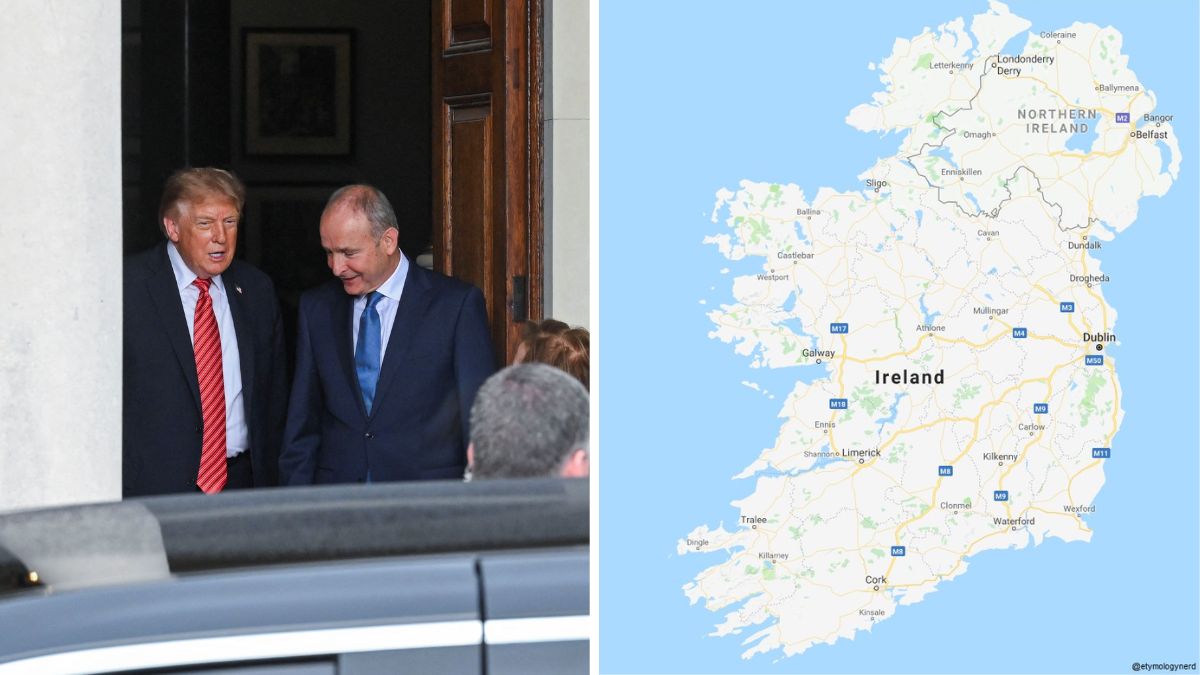
The standard narrative of Northern Ireland is a lazy rerun of a tired soap opera. Pick your channel. On one side, you have nationalist commentators screaming about an inevitable, demographic-driven surge toward a united Ireland, fueled by the slow-motion trauma of Brexit. On the other, unionist hardliners clutch their red-white-and-blue pearls, insisting that the border is an unshakeable monument ordained by history and protected by stubbornness. Both sides are selling a comforting fiction. Both sides want you to believe that the future of a million and a half people boils down to a tribal football match where the winner takes the tricolour or the union jack.
It is absolute nonsense.
If you spend your time tracking opinion polls on constitutional preferences or arguing about whether a border poll is coming in five years or fifty, you are looking at the wrong screen. The actual machinery driving this region has nothing to do with cultural identity, ancient hatreds, or the ghost of Michael Collins. It runs on cold, unromantic spreadsheets, structural deficits, and economic dependency. And until someone has the courage to talk about the numbers, the debate over partition is nothing more than political theater designed to keep incompetent leaders in power.
Let us start by dismantling the most pervasive myth in modern Irish politics: the idea that reunification is an emotional inevitability waiting for a demographic tipping point.
The lazy consensus goes like this. Protestants used to be the clear majority. Now, the Catholic population has caught up, and census data shows a shifting baseline. Therefore, arithmetic dictates that a united Ireland is just around the corner. This is the intellectual equivalent of looking at a weather forecast that says rain is likely and assuming your house is about to wash away.
Demographics do not vote. People vote. And people, regardless of their religious background, vote with their mortgages, their pension plans, and their waiting lists for cancer treatment.
Consider the financial reality that nobody in Dublin wants to whisper, let alone shout about on the campaign trail. Northern Ireland is economically subsidized by the United Kingdom to an extent that makes the Republic of Ireland's fiscal planners break out in a cold sweat. The annual subvention—the net fiscal transfer from London to Belfast to keep public services, hospitals, schools, and civil servant salaries afloat—routinely hovers between ten and fifteen billion pounds a year.
That is not spare change. That is roughly the entire annual budget of several mid-sized European nations.
When nationalists talk about reunification, they wave away this deficit with vague promises of economic dynamism, foreign direct investment, and European Union solidarity. It is magical thinking of the highest order. If Northern Ireland were to absorb into the Republic tomorrow, Dublin would instantly inherit a public sector that employs nearly a third of the workforce, a crumbling infrastructure backlog, and a health service that makes the Republic's own beleaguered HSE look like a Swiss clinic.
To bridge that gap without London's checkbook, the government in Dublin would have to implement immediate, crushing tax hikes on its own citizens, slash public spending in the south, or beg Brussels for structural bailouts that Berlin and The Hague would veto before the ink dried. Are Dublin voters ready to pay an extra ten percent in income tax to fund Belfast's public sector pensions? Ask anyone paying four thousand euros a month in rent in Dublin or trying to secure a childcare spot, and watch how fast their enthusiasm for revolutionary pan-nationalism evaporates.
Yet, unionism is in an equally delusional state of sleepwalking.
For decades, political unionism relied on a strategy of entrenched resistance. Say no to power-sharing. Say no to reform. Say no to anything that smells like an inch given to Dublin. That approach worked when London treated Northern Ireland as a loyal province whose bills would always be paid no matter how dysfunctional its local politicians behaved.
Those days are over. Westminster is fatigued. Successive British governments view Northern Ireland not as an integral emotional jewel of the union, but as an expensive, exhausting headache that occasionally threatens trade relations with the European Union and the United States. When the Northern Ireland Protocol and the Windsor Framework were hammered out, unionism was treated not as a veto-wielding partner, but as an inconvenient obstacle to be managed around.
By treating the constitutional status quo as a permanent insurance policy that requires no maintenance, unionist leaders forgot to make the union work for the average person. If you are a young professional in Bangor or Enniskillen trying to navigate the cost-of-living crisis, stagnant wage growth, and a healthcare system where waiting lists are measured in years, the Union does not look like a proud heritage. It looks like administrative neglect.
When identity politics fails to put food on the table, identity politics loses its grip. This is why the fastest-growing political demographic in Northern Ireland is not hardline nationalism or defensive unionism; it is the pragmatic middle. These are the people who tick "Other" on the census form. They are people who might enjoy a GAA match on Saturday and an international rugby match on Sunday, who care far more about whether their bin gets collected on time and whether their kids can afford a university education than whether the head of state is a king in London or an elected president in the Phoenix Park.
To understand how this plays out in the real world, look at how the debate over a border poll is framed.
Politicians love to demand dates. Sinn Fein insists on a roadmap to a poll by 2030, treating the mechanism of the Good Friday Agreement like a magic ticket to political victory. But the Good Friday Agreement was deliberately designed with a safety valve precisely to prevent this kind of demographic triumphalism. It specifies that a Secretary of State shall only call a border poll if it appears likely that a majority would vote in favour of change.
Notice the phrasing. It does not say "when Catholics outnumber Protestants." It says when a majority would vote for change. Those are two entirely different universes.
A significant block of Catholics in Northern Ireland—often termed "pragmatic nationalists" or "functional unionists"—look at the financial reality of annexation and hit the brakes. They enjoy the safety net of the UK welfare state. They like the National Health Service, flawed though it is, because they know the alternative in the south involves out-of-pocket expenses that would cripple a working-class household. Until a united Ireland can present a credible, detailed, line-by-line financial plan that proves living standards will rise rather than plummet, any border poll will fail. And the longer nationalist parties pretend that budget deficits can be wished away by patriotic fervor, the longer that poll will remain a pipe dream.
Conversely, unionism is failing because its entire pitch is negative. It is an ideology built entirely on opposition. Vote for us or the other side wins. Protect our culture or it gets erased. That is not a political platform; that is a siege mentality.
A sustainable political system cannot survive on grievance alone. If unionism wants to survive the next thirty years, it has to stop acting like a besieged garrison and start acting like a political movement that can make the case for prosperity within the United Kingdom. That means demanding better investment from Westminster, reforming local governance so that public services actually function, and reaching out to the Catholic middle class with economic arguments rather than cultural warnings.
If you want a glimpse of the future, stop reading the manifestos and look at the economic corridors.
Northern Ireland occupies a uniquely bizarre geopolitical position. Thanks to the Windsor Framework, it maintains dual market access—it sits inside the United Kingdom internal market while retaining unfettered access to the European Union single market for goods. In theory, this is an economic superpower. It is the ultimate bridge between two massive economic blocs.
Yet, local politicians have spent the last five years paralyzed by boycotts, wrangling over trade borders, and fighting over flags instead of turning Belfast and Derry into manufacturing and logistics powerhouses that could exploit this advantage. Foreign direct investment should be flooding into the region. Instead, companies hesitate because every time the Stormont assembly collapses over a political tantrum, the entire region looks like an unstable investment risk.
The tragedy of partition is not just the line drawn on a map in 1921. The tragedy is that a century later, the political class on both sides of that line still finds it more profitable to fight over the symbolism of the past than to manage the realities of the present.
When people ask whether Northern Ireland wants reunification, they are asking a question that assumes the population is neatly sorted into two opposing camps waiting for the whistle to blow. The truth is much messier, much more boring, and infinitely more hopeful.
The people of Northern Ireland are quietly breaking free from the binary. They are ignoring the politicians who tell them that their identity must dictate their economic survival. They are looking at the books, they are looking at the hospitals, and they are asking the hard questions that neither Dublin nor London wants to answer.
The border is not going to vanish because of a poetic speech or a demographic milestone. It will only become irrelevant when politicians stop using it as a shield to hide their own incompetence. Until then, keep your eyes on the spreadsheets, ignore the flag-wavers, and realize that the real revolution in Ireland will not be televised, fought on a barricade, or decided by a drumbeat. It will be decided by who pays the bills.


