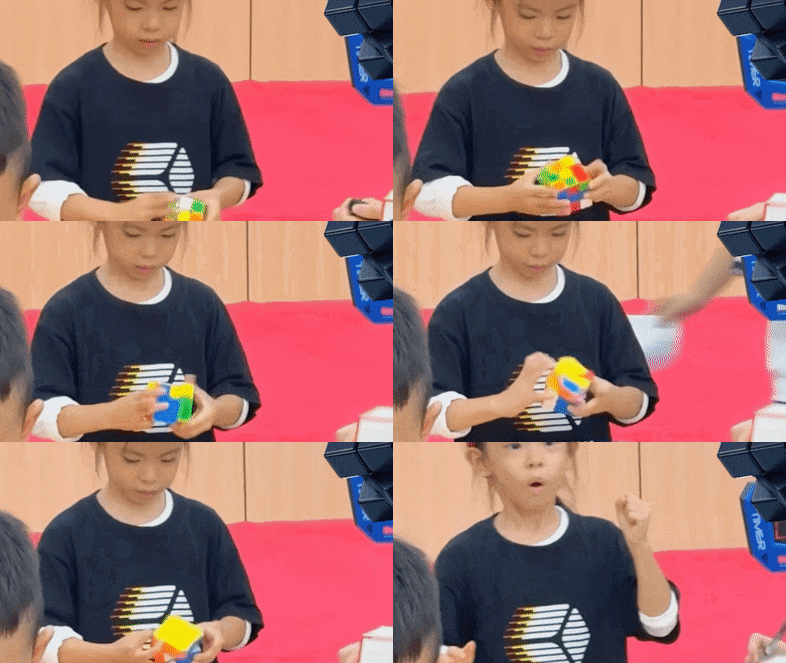
Another week, another breathless headline about a child prodigy. This time, a six-year-old shatters speedcubing records, executing twists with terrifying twitch-speed precision while commentators gush about natural-born genius and the limitless potential of youth. Parents nod in awe. Tech-adjacent lifestyle blogs run think pieces about the future of cognitive enhancement.
It is time to pull the emergency brake on this collective delusion. If you liked this post, you might want to look at: this related article.
What you are looking at is not a window into human genius. It is a masterclass in hyper-specialized rote drilling. Strip away the heartwarming media packaging, and you find a sobering reality: speedcubing at the elite level has almost nothing to do with sprawling intellect, spatial mastery, or profound mathematical intuition. It is an exercise in high-frequency pattern recognition, muscular automation, and algorithmic regurgitation.
When media outlets fawn over a child memorizing thirteen hundred algorithms and grinding for three hours a day under specialized coaching, they are romanticizing industrial-scale drill conditioning. We have confused the human brain for a flash drive, mistaking high-speed data retrieval for actual intelligence. For another angle on this development, see the latest update from The Athletic.
The Myth Of The Spontaneous Savant
The lazy consensus in every mainstream write-up of these records is that children possess some mystical, uncorrupted neurological elasticity that lets them decode complex puzzles intuitively. This is comforting fiction. A six-year-old does not look at a scrambled 3x3x3 cube and reinvent the mathematical group theory underpinning its permutations.
Erno Rubik did not invent a mathematical philosophy; he invented a mechanical puzzle. Speedcubers do not solve puzzles. They execute pre-compiled software loops with their fingers.
When a competitor drops below five seconds, they are running a biological script. The human visual cortex spots the scrambled state, indexes the exact configuration against hundreds of memorized sub-routines, and fires motor-cortex pathways that have been repeated hundreds of thousands of times until they require zero conscious thought.
Call it what it is: mechanical typing with extra steps.
To understand why treating this as high-level intellectual achievement is fundamentally absurd, look at the underlying mechanics. The World Cube Association operates on a standard of memorization and recall. Master the Fridrich method (CFOP), drill cross solutions until your eyes bleed, internalize over a thousand algorithmic cases for Last Layer (PLL and OLL), and your time will drop. It is a deterministic input-output pipeline.
Put a seasoned speedcuber in front of a modified puzzle that shifts the internal mechanics or changes the color parity rules mid-turn, and watch the illusion of genius evaporate. Their fingers will stutter because their pre-programmed muscle memory lacks an API for the unexpected. True genius invents frameworks. Speedcubing merely optimizes the execution speed of a fixed framework designed by someone else decades ago.
The Cost Of Manufactured Mastery
Behind every viral video of a toddler holding a trophy is a grueling apparatus of parental ambition and lifestyle optimization. Reports from these training camps reveal children spending hours daily repeating identical hand movements under the watchful eyes of adults chasing a return on investment in social media clout and national pride.
We love to praise grit and perseverance. But let us look at the opportunity cost. Pushing a child into obsessive, single-track specialization before their brain has finished forming foundational social and creative breadth creates a dangerous cognitive monoculture.
Imagine a scenario where a child spends their formative years treating their hands like high-speed printing presses for plastic cubes. They develop blistering execution speeds, yes. But what happens to deep, divergent problem-solving? What happens to the unstructured boredom from which actual innovation springs?
When you strap blinders onto a child and point them toward a singular, hyper-narrow metric of success—shaving milliseconds off a plastic cube solve—you are training them to be hyper-efficient biological CPUs in a world that increasingly belongs to actual artificial intelligence. Spoiler alert: a machine will always beat a human at executing raw algorithms. Celebrating a human child for trying to out-compute a calculator is like celebrating a toddler who can dig a trench faster than a backhoe. It is impressive in a grim, physical sort of way, but entirely missing the point of human capability.
Redefining What We Celebrate
We need to stop conflating high-frequency repetition with cognitive superiority. The parents and coaches interviewed in these glowing profiles invariably claim that cubing builds concentration, memory, and logical thinking. Sure. Memorizing poetry does that. Learning a musical instrument does that. Coding does that. Playing chess does that while forcing active, adversarial counter-planning against a thinking opponent.
Yet cubing remains uniquely worshipped because it offers a clean, photogenic, TikTok-friendly package of instant validation. Four seconds of blur, a digital timer stopping, a burst of confetti.
If we want to foster actual brilliance in the next generation, we must stop rewarding the unthinking optimization of trivial tasks. True cognitive health is not found in how fast you can spin a plastic toy using a thousand pre-packaged sequences. It is found in the willingness to stare at a problem that has no manual, no established algorithm, and no predetermined solution.
Stop calling them geniuses. They are elite typists of a plastic keyboard. The real test of human intellect begins right where the algorithm ends.