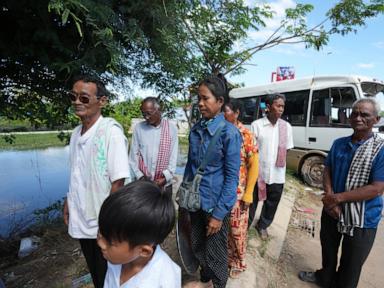
Five Cambodian schoolgirls died when their bus skidded off a rural road and plunged into a roadside pond. Every wire service, regional outlet, and local news desk ran the exact same lazy script. A vehicle lost control. Water filled the cabin. Five young lives ended. End of story.
That framing is not journalism. It is institutional cover for engineered negligence. Expanding on this topic, you can also read: The Walls That Remember Who We Were.
When a newsroom summarizes a fatal water-submersion crash as a bus skidding off the road, it quietly assigns blame to friction, rain, or a momentary lapse behind the wheel. It treats the pond as an act of God and the lack of a guardrail as background scenery. Having spent years auditing civil engineering failures and rural transit corridors across Southeast Asia, I can tell you with absolute certainty that drivers do not kill five children in a single-vehicle runoff. Unforgiving roadside geometry kills them.
The Lie of the "Skid"
Look closely at the standard reporting around rural Southeast Asian transit tragedies. The competitor headline centers entirely on the vehicle's motion—the skid—while treating the fatal hazard as a passive geographic detail. Observers at USA Today have shared their thoughts on this trend.
This is the oldest sleight of hand in transportation reporting. It relies on an outdated 20th-century traffic model that views road safety through a single lens: operator compliance. Under this lazy consensus, if a driver stays awake, obeys the speed limit, and maintains their tires, nobody dies. When somebody does die, investigators look for a mechanical defect or a human error, file a report, and move on.
Modern civil safety engineering dismantled that myth decades ago.
In the 1990s, Swedish traffic planners introduced Vision Zero, a framework built on a radical premise: human beings will always make mistakes. Drivers will misjudge wet asphalt. Tires will blow. Mechanics will miss a worn brake pad. Therefore, the road system itself must be designed so that a predictable human error does not carry a death sentence.
Apply that principle to a rural highway flanked by deep, unshielded borrow pits and aquaculture ponds. In low-lying agricultural regions across Cambodia, roads are routinely built on raised earthen embankments to survive seasonal monsoon flooding. Contractors dig soil directly from the land beside the road to build the roadbed, leaving behind steep, water-filled trenches meters from the shoulder.
They build a high-speed corridor on a narrow ridge, drop deep water hazards on both sides, and install zero physical containment. Then, when a bus inevitably leaves the lane, the press blames the skid.
Why Roadside Ponds Are Engineered Traps
To understand why these crashes carry such terrifying fatality rates, you have to understand the physics of vehicle submersion. A bus leaving a flat, graded shoulder experiences a survivable deceleration. The same bus leaving a raised embankment into a deep pond undergoes a catastrophic sequence of events in under sixty seconds.
First comes the rollover moment. Rural embankments rarely feature the gentle 4:1 or 6:1 slope ratios required by international roadside design standards to let a vehicle recover. Instead, shoulders drop off sharply. Once a bus's front wheel crosses that hinge point, the center of gravity shifts instantaneously. The vehicle does not slide to a stop; it trips and rolls.
Second comes hydrostatic entrapment. The moment a bus hits water deeper than its floorboards, external water pressure pins inward-opening doors shut. Within seconds, water surges past the wheel wells, shorts out electrical window actuators, and creates a violent buoyancy imbalance. Because the heavy engine block sits low in the chassis, the bus either rolls onto its roof or noses downward, trapping passengers in air pockets that shrink by the second.
Third is the structural glazing trap. Many regional commuter buses and converted student transports operate with aftermarket sealed windows to support air conditioning, lacking functional roof hatches or accessible tempered-glass emergency exits with working break-hammers. Even strong swimmers panic in zero-visibility, silt-choked cabin water. Schoolchildren packed into narrow rows stand virtually no chance without immediate external rescue.
Calling this chain of events an accident is an insult to basic physics. If you place a deep water hazard three meters from an unguarded travel lane, you have built a drowning machine and simply waited for the statistical probability of a lane departure to mature.
What Everyone Gets Wrong About Rural Transit Safety
Whenever a multi-fatality school bus crash hits the wires, public debate immediately fractures into predictable, useless arguments. Let us dismantle the three worst misconceptions head-on.
Are rural bus drivers simply too reckless?
Blaming the driver is the cheapest escape hatch available to transportation ministries. Yes, speeding, fatigue, and overloaded passenger counts happen every day on provincial roads. Nobody who has ridden a rural minibus in Southeast Asia would claim driver discipline is spotless.
However, treating driver behavior as the primary cause ignores basic probability. Even if you replaced every rural bus driver tomorrow with an elite, hyper-vigilant professional, mechanical failures, sudden animal crossings, monsoon hydroplaning, and oncoming lane encroachments would still force vehicles off the asphalt. A forgiving roadside turns a blown front tire into a bruised bumper and a tow truck bill. An unguarded embankment turns the exact same tire failure into five funerals.
Do developing nations lack the money for safe roads?
This excuse sounds compassionate, yet it collapses under basic accounting. Critics argue that low- and middle-income countries cannot afford European-style steel W-beam guardrails along thousands of kilometers of provincial roads.
That argument ignores two realities. First, major rural corridors across Cambodia and its neighbors are routinely funded through multi-million-dollar sovereign loans and international development grants. The money for paving, widening, and straightening these roads already exists. When agencies spend millions increasing vehicle speeds by laying smooth asphalt without allocating a fraction of that budget to roadside clear zones or barriers, they actively make the road deadlier. Smooth asphalt raises average speeds; kinetic energy scales with the square of velocity ($E_k = \frac{1}{2}mv^2$). Paving a road without shielding its hazards increases crash severity.
Second, effective roadside containment does not require expensive imported steel along every meter of highway. Engineered earth berms, wide flattened clear zones, and localized barriers placed strictly at high-risk water hazards cost a fraction of continuous guardrail networks. The barrier is political will, not total treasury size.
Would stricter vehicle inspections stop these tragedies?
Vehicle inspections catch bald tires and worn brake pads, which matters. Yet inspections do nothing to alter the geometry of the road outside the windshield. A brand-new, factory-inspected coach will still roll down an ungraded embankment and sink into an unshielded pond if swerving to avoid an oncoming motorbike. Focusing exclusively on fleet inspections lets infrastructure agencies off the hook for building lethal corridors.
The Uncomfortable Truth About My Own Argument
Let me be completely honest about the downside of forcing an infrastructure-first standard onto rural transit networks: it slows down connectivity and exposes local governance failures.
If transportation authorities actually enforced clear zone standards—requiring an unobstructed, traversable recovery area alongside travel lanes—they would have to confront messy, politically sensitive land-use realities. Rural villagers dig ponds right up to the road reserve because they need water for crops, livestock, and household use. Farmers encroach on road shoulders to dry rice. Local officials look the other way because enforcing right-of-way boundaries angers constituents and requires compensating landowners.
Furthermore, mandating physical barriers and graded slopes on every rural road project drives up upfront construction costs per kilometer, meaning fewer kilometers get paved each budget cycle. Politicians love cutting ribbons on fifty kilometers of shiny new blacktop; nobody wins votes by announcing they paved twenty kilometers less so they could afford soil grading and guardrails next to irrigation ditches.
Choosing safe infrastructure means accepting slower road expansion and ugly local land disputes. That is a steep price, which is precisely why governments avoid paying it—and why the media lets them get away with blaming the weather.
How to Actually Stop Water-Submersion Deaths
If we want to stop reading headlines about drowned schoolchildren, we have to abandon generic "drive safely" campaigns and target the exact failure points that turn lane departures into mass-casualty events.
1. Audit and Shield Water-Adjacent Corridors First
Road agencies do not need to guard every kilometer of rural highway overnight. They need to map every stretch of paved road running within ten meters of water deeper than one meter. Using basic satellite imagery and local district surveys, engineers can identify high-lethality water traps in weeks. Every single one of those segments requires either a physical barrier—steel guardrail, concrete Jersey barrier, or reinforced earthen berm—or a filled, graded recovery slope.
2. Ban Uncertified School Transport Conversions
Across rural regions, students rarely ride purpose-built school buses engineered to rollover and emergency-exit standards. They ride in aging commuter vans, open trucks, or modified coaches with bolted seats and blocked rear exits. Any vehicle contracted or permitted to carry students must pass a strict egress audit: unobstructed rear emergency doors that open from both inside and outside without power, accessible roof escape hatches, and verified window-breaking tools mounted within arm's reach of every third row.
3. Mandate High-Visibility Edge Delineation on Raised Embankments
Rural roads frequently lack basic edge lines, reflective pavement markers, or rumble strips. At night or during heavy tropical rain, the transition from asphalt to gravel shoulder to steep embankment disappears entirely. Installing milled shoulder rumble strips and high-intensity retroreflective delineator posts along embankment edges costs pennies per meter compared to road construction, yet gives drifting drivers an immediate tactile and visual warning before their wheels cross the slope hinge.
4. Rewrite the Rules of Crash Investigation
As long as police reports and news articles list "loss of control" as the final cause of death, nothing changes. Independent road safety auditors must inspect every fatal runoff crash to document shoulder drop-off angles, clear-zone widths, barrier presence, and water depth. When an investigation publicly records that a guardrail was omitted to save construction costs, accountability shifts from a dead driver to a living official.
A bus did not just happen to skid into a pond. A road was built beside deep water without a barrier, a vehicle crossed an unguarded edge, and five schoolgirls paid the price for a design choice made years before they ever stepped aboard. Stop calling it an accident.


