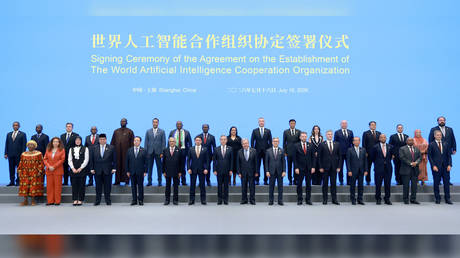
Diplomats love a good photo op. They love treaties. They love standing at polished podiums, speaking in hushed, urgent tones about "shared humanity" and the "common destiny of mankind."
When political leaders call for global cooperation on artificial intelligence and warn against the dangers of a single nation dominating the field, the foreign policy establishment nods in unison. The media writes breathless editorials about the need for a global regulatory framework. Meanwhile, you can find similar events here: Why China Will Never Win the AI War.
It is a beautiful, highly coordinated piece of theater. It is also a dangerous delusion.
The sudden push for global AI cooperation is not a noble quest for safety or equity. It is a calculated strategic play by nations lagging in computing power, designed to slow down the leaders. Calling for multilateral AI governance is the geopolitical equivalent of a runner who tripped at the starting line asking everyone else to jog backward so they can catch up. To understand the full picture, check out the excellent report by Wired.
We need to stop buying into this sanitized consensus. The idea of global, cooperative AI governance is a technical impossibility, a national security hazard, and a fundamental misunderstanding of how technology actually scales.
The Strategic Playbook of the Lagging Superpower
When a country is winning a technology race, it builds. When it is losing, it negotiates.
Look at the chess board. The United States and its allies hold a massive lead in the physical infrastructure of modern AI. They control the advanced semiconductor supply chain, the lithography machines, the cloud data centers, and the foundational software architectures.
If you are a rival state cut off from advanced hardware by export controls, your options are limited:
- You can try to smuggle chips.
- You can spend billions trying to replicate proprietary lithography processes.
- Or, you can launch a diplomatic offensive to neutralize your opponent's advantage.
The third option is by far the cheapest. By framing AI as a "global public good" that must be governed by consensus, lagging powers attempt to establish international bodies where they hold veto power. If you can convince your competitor to submit their development pipelines to a UN-style committee, you have successfully neutralized their speed advantage without firing a single shot or building a single fab.
I have spent years advising national security officials and tech executives on supply chain resilience. I have watched this exact playbook play out in cybersecurity, telecommunications, and satellite tech. The playbook never changes. The country that cannot build the technology demands a global vote on how it is used.
The Math of Unverifiable Treaties
The biggest flaw in the "global cooperation" narrative is the assumption that AI can be regulated like nuclear weapons or chemical agents.
The global non-proliferation framework worked because nuclear weapons are incredibly hard to hide. You need massive enrichment facilities, highly visible cooling towers, and specialized centrifuges. Satellites can spot them. Inspectors can verify them.
AI does not work this way.
An advanced model is just weights—millions of floating-point numbers. Once trained, a frontier model can fit on an array of commercial hard drives. It can be transmitted across the internet in minutes. It can be run on distributed consumer hardware or hidden in deep, subterranean data centers that look indistinguishable from mundane commercial server farms.
How do you verify an AI treaty?
To prove a nation is not training a dual-use military model, you would need absolute, unfettered access to their domestic computing infrastructure. You would need international inspectors monitoring every server, every source code repository, and every training run in real time.
No sovereign state will ever agree to that level of domestic surveillance.
Nuclear Proliferation VS. AI Proliferation
+---------------------------+---------------------------+
| Nuclear Infrastructure    | AI Infrastructure         |
+---------------------------+---------------------------+
| Physical, massive scale   | Digital, easily hidden    |
| Unmistakable signatures   | Indistinguishable servers |
| Highly central supply     | Decentralized compute     |
| Verifiable via satellite  | Unverifiable without      |
|                           | absolute access to code   |
+---------------------------+---------------------------+
Any treaty signed under the guise of "global cooperation" would be fundamentally unverifiable. The democracies of the world would comply because they operate under rule of law and public scrutiny. Autocratic regimes would pay lip service to the treaty, sign the papers, and continue training advanced military models behind closed doors.
Cooperation in this context is not a path to safety. It is a path to unilateral disarmament.
The Threat of the Lowest Common Denominator
What does "global governance" actually look like in practice? It looks like the United Nations. It looks like endless committees, bureaucratic gridlock, and compromises that cater to the most restrictive regimes on earth.
If we establish a global body to dictate AI safety standards, that body must include nations that view information control as a matter of regime survival.
To them, an AI that answers questions truthfully about history, human rights, or state corruption is an existential threat. They will demand that global AI safety standards include "social stability" clauses. They will insist that models be hardcoded to respect state-sanctioned narratives.
By inviting autocracies to co-author the rules of AI, we are not making the technology safer. We are exporting authoritarian censorship standards to the global stage under the brand of "responsible AI."
We have already seen early signs of this. International bodies routinely issue draft guidelines suggesting that AI systems must "adhere to core socialist values" or "preserve social harmony." This is not safety. It is state-mandated bias masquerading as ethics.
The Cold Truth: Dominance is Safer Than a Multipolar Race
The conventional wisdom says that a single nation dominating AI is a nightmare scenario. The opposite is true.
A multipolar AI race, where no single power has a decisive lead, is incredibly dangerous. When two or three ideological rivals are neck-and-neck, safety is the first thing they throw out the window. If you believe your adversary is about to deploy a strategic AI capability, you cannot afford to spend six months testing your model for alignment, bias, or safety vulnerabilities. You ship it.
This is basic game theory. A tight race incentivizes reckless deployment.
                  [ The AI Race Game Theory ]

                   Adversary Cooperates     Adversary Defects
                  +----------------------+----------------------+
                  |                      |                      |
  You Cooperate   | Safe, slow progress  | You lose the tech    |
  (Focus Safety)  | (High mutual trust)  | hegemony entirely    |
                  |                      |                      |
                  +----------------------+----------------------+
                  |                      |                      |
    You Defect    | You win hegemony;    | Reckless race,       |
  (Skip Safety)   | adversary is left    | catastrophic risk    |
                  | behind               | (The default state)  |
                  +----------------------+----------------------+
Conversely, when one block holds a decisive, unassailable lead, the pressure cooker cools down. The leader can afford to slow down, invest in deep safety research, implement rigorous red-teaming, and set high standards for deployment.
A democratic, open alliance dominating the compute supply chain is the only realistic way to enforce global safety standards.
If the democratic West dominates the underlying technology, it can set the terms of use globally. Not through useless treaties, but through market access, cloud computing export controls, and API access restrictions. We do not need a UN resolution to make AI safe; we need to build the best, most secure systems first, and then control who gets the keys to the hardware.
Stop Trying to Regulate the Algorithm (Do This Instead)
Policymakers are wasting their time trying to regulate software, algorithms, and model weights. You cannot regulate math.
If we want a realistic strategy for AI security, we must focus on the physical world.
1. Control the Physical Chokepoints
Do not try to audit code. Audit the silicon.
There are only a handful of facilities on earth capable of manufacturing the extreme ultraviolet (EUV) lithography systems required to build advanced AI chips. There are only a few advanced fabrication plants that can run them.
Instead of drafting vague international treaties about AI alignment, democracies must solidify their control over these physical chokepoints. This means aggressive export controls, heavy investments in domestic semiconductor manufacturing, and tight security around chip design IP.
2. Implement Compute Tracking
Every high-performance GPU has a physical identity.
We need an international registry for advanced compute clusters, similar to how we track nuclear material or aviation assets. If a nation or an enterprise starts pooling tens of thousands of state-of-the-art chips, that cluster must be visible.
You do not need to read the code they are running. You just need to know who has the raw compute power to train a frontier model. If they refuse to register their compute, they should be cut off from the global supply chain of replacement parts, software updates, and developer talent.
3. Build Sovereign Safety Infrastructure
Instead of relying on commercial labs or international committees to verify model safety, governments must build national AI evaluation facilities.
These should be highly secure, air-gapped government labs staffed by elite technical talent. When a company or a research institute develops a model that crosses a specific training compute threshold, that model must undergo rigorous black-box testing in a sovereign facility before it can be deployed on public networks.
The rhetoric of global cooperation is a soothing lullaby. It allows politicians to pretend they are solving complex problems while avoiding the hard, uncomfortable realities of geopolitical competition.
AI is not a collaborative global project. It is a dual-use, strategic capability that will determine the global balance of power for the next century.
The nations that value individual liberty, free expression, and the rule of law cannot afford to compromise their technological lead in exchange for a toothless treaty. We do not need a seat at a global committee designed to slow us down. We need to build, secure our infrastructure, and win the race.