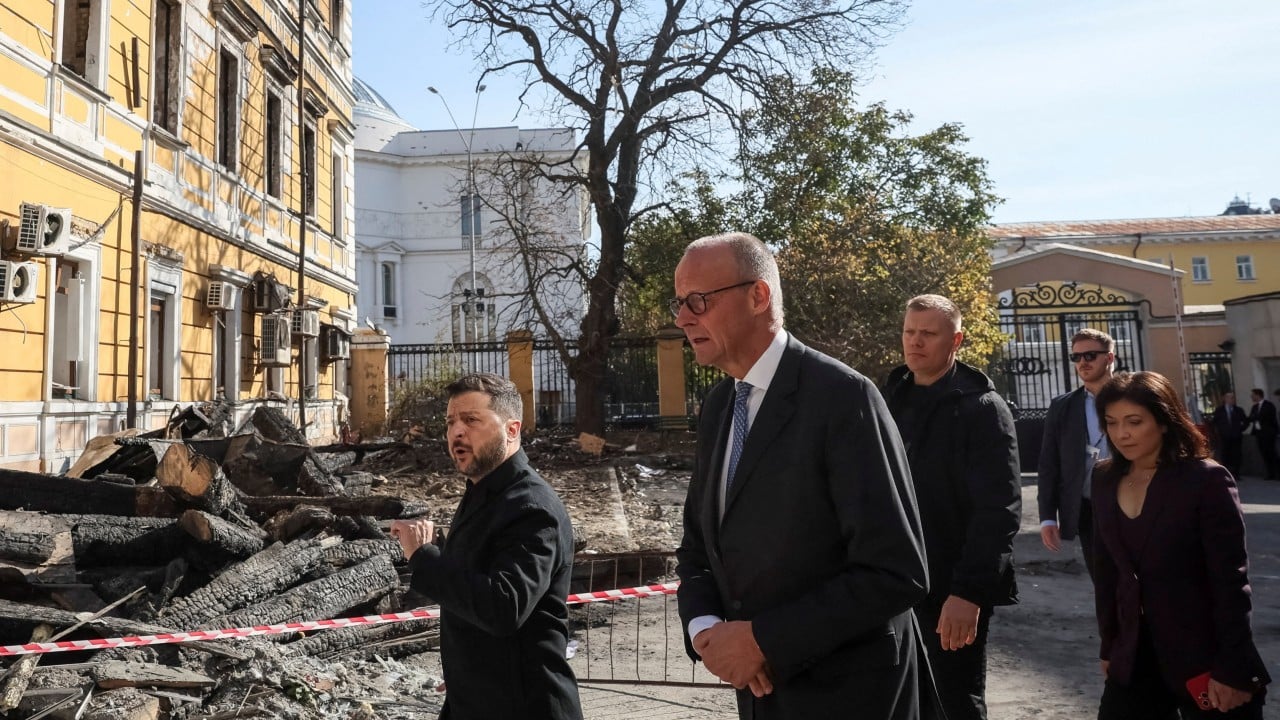
Every time a Western leader steps off a night train in Kyiv to the sound of air raid sirens, cable news anchors treat it like a Churchillian triumph.
They are wrong. You are watching expensive political theater that actively degrades the exact defense network it claims to celebrate.
When German Chancellor Friedrich Merz arrived in Kyiv while Russian missiles slammed into the capital, the mainstream press immediately reached for its favorite worn-out script. The narrative is predictable. Moscow tried to intimidate Berlin. Berlin refused to blink. Solidarity wins the day.
That is the lazy consensus of foreign policy commentators who have never had to allocate a finite stockpile of surface-to-air interceptors across a thousand-kilometer front. In reality, high-profile diplomatic pilgrimages during active ballistic campaigns do not deter the Kremlin. They hand Russian targeteers a predictable operational schedule, force Ukrainian air defense commanders to cannibalize frontline coverage to protect a temporary VIP bubble, and substitute cheap photo-ops for the industrial scale of weaponry Kyiv actually needs to survive.
If you want to understand why this war remains locked in a brutal war of attrition, stop looking at the handshakes on Bankova Street and start looking at the math of interceptor burn rates.
The Myth of the Diplomatic Shield
Mainstream reporting treats a Russian strike during a foreign leader's visit as an act of reckless escalation or desperate signaling. This fundamentally misunderstands how Russian targeting cycles and Western intelligence protocols work.
First, Moscow almost always knows when a major European leader is traveling to Ukraine. Deconfliction channels—quiet backchannels maintained between Washington, major European capitals, and Moscow—exist precisely to prevent the accidental assassination of a NATO head of state, which would trigger an immediate, uncontrollable spiral toward direct military confrontation. Even when specific itineraries are kept tight, the logistical footprint of a visiting chancellor—extra electronic warfare sweeps, heightened intelligence, surveillance, and reconnaissance (ISR) flights over eastern Poland, and sudden shifts in Ukrainian air defense readiness—lights up Russian signals intelligence like a flare.
Second, Russia does not launch multi-million-dollar Iskander-M ballistic missiles or Kinzhal hypersonic weapons merely to photobomb a press conference. Strike packages take days or weeks of intelligence gathering, flight-path programming, and bomber coordination to assemble. When a strike coincides with a visit from Berlin, it is rarely a spontaneous tantrum. More often, Moscow accelerates a pre-planned package to exploit a specific operational vulnerability created by the visit itself.
What is that vulnerability? Concentrated air defense.
Ukraine operates one of the most complex, overworked, and geographically stretched integrated air defense systems (IADS) in modern military history. When a VIP of Friedrich Merz’s stature enters Kyiv, Ukrainian commanders cannot afford even a one-percent chance of a stray missile hitting near the diplomatic quarter. To guarantee absolute protection, batteries—including scarce Western systems like the German-supplied IRIS-T SLM and American-made Patriot systems—must be locked into high-alert point-defense postures around the capital.
Every Patriot PAC-3 MSE interceptor fired to protect a four-hour diplomatic summit in central Kyiv is an interceptor that cannot defend a thermal power plant in Kharkiv, a substation in Odesa, or a mechanized brigade holding the line in Donetsk.
I have watched defense planners burn through millions of dollars in high-end munitions over a single weekend just to maintain a zero-casualty perimeter for visiting politicians who leave on the Sunday night train. The politicians fly back to safe capitals with dramatic footage for their domestic evening news. The local commanders are left staring at empty launch tubes and a looming deficit that will take European defense contractors eighteen months to backfill.
Why Friedrich Merz’s Visit Exposes Berlin’s Core Contradiction
To grasp the deeper irony of Merz’s arrival under fire, you have to look beyond the sirens and examine the structural reality of German defense policy.
For years, Germany’s political establishment has tried to square an impossible circle. Berlin wants the moral authority of being Europe’s indispensable defender of Ukraine without accepting the economic and political pain of shifting onto a genuine wartime industrial footing.
Under the previous administration, this manifested as endless hesitation over heavy armor and long-range strike capabilities—specifically the Taurus KEPD 350 cruise missile. Merz campaigned heavily on breaking that paralysis, positioning himself as a decisive Atlanticist willing to project hard power and give Ukraine what it needs to strike Russian logistics deep behind the lines.
Yet showing up in Kyiv during a bombardment highlights the exact gap between political rhetoric and industrial reality.
Consider the numbers. According to data tracked by the Kiel Institute for the World Economy, Germany has consistently ranked as Ukraine’s second-largest bilateral military donor in absolute terms, committing tens of billions of euros in aid, including vital air defense systems like Patriot batteries, IRIS-T units, and Gepard self-propelled anti-aircraft guns. On paper, Berlin looks like a powerhouse.
On the battlefield, those numbers collide with production bottlenecks. European munitions manufacturing cannot match Russian output, let alone the combined surge capacity of Moscow and its suppliers in Pyongyang and Tehran. While European defense firms like Rheinmetall and Diehl Defence have expanded assembly lines, lead times for complex air defense interceptors still stretch into years, not weeks.
When a German Chancellor stands in Kyiv while Russian missiles rain down, the visual message is supposed to be strength. The actual operational message is dependence. It underscores that after years of full-scale war, Ukraine’s capital still relies on thin, fragile rings of Western-donated air defenses that can be saturated by massed Russian drone and missile salvos.
Imagine a scenario where Berlin canceled every planned VIP trip to Kyiv for the next twelve months and redirected the security, diplomatic, and logistical bandwidth—alongside an emergency diversion of Bundeswehr active-duty stockpiles—directly into hardening Ukraine’s energy grid and delivering long-range strike packages. No television cameras. No dramatic press briefings in underground bunkers. Just cold, unglamorous industrial throughput.
That would terrify the Kremlin far more than a chancellor wearing a flak jacket for forty-eight hours.
Answering the Wrong Questions About Kyiv Strikes
Whenever missiles hit Kyiv during a high-profile visit, public debate immediately gets bogged down in surface-level questions that miss the strategic plot entirely.
Did Russia target Friedrich Merz directly?
Almost certainly not. Assassinating a sitting German Chancellor would instantly shatter the political deadlock in Berlin, trigger emergency consultations across NATO, and force a military response that Moscow has spent years carefully calibrating its escalations to avoid. Russia’s objective is to demonstrate reach and impunity—to prove to the German public watching at home that Russia can strike within kilometers of their leader at will, and that their government’s billions in military aid have failed to secure Ukrainian airspace. It is psychological warfare aimed at European taxpayers, not an assassination attempt.
Do high-profile visits actually unlock more weapons for Ukraine?
Historically, the correlation is weak at best and backwards at worst. Major shifts in Western weapons deliveries—whether HIMARS, Leopard 2 tanks, or F-16 fighter jets—did not happen because a Western leader heard an air raid siren in Kyiv. They happened after months of behind-the-scenes bureaucratic warfare, shifts in domestic polling, and agonizing calculations over escalation thresholds in Washington and Berlin. In fact, dramatic visits often serve as a political pressure release valve. Leaders use the optics of personal bravery to deflect criticism over slow delivery schedules and restrictive rules of engagement.
Isn’t solidarity essential for Ukrainian morale?
Ukrainian morale is not sustained by foreign politicians visiting central Kyiv. It is sustained by whether families in Dnipro and Zaporizhzhia have electricity through the winter, whether infantry units at the front have enough 155mm artillery shells to stop human-wave assaults, and whether injured soldiers have access to rapid medical evacuation. Ask a Ukrainian air defense operator manning a mobile fire group at three in the morning whether he prefers a press conference from a European chancellor or two hundred additional infrared-guided missiles. You already know the answer.
The Cost-Exchange Trap Nobody Wants to Admit
To understand why Russia keeps launching these strikes—and why Western commentary keeps misreading them—you have to look at cost-exchange ratios, the single most ruthless metric in modern warfare.
Air defense is inherently asymmetrical. The attacker chooses the time, the axis of approach, and the density of the strike. The defender must be ready everywhere, all the time.
Russia routinely pairs cheap, one-way attack drones like the Shahed-136 (and its domestically produced Geran variants), which cost tens of thousands of dollars to manufacture, with expensive ballistic and cruise missiles like the Kh-101 or Iskander-M. The drones act as sponges. They force Ukrainian radar operators to illuminate their positions, reveal their locations, and expend scarce interceptors. Once the lower-tier defenses are saturated or reloading, the ballistic missiles dive in at terminal speeds exceeding Mach 5.
Intercepting a single ballistic missile typically requires firing two Patriot interceptors to ensure a high probability of kill. Each PAC-3 missile costs roughly four million dollars.
Do the math. Even when Ukraine achieves a ninety-percent interception rate—a number Western media routinely celebrates as an unmitigated victory—Kyiv is often losing the economic war of attrition. Firing eight million dollars worth of irreplaceable American or European interceptors to shoot down a single Russian missile that Moscow can replace faster than the West can replace the interceptors is not a sustainable strategy. It is a slow bleed.
High-profile diplomatic visits worsen this asymmetry. Because the political cost of a single missile getting through during a VIP visit is catastrophic, commanders are forced to abandon economical engagement doctrines. They cannot let a marginal threat pass toward an empty field or risk relying on lower-tier electronic warfare jamming. They have to throw the most expensive, highest-probability interceptors in the inventory at anything entering the sector.
Moscow understands this math coldly. Every time Russia launches a modest strike package during a European summit in Kyiv, it forces Ukraine to burn top-shelf Western munitions at a terrible exchange rate while generating free propaganda for Russian state television showing Western leaders scrambling into basements.
The Counter-Intuitive Fix: Stop Defending the Sky and Start Burning the Launchers
If the status quo—celebrating diplomatic bravery while bleeding scarce air defense interceptors—is a losing game, what is the alternative?
To give credit where it is due, military strategists like Lawrence Freedman and analysts at the Royal United Services Institute (RUSI) have spent years hammering on a fundamental truth of air power: you cannot win a war strictly from the defensive. Trying to shoot down every arrow while leaving the archer untouched is military malpractice.
Yet that is precisely what Western policy has forced Ukraine to do for much of the conflict. By drip-feeding air defense systems while imposing agonizing delays and geographic restrictions on long-range strike weapons, Germany and its allies turned Kyiv into a passive target range.
If Merz and his European counterparts want to permanently stop Russian missiles from disrupting their visits to Kyiv, they need to invert the entire paradigm of Western support. Instead of obsessing over point-defense shields for the capital, Berlin must focus on three ruthless priorities:
- Unrestricted Deep-Strike Capability. Remove every political restriction on long-range cruise missiles, including Germany’s Taurus system, and pair them with real-time Western targeting intelligence. The cheapest way to stop an Iskander missile or a Tu-95 strategic bomber is not with a four-million-dollar interceptor over Kyiv; it is by destroying the airbase, fuel depot, or assembly facility three hundred kilometers inside Russian territory before the weapon ever leaves the ground.
- Shift from Boutique Systems to Mass-Produced Attrition. European defense procurement is addicted to exquisite, gold-plated weapons systems that take years to build in tiny batches. Berlin needs to subsidize rapid, mass-scale production of low-cost counter-UAS (unmanned aerial system) technologies—radar-guided autocannons, interceptor drones, and high-power microwave systems—that can swat down Shahed swarms for pennies on the dollar, preserving Patriot and IRIS-T batteries strictly for high-end ballistic threats.
- Move Summits Out of the Crosshairs. Stop staging predictable, multi-day diplomatic pageants in the center of a city under active ballistic threat. Conduct high-level bilateral meetings in hardened facilities near the Polish border or in Lviv, where integrated NATO border air defenses and shorter logistical tails minimize the operational drain on Ukraine’s battered air defense network.
The Honest Downside of Cutting the Theater
There is a legitimate counterargument to dismantling the VIP visit circus, and ignoring it would be intellectually dishonest.
In democratic alliances, political will is an operational resource. Without dramatic visuals—without European leaders walking through bombed-out neighborhoods and standing beside Ukrainian officials during air raids—public attention in Berlin, Paris, and Washington rapidly drifts toward domestic inflation, migration, and energy costs.
Politicians like Friedrich Merz do not travel to Kyiv solely out of vanity. They go because democratic voters need visceral reminders that a brutal land war is raging on Europe’s doorstep. If Western leaders retreat to quiet border bunkers and treat the war purely as an accounting exercise, the political consensus required to pass multi-billion-euro aid packages could erode even faster.
That is the real tension at the heart of Western statecraft. Optics buy political capital at home, even as they impose operational costs on the battlefield.
The mistake is confusing the optics with the objective. A diplomatic visit is a fundraising tool, not a military victory. Treating Merz’s arrival under Russian fire as proof that Moscow is losing—or that solidarity alone can blunt ballistic missiles—breeds dangerous complacency in Western capitals.
Drop the Applause
The next time a European leader steps off a train in Kyiv while air raid sirens wail across the city, turn down the volume on the pundits praising their courage.
Courage is not taking a guarded armored convoy into a capital protected by the densest ring of Western air defenses in Eastern Europe for forty-eight hours. Courage is forcing an unwilling German industrial base onto a wartime footing. Courage is signing off on deep-strike weapons despite Russian nuclear saber-rattling. Courage is accepting the domestic political heat of higher defense spending today so Ukrainian cities do not have to beg for interceptors tomorrow.
Until Berlin and its allies measure their support in destroyed Russian launch sites rather than dramatic photographs from Kyiv’s train station, the missiles will keep falling—no matter who is in town to hear the sirens.