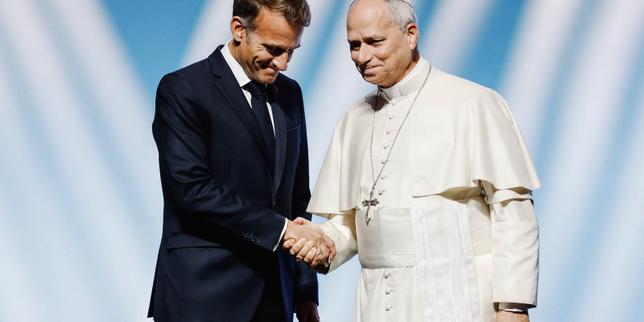
The rain in Metz does not merely fall; it lingers. It settles into the porous sandstone of the cathedral, darkening the ancient carvings until the saints and gargoyles look like they are sweating history. On a Tuesday that smelled of wet asphalt and wet wool, thousands gathered beneath a canopy of black umbrellas, waiting.
They were not waiting for a politician bearing promises of lower taxes or a general rattling a sabre. They were waiting for a man in white, standing in a city that has changed nationalities four times in a century, to speak about a world that feels increasingly unmoored.
When Pope Léon XIV stepped up to deliver his second major address on French soil, the murmur of the crowd died instantly. Not out of fear, but out of that rare, desperate hunger for a sentence that actually means something.
Consider the weight of the geography. Metz is a hinge of Europe. German spoken softly in the cafés fifty years ago; French dominant today; the scars of the Franco-Prussian War and two world wars etched into the municipal architecture. It is a place that understands borders are fiction, but grief is real.
The speaker knew this. He did not lean on theological abstractions. Instead, he spoke of memory.
"We are building towers to outrun our own reflections," he said, his voice carrying effortlessly across the Place d'Armes, dry and crisp despite the humidity. "Yet we are starving for a hearth."
It was a striking pivot from his first address in Paris, which had crackled with the electric, defensive energy of a capital city trying to protect its cultural museum-piece status. Here, in the industrial shadow of the Moselle, the tone softened into something closer to an elegy. He talked about the loneliness of hyper-connectivity. He talked about the quiet violence of a society that measures human worth in output.
A woman standing near the front—let us call her Martine, because a hundred Martines were there with shopping trolleys and rosary beads in their pockets—tightened her grip on her umbrella handle. She told me later, her eyes sharp with the skepticism of someone who has lived through three factory closures and a divorce, "He isn't talking to the bishops. He's talking to my kitchen table."
That is the paradox of Léon XIV. A global figure wielding an ancient title, yet speaking with the granular intimacy of a neighborhood priest who knows who is drinking too much and who hasn't spoken to their daughter in three years.
The speech itself was anchored by stark, unromanticized observations. He noted how Europe has grown old—not just demographically, with its graying census data and hollowed-out villages, but spiritually old. Tired of crises. Exhausted by the endless cycle of outrage that flashes across smartphone screens before breakfast and is forgotten by lunch.
He offered no easy policy prescriptions. He did not hand down an encyclical on economic reform or migration quotas. Instead, he did something far more dangerous: he asked why we are so eager to let algorithms dictate our capacity for mercy.
"Memory is not a museum," he warned. "It is a root."
The crowd shifted. A child laughed somewhere behind a row of riot police whose helmets seemed absurdly heavy against the damp autumn air.
What makes these French addresses significant is not the diplomatic theater of Vatican-Elysée relations, though the handshakes behind closed doors were no doubt fraught with the usual bureaucratic dance. The real story is happening in the pews, and more importantly, outside them. France is a nation fiercely, almost violently, secular. Its laïcité is a sacred civic religion, guarding the public square against the intrusion of faith like a medieval moat.
Yet here they were. Hundreds of thousands of secular citizens, agnostics, lapsed Catholics, and the curious young standing shoulder-to-shoulder in the rain, not to worship, but to listen. Why? Because when the secular narrative runs out of answers—when the promise of endless material progress hits the brick wall of climate anxiety, economic precarity, and digital alienation—people look for elders. Real elders. Not influencers with ring lights, but figures who stand outside the churn of quarterly earnings and election cycles.
The second address in Metz was a masterclass in reading the room. Léon XIV did not scold France for abandoning its Catholic heritage. He validated its search for meaning in the ruins of that heritage. He treated the French skepticism not as a sin, but as an honest wound.
As the speech concluded, the bells of Saint-Étienne did not ring out immediately. There was a beat of absolute silence—that rare, heavy silence that only happens when thousands of people hold their breath simultaneously.
Then came the applause. It did not roar; it rolled. It sounded like surf hitting a gravel beach.
The Pope stepped back from the microphone, his white robes catching the slate-gray light of the Lorraine sky. He bowed his head, not in triumph, but in acknowledgment of the storm—both meteorological and metaphorical—that everyone present had to walk back out into.
Martine adjusted her shopping bag, folded her umbrella, and began the long walk toward the bus stop. The rain was easing now, leaving behind the smell of wet stone and coal smoke. Nothing had changed, strictly speaking. The factories were still quiet. The politicians in Paris were still plotting their next crisis. The screens in our pockets were still glowing in the dark.
And yet, as the crowd dispersed into the side streets of Metz, the city felt a fraction of an inch heavier, grounded by a handful of words that refused to evaporate in the damp air.


