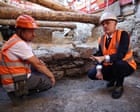
You can hear the city breathing if you press your ear hard enough against the asphalt.
Above, a Vespa screams past, its exhaust cutting through the sharp autumn air of the Left Bank. Sirens wail in the distance, a familiar urban symphony. Tourists cluster near a zinc-topped café counter, arguing good-naturedly over the price of an espresso. Paris moves with its customary, relentless velocity. It is a city of glass, iron, and light, built on the assumption that tomorrow is simply a shinier version of today.
But down there, beneath the hum of the subway cables and the subterranean rivers of sewage and cable lines, time has stopped.
In a damp, suffocating trench carved out of the earth during routine utility work, a trowel scrapes against something stubborn. It is not modern concrete. It is not nineteenth-century Haussmannian stone. It is a jagged, silent spine of rock, stacked with a deliberate, brutal human geometry.
An ancient wall.
For decades, history books have offered a tidy, comfortable script about the origins of the French capital. We learned of Lutetia, the modest Roman outpost planted on the Île de la Cité, rising orderly from the marshlands after Julius Caesar’s legions marched through. We learned to picture toga-clad administrators drawing up blueprints, imposing Mediterranean symmetry upon the untamed banks of the Seine. It was a story written by conquerors, neatly bound and easy to teach.
This wall whispers a different story. A wilder, older one.
Consider what life looked like here long before the first Roman sandal pressed into the mud. Imagine a hypothetical dawn two thousand and some odd years ago, long before stone was hauled into place. Let us call her Vella, though her name was lost to the wind before Latin was even a dialect. She wakes before the sun clears the damp fog clinging to the river reeds. Her bones ache from a dampness that never quite leaves the skin. Around her, a dozen roundhouses made of wattle and mud shelter her kin. They are the Parisii, a Celtic tribe who look out across the broad, grey expanse of the Seine not with romantic admiration, but with a cautious, tactical eye.
They know the river gives, and the river takes. They know that strangers come from the south with iron swords and burning ambition.
To survive, they must mark their territory. They must draw a line in the earth.
Vella and her people do not think of themselves as ancient history. They do not know that thousands of years later, people encased in glass boxes rolling on rubber wheels will speed above their heads. They only know the immediate, grinding weight of labor. They haul limestone blocks from the nearby quarries, wedging them together with wet clay and raw muscle. They stack them high, creating a sturdy rampart designed to keep the floodwaters at bay, or perhaps to ward off raiders peering through the tree line.
They build because they intend to stay.
When modern archaeologists uncover fragments of this forgotten barricade, they are not merely dusting off old relics. They are unearthing the stubborn anchor of human permanence. This newly analyzed wall, buried deep within the urban strata, shifts the foundational timeline of human settlement in the Paris basin. It suggests that the footprint of civilization here is older, denser, and far more indigenous than the Roman narrative allowed. The conquerors did not build upon an empty slate; they built upon a bruised, resilient, pre-existing home.
To understand why this matters, you have to look at how we treat our own origins. We prefer our history clean. We like museums with polished glass cases, track lighting, and climate-controlled air. We want our ancestors to feel distant, museum-bound, and neatly categorized.
Yet, standing at the edge of an archaeological excavation pit, the illusion shatters.
The air smells of wet earth, iron, and ancient decay. The walls of the trench display strata of human occupation like the rings of a scarred tree. Here is a layer of twentieth-century rubble from a blown-out water main. Just beneath it lies medieval refuse, discarded bones, and broken pottery shards. Deeper still, the Roman tiles. And beneath that—silent, dark, and undeniable—the rough-hewn stones of the pre-Roman era.
Each layer is a generation of human beings who thought their world was the final, definitive version of reality. They paid their taxes, worried about the harvest, loved their children, and buried their dead, completely unaware that centuries later, a modern excavator would rip open their floorboards to lay fiber-optic cables.
There is a profound humility in watching an archaeologist work in such conditions. Dr. Hélène Mercier, a fictionalized composite of the tireless specialists who spend decades in these subterranean trenches, kneels in the muck with a soft-bristled brush. Her fingers are stained with dark Parisian silt. She does not look like a movie scientist. She looks like a detective working a cold case where the victim has been dead for millennia.
"People ask me why we get excited over a pile of old rocks," she says, wiping sweat and dirt from her forehead. "They think it is just archaeology. But it is not. It is an argument against erasure. Every time we find a wall like this, we are proving that the people who lived here before us were real. They weren't just footnotes in a textbook. They stood right where we are standing, worried about the same rising waters, and left their mark against the void."
The discovery of this wall forces a quiet reckoning with how cities evolve. Paris is often marketed as an eternal postcard—a timeless dreamscape of romantic promenades, haute couture, and intellectual cafes. But cities are not born; they are accretions. They are built on top of ghosts. Every square meter of pavement is a graveyard of discarded ambitions, forgotten languages, and lost architectural dreams.
When the news of the wall breaks, the public reaction is predictable yet fascinating. Social media feeds fill with hurried photographs of the trench, juxtaposed with vintage engravings of nineteenth-century Paris. Commentators use grand words to describe the find. Yet, standing on the street level above the site, none of that intellectual abstraction matters.
A delivery driver leans against his scooter, staring down into the illuminated pit where the floodlights cast long shadows across the ancient stones. He does not pull out a history book. He simply watches in silence for a long, unbroken minute. You can see the gears turning behind his eyes. He is realizing, perhaps for the first time, that the street he navigates every day is perched precariously over an abyss of forgotten time.
That realization is the true value of these discoveries. They puncture the claustrophobia of the present moment. We live in an era obsessed with the immediate, where every news cycle feels like the end of the world, and every technological shift is hailed as an unprecedented epoch. We imagine that our current struggles, our concrete towers, and our digital networks are uniquely complex.
Then a backhoe hits a wall built two thousand years ago by people who did not even have iron nails, and we remember our place in the queue.
The technical analysis of the stones reveals fascinating details. Mineral signatures point to local quarries long since paved over. Tool marks left by bronze chisels show the precise angle of a worker's stroke, a muscular twitch frozen in stone. Soil samples trapped between the masonry reveal the pollen of ancient weeds, long-extinct varieties of grasses that once grew wild on the banks of a much wider, more untamed river.
Science can measure the density of the mortar and carbon-date the organic matter trapped within the sediment. But science cannot fully capture the emotional resonance of the moment the stone is first exposed to light after twenty centuries of absolute darkness.
There is an eerie intimacy to it. Imagine the last person who touched that stone before it was buried by rising silt and forgotten generations. Did they know their work would survive them? Did they worry about the future, or were they simply trying to keep their feet dry through the winter rains?
We will never know their name. Vella, or whoever stacked that particular block of limestone, vanished from the memory of humanity long before written records took root in this valley. Yet, here their labor stands, mocking our modern obsession with permanence. Our digital files corrupt; our plastic packaging clogs the oceans; our steel structures rust and collapse. But a wall built of rough river stone and clay outlasts empires, revolutions, and the rise and fall of digital kingdoms.
As the afternoon light fades above the excavation site, the streetlamps of Paris flicker to life, casting a warm, golden glow across the Haussmannian facades. The evening rush hour begins its steady, rhythmic roar. Commuters flood down the stairwells of the metro, their eyes fixed on glowing smartphone screens, stepping right past the plywood barriers protecting the trench below.
Down in the dark, the ancient wall stands untouched by the noise. The dust settles back into the crevices of the stone. The river continues its ancient, indifferent crawl toward the sea.
We build our towers out of glass and light, convinced we are writing the final chapter. But the earth beneath us holds its breath, waiting for the day our own descendants dig deep enough to ask who we used to be.