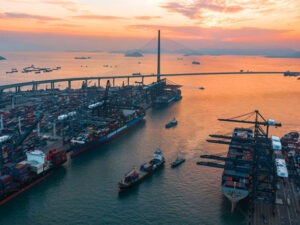
The air inside a shipyard doesn't smell like the ocean. It smells of ozone, burnt sugar from the welding arcs, and the heavy, metallic tang of industrial primer. It is a place where abstract federal budgets take physical form. Here, the U.S. Navy isn’t a collection of grand strategies or geopolitical maneuvers; it is a series of hulls waiting for a name.
Right now, there is a quiet scramble happening behind the scenes of American manufacturing. It isn't about aircraft carriers that cost billions or submarines that disappear into the deep for months. This is about the "small" stuff. The workhorses. The Navy has put out a call for 474 new vessels, backed by a $650 million ceiling that represents more than just a contract. It represents the lifeblood of the coastal defense and the literal platform upon which thousands of sailors will stand. Recently making headlines in related news: The Brutal Truth Behind China Electric Vehicle Expansion Beyond European Tariff Walls.
Imagine a young petty officer—let's call him Miller—operating on the choppy, unpredictable waters of a busy port. Miller doesn’t care about the line items in a Congressional budget. He cares about the way his boat handles a four-foot swell when he is trying to intercept a suspicious craft. He cares if the deck is slick or if the engine coughs when he punches the throttle. To the Navy, these 474 boats are a procurement goal. To Miller, they are his entire world for twelve hours a shift.
The competition is fierce. The Navy isn't just looking for one company to build a fleet; they are looking for a stable of partners. This is a multi-award, firm-fixed-price deal. In the language of business, that means the risk is on the builder. In the language of the shipyard floor, it means you better get the welds right the first time because there is no safety net for inefficiency. Additional insights regarding the matter are detailed by Harvard Business Review.
The Bones of the Fleet
What are we actually building? The scope is staggering. The Navy needs everything from seven-meter rigid-hull inflatable boats (RHIBs) to much larger, specialized craft. These aren't the ships that make the evening news. They are the boats that ferry SEAL teams, conduct harbor security, and perform the thankless, essential tasks that keep a global maritime power functioning.
Think of a massive logistics chain. If a carrier is the heart, these small boats are the capillaries. They reach where the giants cannot. They navigate the shallow inlets, the crowded piers, and the treacherous surf zones. Without them, the heart eventually stops.
The $650 million pot is a signal. It says the Pentagon is shifting its gaze toward a more distributed, agile force. They need numbers. They need durability. Most importantly, they need a domestic industrial base that hasn't forgotten how to bend steel and mold fiberglass at scale.
But there is a tension here.
The American shipbuilding industry has been through the ringer. Supply chains are still brittle, and the skilled labor needed to weld these hulls isn't something you can find with a simple help-wanted ad. It takes years to train someone to the point where their work can withstand the relentless corrosion of salt spray and the physical pounding of the open sea.
The Invisible Stakes
When a contract this size hits the street, it creates a ripple effect far beyond the primary shipyards. It touches the small machine shop in Ohio that makes the cleats. It affects the electronics firm in Oregon designing the navigation consoles. It is a massive injection of capital into a specific kind of American craftsmanship.
Yet, we often talk about these numbers as if they are just data points. $650 million. 474 boats. We forget the human intuition required to win.
Consider a hypothetical CEO of a mid-sized boat builder in Alabama. She is looking at the RFP (Request for Proposal) and weighing the cost of aluminum against the scarcity of marine-grade engines. She knows that winning a slice of this contract means she can keep her crew employed for the next five years. It means her town stays viable. But she also knows that if her bid is too low, a single spike in material costs could sink her company.
This is the high-stakes poker game of military procurement. It is a balance of patriotic duty and cold-blooded accounting.
The Navy knows this, too. By opening this up as a competition rather than a single-source award, they are trying to spark a Darwinian evolution of design. They want the builders to push each other. They want a boat that is faster, lighter, and more resilient than the one it replaces. They are buying innovation by the crate.
The Reality of the Water
There is a specific kind of violence to the way a small boat moves through a high sea state. It isn't the slow, majestic roll of a destroyer. It is a sharp, bone-jarring slam.
Every one of those 474 boats must be built to survive that violence thousands of times over. If a weld fails in a spreadsheet, you change a cell. If a weld fails in the middle of a night intercept, people die.
This is why the competition is so rigorous. The Navy isn't just checking boxes; they are looking for a pedigree of reliability. They are looking for builders who understand that a "workboat" is a misnomer. These are tactical tools. They are the difference between a successful mission and a catastrophic failure in the dark.
The sheer volume of the order—nearly five hundred vessels—suggests a pivot in strategy. We are seeing a move away from "exquisite" platforms—those few, incredibly expensive ships that are too precious to risk—and toward a "loss-tolerant" fleet. If you have 400 boats, you can be bolder. You can be in more places at once. You can saturate an environment with presence.
The Cost of Silence
We don't often hear about these small boat contracts. They aren't as flashy as a new stealth bomber or a hypersonic missile. But ask any sailor what they used most during their deployment. It wasn't the cruise missiles. It was the boat that took them to the pier, the boat that guarded their flank, and the boat that pulled their buddy out of the water.
The $650 million is a down payment on that reality.
As the bids come in and the builders sharpen their pencils, the real work begins. It happens in the quiet hours of the morning when the first shift starts. It happens in the smell of the shop and the heat of the torch.
Behind every one of those 474 boats will be a story. A story of a welder who took pride in a perfect seam. A story of an engineer who stayed late to shave ten pounds off the hull weight. And eventually, the story of a sailor like Miller, who will push the throttle forward in a storm and feel the boat bite into the water, trusting his life to the craftsmanship of strangers.
The contract is signed. The steel is being ordered. The pulse of the shipyard quickens.
Somewhere, a sheet of metal is being cut that will one day carry a crew through a night they will never forget.