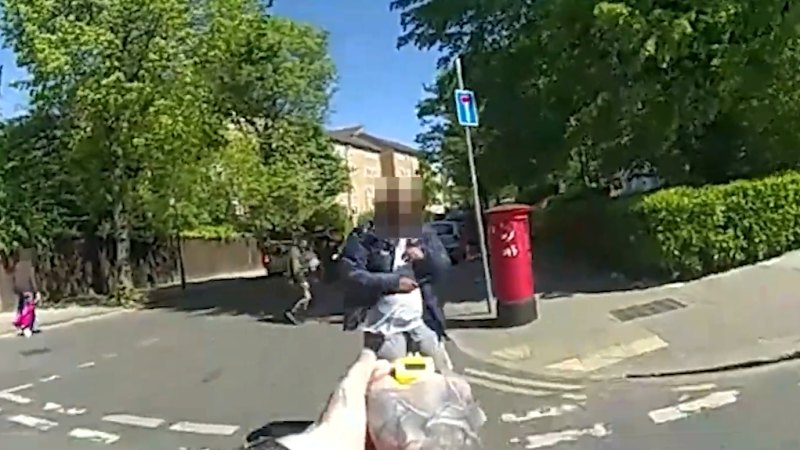
The lens of a police body camera is a strange, unblinking witness. It doesn’t feel the adrenaline that makes a constable’s fingers twitch near their belt, and it doesn’t experience the sudden, bone-chilling damp of a London afternoon. It simply records the grey sky, the red brick of suburban streets, and the moment a mundane Tuesday transforms into a frantic hunt for a shadow.
When the footage from the recent arrest in London begins, the first thing you notice isn't the suspect. It’s the sound. The heavy, rhythmic thud of boots hitting pavement. The distorted crackle of the radio—a frantic burst of coordinates and descriptions that sound like white noise to a civilian but serve as a heartbeat to the officers on the move. Somewhere in the sprawling labyrinth of the city, a man had allegedly wielded a blade, leaving a trail of terror behind him. Now, the hunters were closing in.
The Weight of the Vest
Imagine the physical burden of a Metropolitan Police officer. It isn't just the fifteen pounds of equipment—the radio, the handcuffs, the baton, the spray. It is the psychological weight of knowing that every corner turned could lead to a final confrontation. When they received the call about a stabbing suspect on the loose, the air didn’t just turn cold; it turned heavy.
The footage captures this tension through the shaky, handheld-style motion of the camera. We see the world through the officer’s chest. We see the steering wheel spinning as the van navigates tight corners, the blur of pedestrians who are blissfully unaware that a violent suspect might be walking among them. This is the invisible stake of urban policing: the thin, precarious line between a normal day and a tragedy that makes the evening news.
The suspect wasn't a monster from a movie. On the screen, he was just a figure. A man in a dark jacket, blending into the urban scenery with terrifying ease. That is the reality of modern crime. It doesn't always wear a mask. It looks like a neighbor. It looks like a passerby. It looks like someone you’d step aside for on the Tube.
The Point of No Return
The pursuit narrowed to a residential street. The architecture here is repetitive—symmetrical windows, small gardens, the occasional parked car. It is a setting designed for quiet lives, not for a high-stakes takedown.
Then, the visual shift happens. The officer exits the vehicle. The camera jars violently.
"Police! Stay where you are!"
The shout isn't polished. It isn't the practiced bark of a television actor. It is raw, strained by the physical exertion of the chase and the sudden spike of cortisol. The suspect doesn't flee immediately. There is a micro-second of stillness—a terrifying beat of silence where the world holds its breath. In that moment, the officer has to make a calculation that most of us won't make in a lifetime: Is he armed? Is he reaching? If I move, do I live?
The footage shows the suspect turning. The officers move with a synchronized, practiced aggression. This isn't about cruelty; it is about the physics of control. When a person is suspected of a violent stabbing, the objective is to remove their ability to cause further harm in the shortest amount of time possible.
The Geometry of an Arrest
The takedown is a mess of limbs and shouting. The camera view is obscured by the blue fabric of a uniform, then the asphalt of the road, then the sky. You hear the metallic click of handcuffs. It is the most definitive sound in the criminal justice system. It represents the transition from a threat to a prisoner.
On the ground, the suspect is no longer a looming shadow. He is a man pinned to the earth. The adrenaline begins to ebb, replaced by the grim, procedural reality of the aftermath. Officers check their own bodies for injuries they might not have felt in the heat of the struggle. They check the suspect. They begin the long, tedious process of turning a chaotic encounter into a legal record.
While the headlines will focus on the "arrest of a stabbing suspect," the footage tells a deeper story about the cost of public safety. It shows the exhaustion in the officers' breathing once the cuffs are on. It shows the way they look around at the houses nearby, perhaps wondering how many children were watching from behind the curtains.
The Invisible Scars
We often view these videos as a form of dark entertainment or a mere verification of facts. We see the "what" and the "where." But we rarely consider the "after."
For the victims of the initial stabbing, this footage offers a cold kind of justice. It is the sight of the person who shattered their world being brought to heel. Yet, the metal and glass of the bodycam can't capture the trauma that remains in the neighborhood. It can't record the way a mother will now grip her child’s hand a little tighter when walking down that same street. It doesn't show the nightmares of the officers who will go home, take off their vests, and try to eat dinner with their families as if they hadn't spent their afternoon wrestling with a man accused of bloodletting.
The static on the radio eventually fades. The vans drive away. The street returns to its quiet, red-brick stasis. But the footage remains—a digital scar of a moment when the safety we take for granted was briefly, violently suspended.
The lens stays clear, but the human element is forever blurred by the trauma of the encounter. As the screen goes black, the only thing left is the memory of those boots on the pavement, and the chilling realization of how close the chaos always is.