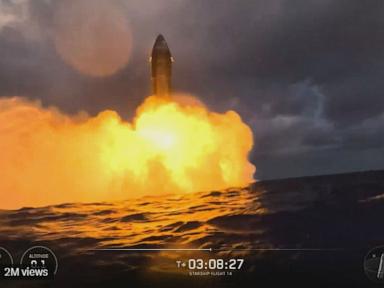
A massive fireball lights up the Texas sky. Debris rains down into the Gulf of Mexico. Millions of viewers watching the livestream groan, assuming another multi-billion-dollar rocket has turned into expensive scrap metal.
Mainland media outlets immediately rush to publish headlines about catastrophic failures and exploding rockets. They treat every fiery crash like a terminal diagnosis for humanity's ambitions on Mars. Meanwhile, you can find related stories here: Ro Khanna and the Impossible Math of Banning Recursive Artificial Intelligence.
They are completely missing the point.
SpaceX doesn't build rockets like traditional aerospace companies. They build them like software startups that happen to deal in liquid oxygen and methane. When a Starship prototype detonates over the ocean or tears apart during a pressure test, the engineers aren't crying in a boardroom. They are frantically downloading terabytes of telemetry data. To them, a pristine rocket sitting safely in a hangar is a rocket that didn't push hard enough to find its limits. To explore the full picture, check out the detailed analysis by ZDNet.
If you want to understand modern rocket science, you have to throw out everything you know about traditional corporate caution. Let's look at how blowing things up on purpose became the most efficient strategy in aerospace history.
The Death of the Waterfall Method
Old-school aerospace engineering relies on the waterfall method. You spend ten years drawing blueprints. You run millions of computer simulations. You build expensive mockups in sterile cleanrooms. Every single part is meticulously checked by dozens of committees before a single bolt is turned.
Then, when the rocket finally launches after a decade of delays, it better work on the first try. Because if it doesn't, Congress panics, budgets get slashed, and heads roll.
SpaceX looked at that multi-billion-dollar bureaucratic nightmare and threw it in the trash.
Instead, they adopted the iterative prototyping model used by software developers. Write code, ship it, watch it crash, fix the bug, ship it again. Translate that into physical hardware, and you get stainless steel rings welded together in a tent in Boca Chica, followed by rapid flight tests that often end in spectacular pyrotechnics.
It looks chaotic. It looks reckless to outsiders. But it is blindingly fast. While old space contractors spend five years debating a valve design, SpaceX builds three prototypes, blows two up on the pad, and learns more from a ten-minute flight than a traditional agency learns in a five-year study.
Why Destructive Testing Beats Computer Models
Computers lie. Well, not deliberately, but simulation software can only predict what engineers already know how to program. Navier-Stokes equations for fluid dynamics are notoriously difficult to solve at orbital speeds and extreme temperatures.
You can run CFD simulations until your servers melt. You still won't know how a weld holds up when cryogenic liquid methane slams against it under thirty Gs of vibration until you actually build the thing and push it until it snaps.
That is why a fiery end is so valuable. Every explosion provides an exact boundary condition. When a heat shield tile pops off at Mach four and triggers a cascading structural failure, engineers no longer have to guess what thermal protection threshold fails. They have empirical ground-truth data.
Think of it like crash testing cars. Safety regulators don't just trust computer models of sedans hitting concrete walls. They smash real cars into real walls at high speeds. They crush roofs, deploy airbags, and smash windshields until the metal yields. SpaceX treats every Starship test flight as a full-scale crash test in the upper atmosphere.
When a ship breaks apart, it draws a bright red line across the engineering margin. Everything to the left of that line is safe. Everything to the right requires thicker steel, better welds, or redesigned thermal blankets. You cannot buy that kind of clarity with computer code alone.
The Economics of Blowing Up Rockets
Critics love to talk about money. They point to every exploded Starship and scream about wasted taxpayer dollars or burning venture capital.
Here is the dirty secret they miss. SpaceX builds these vehicles out of inexpensive 301 stainless steel instead of exotic carbon composites or high-cost lithium-aluminum alloys. Stainless steel costs roughly a few dollars per pound. Carbon fiber costs a small fortune and takes months to autoclave into shape.
By choosing cheap, flexible, and heat-tolerant steel, SpaceX radically lowered the cost of failure. Building a replacement ring takes days, not years. If a test article goes up in flames, the financial loss is a rounding error compared to the hundreds of millions saved by skipping endless rounds of redundant bureaucratic reviews.
The traditional aerospace model spends a fortune trying to guarantee perfection on day one. The result is rockets that cost two billion dollars a pop and fly once every three years. SpaceX spends a fraction of that amount, builds cheap hardware rapidly, and learns from real-world physics instead of theoretical perfection.
By the time a Starship finally carries humans to the Moon or Mars, it will have survived dozens of intentional and unintentional stress tests that older rockets never faced on a drawing board.
Sorting Fact from Fiction in Flight Telemetry
When a mission ends in a fireball, the internet fills up with armchair rocket scientists blaming everything from bad software code to rogue wind shears.
Let's look at what actually happens behind the scenes when telemetry goes dark.
A modern Starship carries thousands of individual sensors tracking pressure, strain, temperature, vibration, and propellant flow. When an anomaly occurs, it happens in milliseconds. A tiny microcrack in a weld lets oxygen mix with methane near an engine bell. A localized fire ignites. Pressure sensors spike. Flight control computers try to compensate by throttling adjacent Raptor engines.
If the burn-through compromises primary wiring harnesses, telemetry drops out. Within seconds, aerodynamic forces tear the vehicle apart.
To an outside observer, it looks like a sudden, mysterious disaster. To the propulsion team staring at the high-frequency logs, the cascade is glaringly obvious. They can pinpoint the exact millisecond the first sensor anomaly registered. They can trace the pressure drop in the autogenous pressurization line. They can see whether a valve actuator hung up due to ice formation in cryogenic lines.
This level of granular feedback is impossible to gather in a static test stand. You need the punishing vibration and thermal shock of actual orbital flight to expose weak points.
The Human Element Behind the Chaos
It is easy to view SpaceX as a cold, automated machine churning out steel cylinders in South Texas. Walk around Starbase, and you realize it is deeply human.
Technicians work around the clock in the humid Texas heat, welding plates together with torches and sweat. When a ship explodes after an otherwise flawless ascent, the mood in the control room isn't despair. It is a strange mix of heartbreak and intense curiosity.
Engineers live for the data dump. The moment telemetry hits the servers after a breakup, dozens of specialists crowd around monitors, arguing over pressure curves and video feeds. Someone spots a fluttering flap. Someone else correlates it with an acoustic sensor reading. Within hours, corrective actions are written on whiteboards.
This culture of relentless iteration requires a specific type of person. You cannot be afraid to break things. If an engineer's primary goal is protecting their ego and never making a mistake, they will never build anything revolutionary. True innovation demands a willingness to look foolish in public on a live-streamed camera watched by millions.
Most institutions protect their reputation by hiding their mistakes behind closed doors. SpaceX broadcasts theirs in 4K resolution, complete with dramatic camera angles and public post-mortems.
Why the Rest of the Industry is Copying the Playbook
For years, legacy aerospace companies mocked SpaceX's exploding prototypes. They ran glossy PR campaigns emphasizing safety, reliability, and conservative engineering.
That tune has changed.
When you watch traditional defense contractors struggle with massive schedule overruns and ballooning budgets for rockets that take a decade to build, the math becomes undeniable. You cannot iterate if your development cycle takes ten years per iteration. By the time a traditional rocket launches, its avionics are already obsolete.
Competitors are slowly realizing that the fastest way to build a reliable heavy-lift vehicle is to stop fearing failure. They are trying to spin up their own rapid prototyping yards, adopting agile software principles for hardware development, and accepting that the road to orbit is paved with twisted metal and charred composite panels.
Yet, changing corporate culture is harder than welding steel. Legacy institutions are trapped by legacy mindsets, risk-averse management structures, and legacy supply chains. They are built to protect existing revenue streams, not to disrupt them.
SpaceX has no such anchor holding them down. Their entire corporate structure is engineered for speed, failure, and rapid adaptation.
What Comes After the Fire
Every fiery end marks the beginning of the next design revision.
When a ship breaks up during reentry because atmospheric friction overwhelms thermal protection tiles, engineers don't abandon the ship design. They redesign the pin mounts, strengthen the substrate, or add active cooling channels. The next vehicle rolls out of the high bay with those fixes already baked into its skin.
This is how transport engineering has always advanced. Early aviation pioneers didn't build a Boeing 747 on their first try. They built flimsy wooden box kites, crashed them into sand dunes, broke their bones, patched themselves up, and built better kites the next morning.
The only difference today is the scale. Instead of wood and fabric, we are talking about stainless steel towers and thirty-three Raptor engines burning liquid methane at millions of pounds of thrust. The physics remain identical. You learn by breaking things.
When future historians look back at the establishment of permanent human settlements on the Moon and Mars, they won't remember the rockets that blew up over the ocean. They will remember the machine that changed the cost of access to space from millions of dollars per ton to pocket change.
And every single one of those future missions will owe its existence to a charred pile of stainless steel sitting quietly at the bottom of the sea.