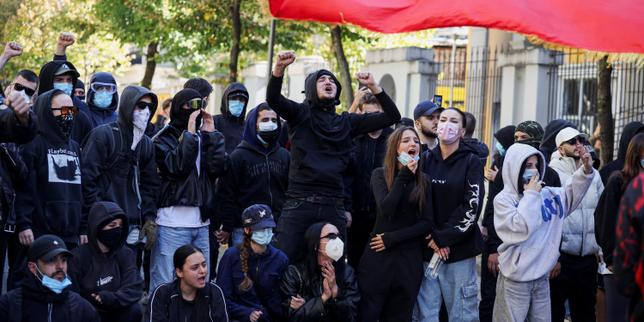
Candlelight vigils do not stop batons. Hashtags do not reform a ministry.
When commentators write about solidarity organizing against police violence in Albania, they usually reach for a comforting script. Citizens march. Activists document abuses. Civil society groups issue urgent statements. Foreign observers nod approvingly at "grassroots resilience." Building on this theme, you can find more in: When the Shield of Diplomacy Cracks on a Dusty Road.
That script is lazy. Worse, it is misleading.
Anyone who has spent years watching democratic backsliding, post-communist institution-building, and protest dynamics in the Western Balkans knows the uncomfortable truth. In Albania, solidarity against police misconduct is real at the human level, yet structurally fragile at the political level. Street-level empathy rarely converts into institutional accountability when the state holds tight levers over media access, judicial follow-through, and political loyalty. Experts at Reuters have also weighed in on this matter.
Calling every protest or mutual-aid push a turning point misreads how power actually works in Tirana and across the country. If we want to understand what happens when Albanian citizens push back against heavy-handed policing, we have to stop romanticizing "solidarity" as a magic shield and start examining why civic outrage keeps hitting the same brick wall.
The Lazy Consensus Around Street Solidarity
The standard narrative treats police violence and civic solidarity as a clean tug-of-war. On one side sits an overreaching security apparatus. On the other stands an awakened public united by shared grievances.
It makes for tidy journalism. It also skips the hard mechanics.
First, solidarity in Albania frequently forms in reaction to a specific flashpoint—an aggressive eviction, a heavy-handed crowd dispersal, an arrest that crosses an obvious line—and then dissolves once the immediate camera beam moves elsewhere. Outrage spikes. Mutual aid rallies. Legal volunteers step up. Friends check on detainees. That warmth matters deeply to the people caught in the crossfire.
Yet emotional solidarity is not organizational power. A crowd sharing water bottles and filming officers on smartphones is doing something very different from a coalition capable of imposing political costs on a government. Without sustained institutional pressure, episodic solidarity functions like a pressure valve. It lets people vent and connect, leaving the underlying command structure untouched.
Second, commentators often blur two distinct phenomena: public sympathy and collective leverage. Polls or comment sections may show widespread irritation when police use disproportionate force. Sympathy is cheap. Leverage requires coordination across social divides, protection against retaliation, and credible consequences for officials who authorize or excuse abuse.
I have watched civic campaigns across the region pour immense energy into awareness and moral condemnation while underinvesting in boring, unglamorous follow-through—like maintaining airtight evidence logs, pursuing administrative complaints to the end, and building cross-partisan credibility so abuse is treated as a rule-of-law failure rather than a partisan talking point. Moral clarity without organizational durability gets chewed up by the news cycle.
Policing in Albania Is About Control, Not Just Crowd Management
To understand why pushback faces steep odds, you have to define what is actually happening on the pavement.
Police violence is not merely a matter of a few "rogue officers" losing their temper in the heat of the moment, though individual misconduct certainly happens. In transitional democracies with entrenched political patronage, policing frequently operates at the intersection of public order, property disputes, political competition, and state authority.
When demonstrators gather over urban redevelopment, contested elections, cost-of-living pressures, or local governance grievances, officers are rarely acting in a vacuum. They are executing orders shaped by political risk tolerance. If a government views a protest as a direct challenge to its authority or a flagship project, tolerance for friction shrinks fast.
Consider how accountability mechanisms work in theory versus practice. In principle, oversight bodies, prosecutors, and courts exist to investigate excessive force, discipline officers, and compensate victims. In practice, investigations into police conduct in many post-communist systems move slowly, rely heavily on internal accounts, or stall before senior officials face scrutiny. Even when courts or oversight bodies criticize actions after the fact, the political payoff for the executive often comes early—when the street is cleared and the momentum is broken.
Imagine a scenario where a municipal protest turns tense after hours of standoff, tear gas is deployed, and several citizens are injured or detained. Within days, civil society groups publish testimonies and demand an independent probe. By the time formal review processes crawl forward weeks or months later, public attention has fractured, the contested measure has moved ahead, and the incident is treated as old news.
That timing asymmetry is the real story. State action is immediate. Accountability is slow.
Asking the Wrong Questions About Resistance
When people search for answers around police violence and solidarity in Albania, they tend to ask the wrong questions—or ask the right ones while smuggling in false assumptions.
"Does public solidarity force police reform?"
Not by itself. Public solidarity can expose abuses that officials hoped would stay quiet, and it can give victims psychological and practical backup. Sometimes it forces a tactical retreat on a single issue.
Structural police reform, however, requires sustained pressure on budgets, command chains, prosecutorial independence, and political incentives. Without those levers, solidarity can shame a ministry for a week without changing how a unit operates the following month.
"Are protests failing if abuses still happen?"
Measuring a movement solely by whether police behavior changes overnight is a trap. Protests in Albania often serve other functions: breaking fear, proving that dissent still exists, documenting state overreach for international scrutiny, and connecting isolated citizens who feel powerless.
Still, we should be honest about the limits. Showing up is a starting line, not a finish line. If a movement treats the act of gathering as proof of strength while ignoring coalition-building, legal strategy, and media framing, it confuses visibility with influence.
"Why don't citizens just unite across political lines?"
Easy to ask from a distance. Hard to pull off on the ground.
In a polarized political environment where parties routinely weaponize grievances for their own gain, ordinary citizens grow skeptical of movements that look like Trojan horses for rival politicians. Conversely, if a civic movement refuses any political alignment and stays strictly "non-political," it sometimes struggles to turn street energy into legislative or institutional pressure.
There is no clean cheat code here. Every strategic choice carries a cost.
What Heavy Hitters in Governance and Rights Actually Point To
Serious scholars and practitioners who study democratic backsliding, protest policing, and rule-of-law reform—figures like political scientists Pippa Norris and Erica Chenoweth, alongside long-running governance and human rights researchers—have repeatedly highlighted a pattern that applies far beyond Albania.
Nonviolent resistance and civic mobilization are far more effective when they combine moral appeal with strategic discipline: clear goals, broad cross-cutting participation, documented nonviolence, and credible pathways that make repression costly for authorities. Conversely, when movements remain narrow, reactive, or easily painted as purely partisan, governments find it much easier to isolate them, wait them out, or frame heavy policing as "restoring order."
In the Western Balkans specifically, institutional analysts and legal observers have long emphasized a stubborn gap between formal laws on paper and enforcement in practice. Passing a rule or issuing a statement is easy. Making sure prosecutors, ombudsmen, courts, and interior ministries act independently without fear or favor is the hard slog of decades.
Anyone pretending that a wave of street solidarity bridges that gap overnight is selling a fairy tale.
The Downside of Being Skeptical About Solidarity
Let me put my cards on the table, because there is a real risk to taking this contrarian view.
Over-index on structural cynicism, and you can accidentally demoralize the very people doing the hardest work. Mutual aid matters. Standing beside someone who was roughed up by police matters. Refusing to stay silent matters. If I sound dismissive of everyday courage on the street, I am doing a disservice to citizens who put themselves on the line.
There is also a danger of sounding like an armchair critic who demands perfection from under-resourced activists while operating from a comfortable distance. Organizing under pressure is messy. Volunteers burn out. Messages get tangled. Mistakes happen. Pointing out strategic flaws from the sidelines is easy; building a durable movement in a tough political climate is brutal.
A sharp contrarian perspective should clarify reality, not breed fatalism. Recognizing the limits of street solidarity is not an argument for staying home. It is an argument for upgrading what happens around and after the street.
How to Build Solidarity That Actually Bites
If solidarity against police violence in Albania is going to move past symbolic outrage, activists, journalists, and citizens have to get sharper about mechanics.
- Treat documentation as forensic evidence, not just content. Viral clips fade fast. Time-stamped video, medical records, witness names, badge or vehicle details where visible, and structured timelines build cases that lawyers, oversight bodies, and international monitors can actually use.
- Pair street action with legal and institutional stamina. Outrage wins headlines; follow-up wins accountability. Supporting legal aid through slow administrative and court proceedings is less dramatic than a rally, and far harder for authorities to ignore over time.
- Guard against partisan capture without surrendering political weight. Citizens should stay clear-eyed about politicians trying to ride civic anger for applause, while still pressing elected officials and oversight institutions on concrete policy and conduct standards.
- Build coalitions beyond the usual suspects. Movements that stay locked inside tight activist or urban circles limit their reach. Connecting grievances around policing to everyday issues—housing, labor, local services, fair treatment for ordinary families—broadens the base and makes heavy-handed tactics harder for officials to justify.
- Measure success by durability, not decibels. A loud afternoon that leaves zero new networks, zero legal follow-through, and zero institutional pressure fades by Monday. A smaller, steadier effort that builds legal literacy, mutual protection, and long-term oversight leaves a mark.
Solidarity is a spark, not an engine. Light the spark, then build the engine.


