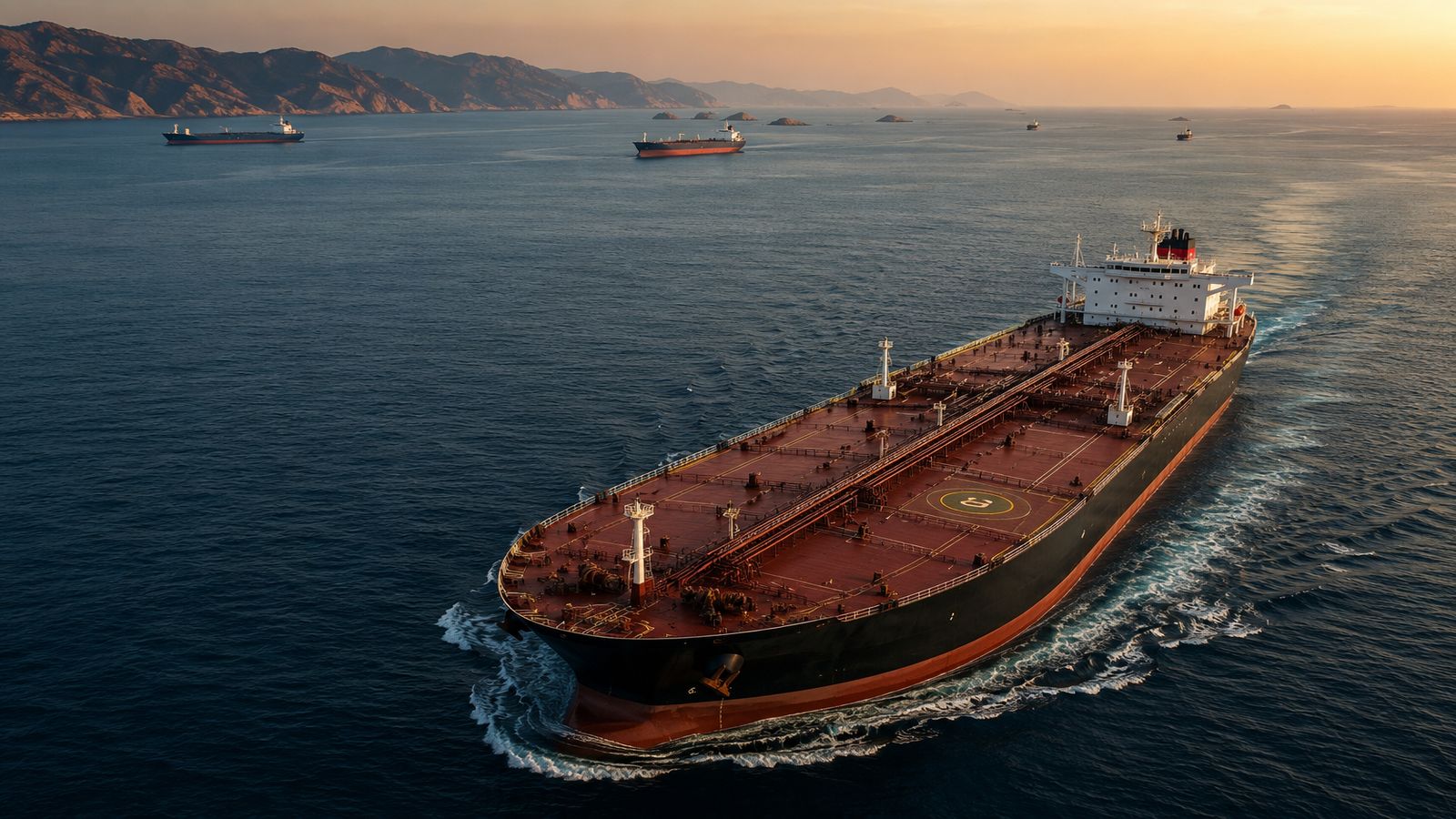
The heat in the Strait of Hormuz does not merely warm the skin; it violently compresses the lungs. At 3:00 AM, the air hovering over the black water registers a stifling forty-two degrees Celsius. On the bridge of a Very Large Crude Carrier—a steel beast stretching three hundred meters from bow to stern—the silence is heavy, broken only by the low, sub-audible thrum of an engine the size of a three-story house.
To the untrained eye, this stretch of water is a geopolitical chokepoint, a narrow gap between Oman and Iran through which a fifth of the world’s petroleum passes. To the spreadsheets of London and Singapore commodity traders, it is a risk coefficient. But to the men who own the steel, and the crews who navigate it, the Strait is a hyper-profitable, terrifying high-wire act.
Most shipowners look at this body of water and see a nightmare of soaring insurance premiums, drone threats, and political volatility. They steer clear. But a select few see something else entirely.
They see a goldmine.
The Economics of Anxiety
When tension spikes in the Middle East, the global maritime insurance market reacts with predictable panic. War risk premiums skyrocket. For a standard oil tanker, the cost of simply crossing into the Persian Gulf can jump by hundreds of thousands of dollars for a single seven-day voyage.
For the average shipping conglomerate answerable to conservative boardrooms, this risk is unacceptable. They pull back, anchoring their fleets in the safe, deep waters of the Gulf of Oman, just outside the danger zone.
This creates a structural bottleneck. The oil inside the Persian Gulf—harvested from the colossal fields of Saudi Arabia, Iraq, and Kuwait—still needs to get out. The world's refineries are hungry. The factories of Asia and the gas stations of Europe do not pause for geopolitical instability.
Enter the shuttle kings.
Consider a hypothetical operator named Andreas. He does not exist as a single individual, but rather represents a composite of three different Greek and Emirati tycoons who have mastered this specific niche. Andreas does not operate on the grand, predictable routes of global commerce. He does not send his ships on leisurely forty-day journeys from Rotterdam to New York.
Instead, Andreas plays a high-stakes game of ping-pong.
His strategy is deceptively simple: buy older, fully depreciated supertankers that other companies are preparing to scrap. Register them under flags of convenience. Insure them through bespoke, high-risk syndicates willing to take a gamble for an extortionate fee. Then, run the gauntlet.
The Sixty-Mile Sprint
The business model relies entirely on a short, intense journey known as the Hormuz shuttle.
Andreas’s ships sail into the Persian Gulf, load up with millions of barrels of crude oil from terminals like Ras Tanura or Basra, and immediately turn back around. They sprint through the narrow Strait, dump the cargo into storage tankers or floating terminals just outside the chokepoint in places like Fujairah, and immediately turn back to do it again.
Sixteen hours in. Sixteen hours out. Constant, relentless repetition.
The financial math behind this hustle is staggering. Because most global fleets refuse to enter the Gulf during a crisis, the freight rates for these short shuttle runs explode. A journey that would normally command a standard rate of two hundred thousand dollars can suddenly fetch one. Two million. Three million. For less than forty-eight hours of actual sailing time.
Even after factoring in the exorbitant cost of war-risk insurance and the hazard pay required to convince crews to sail into a potential conflict zone, the net profit margins are astronomical. A single supertanker, purchased second-hand for twenty-five million dollars, can entirely pay for itself in less than two months of continuous shuttle operations.
It is capital capitalism stripped down to its rawest, most mercenary element. It is the monetization of geopolitical terror.
The Human Cost of the Ledger
From a comfortable office in Athens or Dubai, the shuttle run looks like a beautiful, frictionless machine that converts risk into pure liquidity. The reality on the water is vastly different.
The sailors who man these vessels are rarely from the same countries as the tycoons who own them. They are largely Filipinos, Ukrainians, and South Asians. For them, the shuttle run is not a masterstroke of financial arbitrage. It is a grueling, nerve-shredding test of human endurance.
Imagine standing on the deck of a vessel carrying two million barrels of highly flammable liquid, knowing that you are navigating a waterway flanked by hostile coastal missile batteries and swarming fast-attack craft. The radar screens on the bridge are cluttered with targets. Every fishing dhow could be a scout; every drone report on the maritime news tickers could be the one that hits your hull.
The physical environment complicates the psychological strain. The heat inside the Persian Gulf during the summer months is so intense that maintenance work on the open deck can only be performed in short, twenty-minute shifts before heatstroke sets in. The steel of the ship cooks under the sun, radiating heat long after darkness falls.
Why do they do it? The answer is simple, universal, and deeply human.
Hazard pay.
A crew member on a Hormuz shuttle can earn double or triple their standard monthly wage for every day spent inside the high-risk zone. For a young third mate from Manila, three months of continuous shuttle runs can mean buying a house outright for their parents or securing a university education for their siblings. The tycoons exploit the macro-economic reality of the world, while the crews exploit their own tolerance for fear to rewrite their family destinies.
The Hidden Engine of Global Stability
There is a profound irony at the heart of the supertanker shuttle business. The tycoons who run these operations are frequently criticized as war profiteers, vultures feeding on the volatility of international friction. They are viewed as shadowy figures operating in the blind spots of international maritime law.
Yet, without them, the modern world would shudder to a violent halt.
If the oil locked inside the Persian Gulf could not find a way out, the global energy supply would contract instantly. Oil prices would not merely rise; they would warp. The cost of diesel would spike, driving up the price of agricultural transport, which would instantly inflate the cost of bread in Cairo, milk in Chicago, and logistics in Shanghai.
The shuttle kings, driven by pure, unadulterated profit, inadvertently serve as the safety valves of the global economy. By absorbing the risk that institutional mega-corporations refuse to touch, they ensure that the lifeblood of modern industrial society keeps flowing. They are the high-risk middlemen keeping the lights on in cities thousands of miles away from the blistering heat of the Oman Gulf.
The sun begins to rise over the jagged mountains of the Musandam Peninsula, casting a harsh, blinding glare across the water. On the bridge of the supertanker, the captain watches the digital chart as the vessel finally clears the easternmost point of the Strait, entering the open, safer waters of the Arabian Sea.
Behind them, another empty tanker is already steaming inward, heading straight into the heat, ready to repeat the dance. The tycoon’s bank account will swell by another digit before nightfall, paid for by a world that prefers not to look too closely at how its survival is secured.