You can taste crude before you ever see it.
Not the refined, clean fuel that hums inside a hatchback on a Tuesday morning commute, nor the sterile plastic of a credit card statement. Real crude tastes like heavy metal, old grease, and desert dust baking under a relentless sun. Anyone who has spent enough years around the Gulf energy corridor knows that smell clings to shirt collars, creeps into air-conditioning vents, and settles quietly into the back of the throat when the wind shifts off the sand.
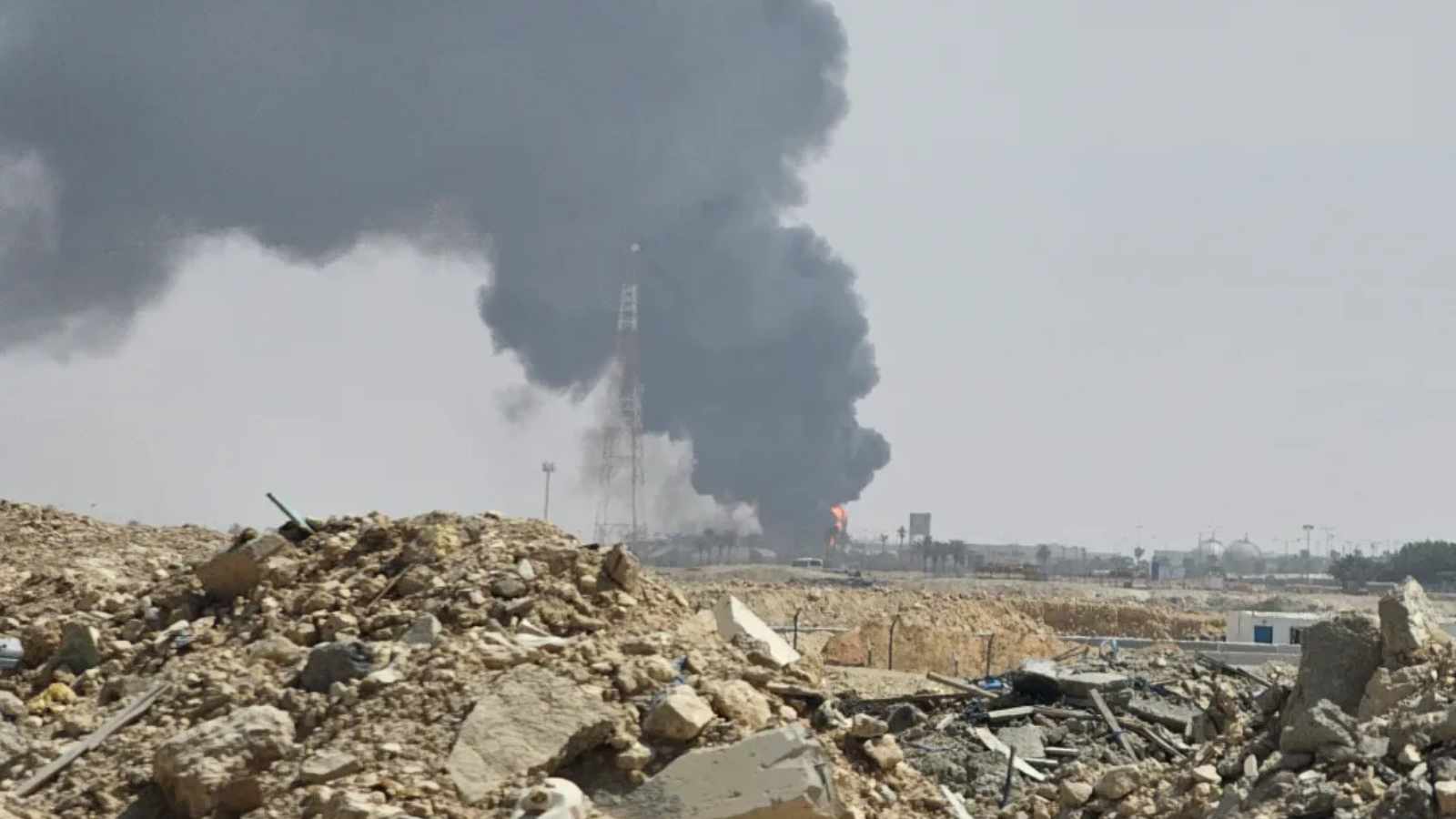
When a fire breaks out near the nerve center of Saudi Aramco in Dhahran following a cross-border strike attributed to Houthi forces, the wire reports usually arrive in neat, bloodless rectangles. Mention of a drone or projectile. A localized blaze brought under control. No casualties reported. Markets twitch for an hour or two, then find their footing.
Clean. Contained. Forgettable.
Except nothing about a strike on the headquarters of the world's most consequential energy producer is truly contained. Not in the minds of the people watching smoke curl against a bleached sky, and certainly not in the quiet, braided arteries that keep modern life running from Tokyo to Rotterdam to a suburban kitchen in Ohio.
I have stood on enough industrial perimeters and watched enough emergency response drills to know how deceptive calm can be once the sirens stop. The cameras zoom out. The press releases use passive verbs. Yet the real story of a fire at Aramco headquarters does not live in a single flame. It lives in the tremor that runs through engineers checking telemetry screens at three in the morning, in the sudden vulnerability of concrete and steel that were built to feel permanent, and in the realization that the global economy rests on places most of us will never visit.
What a Blaze at the Nerve Center Actually Means
To understand why a fire at Aramco headquarters carries weight far beyond a single perimeter fence, you have to strip away the jargon of barrel counts and geopolitical briefings and look at what Dhahran represents.
Dhahran is not merely another office park with glass walls and company badges. Founded in the 1930s alongside the discovery of commercial oil in Saudi Arabia, it grew into the beating administrative and technical heart of Saudi Aramco—a company that for decades has supplied roughly one in every ten barrels of oil consumed worldwide, alongside massive gas and petrochemical operations. Even when physical attacks target refineries, pipelines, or processing plants elsewhere in the kingdom—such as the dramatic September 2019 assaults on Abqaiq and Khurais, which temporarily knocked out roughly half of Saudi crude output—any incident touching the headquarters strikes a psychological and operational nerve at the very top of the chain.
Consider what happens inside a command center when an alert flashes.
(Note: The following scene is a hypothetical reconstruction designed to illustrate how crisis response unfolds inside a high-stakes energy facility during a security incident.)
Picture Tariq, a senior operations engineer in his late forties, sitting in a dimly lit control room in Dhahran as the evening shift turns over. He has spent twenty-two years reading pressure gauges, flow rates, and thermal sensors. He knows the rhythmic hum of the servers and the quiet confidence of a facility designed with layers of redundancy. When word comes through of a projectile or drone strike and a fire near the headquarters compound, Tariq does not panic. Panic is a luxury nobody in operations can afford. His hands move automatically across his console—verifying automated shutoffs, checking perimeter feeds, confirming that backup systems are holding steady.
For twenty minutes, everything is sound, procedure, and cold adrenaline. Then comes the silence after the emergency crews reach the scene and the flames are knocked down. That is when the weight settles in. Tariq looks out toward the dusk, thinking about the colleagues on the ground, the families watching local group chats light up with rumors, and the simple, unsettling fact that distance no longer guarantees insulation.
Even if a fire at headquarters causes limited physical damage and leaves export terminals flowing without interruption, the signal travels faster than smoke. It tells every insurer, shipper, central banker, and industrial buyer on earth that asymmetric warfare has reached a new level of boldness. Drones and long-range projectiles are cheap compared to the infrastructure they target. A single low-cost airframe carrying a modest payload can force an entire multinational security apparatus into high alert, reroute air traffic, spike war-risk premiums on tankers in the Red Sea and Persian Gulf, and inject a sudden risk premium into energy markets.
Markets hate surprises, yet they live on them.
When traders see smoke near an Aramco facility, they do not price in only today's barrels. They price in probability. What if the next strike is more accurate? What if a coordinated wave hits a critical gas-oil separation plant or a loading terminal at Ras Tanura? Even a two- or three-dollar jump per barrel—or a sharp spike when tensions flare—ripples outward through freight rates, jet fuel, chemical feedstocks, and the cost of hauling groceries across continents.
The Invisible Thread Between Desert Heat and Your Grocery Bill
Most people do not wake up thinking about upstream extraction or sovereign energy security. They wake up to an alarm clock, step onto a floor made with synthetic fibers derived from petrochemicals, drink coffee transported on diesel-powered ships and trucks, and check a phone powered by electricity generated in part by fossil fuels.
We live inside an energy choreography so smooth it feels invisible.
Think of the global supply chain like a vast suspension bridge spanning a canyon in thick fog. You cannot see the anchor cables buried deep in the rock on either side, and you rarely notice the wind until the deck begins to sway. Oil and gas are those anchor cables. They hold up agriculture through fertilizers and tractor fuel, manufacturing through plastics and industrial heat, aviation through kerosene, and trade through bunker fuel.
When a fire erupts at a major energy hub in the Middle East, the wind picks up on that bridge.
A family in Madrid or Manila might never read a technical breakdown of Houthi drone capabilities or air-defense interception rates. Yet months later, they may feel the echo of that tension when airline tickets cost more, when shipping delays lengthen, or when central banks hesitate to cut interest rates because energy-driven inflation refuses to cool.
Let's be honest with each other: trying to track every geopolitical flare-up in the Middle East can feel exhausting and confusing. One headline claims a strike caused no disruption; the next warns of regional escalation. One analyst shrugs it off as noise; another treats every spark as a prelude to a supply shock. If you ever feel a little whiplash trying to figure out what actually matters and what is just cable-news static, you are not alone. Even seasoned economists sometimes misread how quickly markets digest—or misprice—security shocks.
The confusion comes from mixing two different timelines.
On the tactical timeline of hours and days, modern energy infrastructure has become remarkably resilient. Decades of hard-earned lessons—from past regional conflicts to the 2019 attacks—have pushed operators to harden perimeters, diversify export routes, maintain strategic reserves, and automate emergency isolation valves. A localized fire at a headquarters complex can often be extinguished quickly without halting the physical flow of oil out of Saudi ports.
On the strategic timeline of months and years, however, repeated strikes erode complacency. They force governments and corporations to spend billions on air defenses, surveillance, insurance, and supply-chain redundancy. Every dollar spent defending against a threat is a dollar not spent elsewhere, and every successful penetration of airspace proves that no perimeter is absolute.
Why Houthi Strikes Keep Testing the Same Fault Line
To grasp why an incident involving Houthi forces and Saudi energy infrastructure keeps resurfacing in global headlines, it helps to step back into the recent history of the region.
For years, the conflict in Yemen has spilled across borders in ways that reshaped modern warfare. Houthi forces, backed by Iran, have expanded their arsenal from basic rockets to long-range ballistic missiles, cruise missiles, and one-way attack drones capable of flying hundreds of miles across desert terrain. Against targets like sprawling oil facilities, pipelines, and administrative compounds, these weapons act as instruments of leverage and pressure.
From Riyadh's perspective, energy infrastructure is not just an economic asset; it is the foundation of state revenue, public services, and national stability. Protecting it is an existential priority. Over the past several years, Saudi Arabia has invested heavily in layered air-defense systems, radar networks, and diplomatic efforts—including periods of de-escalation and talks aimed at curbing cross-border hostilities—precisely because energy vulnerability translates directly into strategic vulnerability.
Yet geography is stubborn. The Arabian Peninsula stretches wide, and the sky is vast. No air-defense shield on earth intercepts one hundred percent of incoming threats every single time, especially when low-flying drones hug terrain or arrive in complex profiles. Even when defenses succeed or damage is limited to a single structure or yard, the attempt itself shifts the psychological calculus.
Consider another perspective—someone far removed from control rooms and ministries.
(Note: The following character is a hypothetical composite created to reflect everyday economic ripples.)
Imagine Elena, a small-business owner running a regional logistics and packaging company thousands of miles away. She has never set foot in Saudi Arabia. Her daily worries revolve around fuel surcharges, warehouse rent, and keeping clients happy when delivery windows tighten. When news breaks of a fire at Aramco headquarters following a Houthi strike, Elena glances at the headline over morning coffee. At first, it feels like a world away. By afternoon, she notices diesel futures ticking upward and wonders whether her fuel suppliers will tack another surcharge onto next month's invoices. For Elena, geopolitics isn't an abstraction on a map; it is a line item that squeezes a thin margin.
That is the quiet power of energy markets. They stitch distant events into ordinary budgets.
The Myth of Total Invulnerability
There is a comforting illusion that big institutions are untouchable. When a company is worth hundreds of billions or trillions of dollars, when its campuses have palm-lined boulevards, security checkpoints, and world-class engineering teams, it is easy to assume nothing serious can touch its doorstep.
Fires have a way of puncturing that illusion.
Flame is ancient. It does not care about market capitalization, diplomatic rank, or architectural prestige. Whether a blaze starts from an electrical fault, an industrial mishap, or an external strike, the immediate response is always primal: get people to safety, cut the fuel to the fire, keep it from spreading, and figure out how it got past the outer wall.
What makes a fire at Aramco headquarters particularly sobering is the contrast between scale and precision. A massive energy enterprise spans thousands of square miles of desert, pipelines, rigs, and offices. Protecting every square inch against determined, low-cost aerial threats is an engineering puzzle with no neat, final answer. You can harden critical nodes. You can build redundancy. You can train emergency teams until their muscle memory is sharp. Still, risk never drops to zero.
And that brings us to a question worth sitting with long after the news cycle moves on: how much resilience have we actually built into our own daily lives when a single spark thousands of miles away can still rattle global nerves?
We often talk about energy transition, supply chains, and geopolitical risk as if they belong to specialists in suits. In truth, they belong to all of us. Every time a strike or fire tests a major energy hub, it reminds us that comfort depends on continuous, unbroken systems—power grids, shipping lanes, trade agreements, and fragile regional truces.
When the smoke clears over Dhahran and the cameras turn off, the real test begins—not in the headlines, but in the quiet hours when everyone wonders what comes next.
Look up at the sky sometime when a commercial jet crosses high above, leaving a faint white line against the blue, and ask yourself what it took to get that fuel into its tanks—and how thin the margin is between a routine flight and a world on edge.