The sound does not belong to the sky. It is a low, rhythmic rasping, like an old moped engine struggling up a steep hill, or a lawnmower cutting grass two streets over. In Kyiv, in Kharkiv, in the blackout-darkened villages of the Donbas, that sound makes people stop breathing. It is the signature hum of a Shahed-136 drone, an Iranian-designed flying bomb, packed with explosives, hunting by pre-programmed coordinates.
When the air raid sirens wail, they sound like a warning. The drone sounds like an executioner.
For decades, military strategists talked about the future of warfare in sterile terms. They spoke of electronic countermeasures, network-centric operations, and theater-level defense. They drew clean lines on digital maps. They forgot that when a sky turns hostile, the frontline isn't just a trench. It is the roof above a child’s bed. It is the power grid that keeps a neonatal ward warm.
Right now, an unprecedented, frantic evolutionary race is happening in the airspace over Ukraine. It is a war of numbers, pennies, and brutal mathematics. The old way of defending the sky—firing a million-dollar, radar-guided missile at a twenty-thousand-dollar piece of flying plastic—is a mathematical trap. It leads straight to bankruptcy and empty arsenals.
To survive, Ukraine has been forced to reinvent air defense from scratch. They are doing it with code, discarded car parts, old machine guns, and an absolute refusal to die.
The Sound of Two Thousand Dollars
Consider a young software engineer named Mykola. Before the invasion, he wrote code for a logistics startup in Lviv. He drank pour-over coffee. He worried about cloud server optimization. Today, he sits in a dimly lit room, staring at a screen that tracks acoustic signatures across the country.
He is part of a sprawling, largely decentralized network that has turned the entire nation into a giant microphone.
The problem with modern radar is that it was built to spot big, fast, hot things. A fighter jet screaming through the stratosphere at Mach 2 leaves a footprint the size of a barn. A Shahed drone is different. It is made of fiberglass and carbon fiber. It flies low, hugging the contours of the river valleys and highways, slipping beneath the radar beams like a thief crawling under a tripwire.
So, Ukraine went backwards to go forward.
They took thousands of cheap Android smartphones. They mounted them on poles, fitted them with external microphones, and scattered them across fields, forests, and rooftops from the border to the capital. These phones do one thing: they listen. When the distinct, lawnmower-like rattle of a drone enters their radius, the audio data is pushed to a centralized, AI-driven software platform.
Within seconds, the system triangulates the drone's speed, altitude, and heading. It doesn't use multimillion-dollar satellite arrays. It uses the same basic geometry a high schooler learns, processed at lightning speed by algorithms that weed out the sound of actual lawnmowers, passing trucks, and barking dogs.
This digital ghost map is then beamed directly to the tablets of mobile fire teams.
These teams are the literal shield. They aren't elite missile crews in high-tech bunkers. Often, they are volunteers—teachers, mechanics, dentists—perched in the back of converted pickup trucks. They wait in the pitch black of the Ukrainian steppe, shivering, staring into the night with thermal optics. When the app on their phone alerts them that a drone is three minutes away, they crank up an old Soviet-era Maxim machine gun or a twin-barreled anti-aircraft cannon.
They trace the sound. They look for the tiny spark of the exhaust. Then, they open fire.
It is primitive. It is terrifying. And it is working. But a human being with a machine gun can only see so far, and the sky is very, very big.
The Mathematical Trap
To understand why this desperate innovation is necessary, you have to look at the cold ledger of modern attrition.
When a swarm of thirty drones enters Ukrainian airspace, the immediate instinct of any Western-trained military is to fire Patriot, NASAMS, or IRIS-T missiles. These are masterpieces of engineering. They rarely miss. They track targets with active radar homing and explode with surgical precision.
They also cost anywhere from $500,000 to $4 million per shot.
A Shahed drone costs about $20,000 to manufacture. Russia can build or buy them by the thousands.
If you use a million-dollar arrow to kill a twenty-thousand-dollar wasp, you lose the war. It doesn't matter if you hit the target every single time. Eventually, you run out of arrows. Your enemy knows this. The swarms aren't just designed to destroy infrastructure; they are designed to bleed the air defense stocks dry, leaving the cities naked against much larger, faster ballistic missiles.
This is where the paradigm had to break. The cost of the interceptor must match, or be lower than, the cost of the threat.
The Machine that Hunts Itself
The next phase of this evolution is already airborne, and it removes the human element from the trigger entirely.
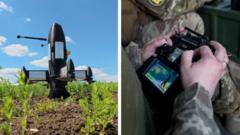
Engineers in hidden workshops across Ukraine are now producing thousands of small, low-cost interceptor drones. These are not the reconnaissance quadcopters you see in electronics stores. These are fixed-wing and high-speed multirotor aircraft designed for a single, violent purpose: ramming.
Imagine a tiny, battery-powered hobby drone equipped with an onboard computer chip no more powerful than the one inside a modern washing machine. It is launched by a ground operator who guides it toward the general vicinity of an incoming Russian reconnaissance drone—the eyes that spot targets for artillery and missiles.
Once the interceptor gets close, the human drops off the controls. The drone’s internal AI takes over.
Using basic optical tracking algorithms—computer vision trained on thousands of hours of flight footage—the interceptor locks onto the shape of the enemy aircraft. It doesn't need GPS, which the Russians jam constantly. It doesn't need a radio signal that can be intercepted. It simply looks at the target through its cheap camera lens, calculates the intercept vector, and guns its electric motors to maximum speed.
It flies directly into the enemy's propellers.
A violent shatter of plastic, a brief puff of smoke three thousand feet in the air, and both machines tumble into the mud. The cost of the Ukrainian interceptor? Perhaps a few hundred dollars. The cost of the Russian Orlan-10 reconnaissance drone it just blinded? Upwards of $100,000.
For the first time in the history of aerial warfare, the financial math has flipped in favor of the defender.
The Friction of the Electronic Void
Yet, walking through this technological renaissance feels less like entering a sci-fi future and more like surviving a storm in a leaky boat. There is an ambient anxiety that never leaves the engineers, programmers, and soldiers who build these systems.
The invisible world is thick with static.
Electronic warfare is the silent undertow of the entire conflict. Every time Ukraine develops an AI algorithm that can track a drone by its shape, Russia changes the paint scheme of their aircraft or alters their flight profiles. Every time a new radio frequency is used to guide an interceptor, massive Russian jamming towers flood the airwaves with white noise, causing the drones to lose their minds and drift aimlessly until their batteries die.
It is a constant game of cat and mouse played in milliseconds and megahertz.
"You write a piece of code that saves twenty lives on a Tuesday," an engineer named Anya told me recently. She spoke with the flat, exhausting calm of someone who hasn't slept a full night in two years. "By Thursday, the enemy has updated their firmware, your code is useless, and five buildings are hit. You don't get to celebrate. You just go back to the keyboard."
This is the vulnerability the West often fails to see when looking at charts of donated equipment. Hardware is static. A missile launcher delivered six months ago is the same missile launcher today. But the software governing drone warfare changes every week. If a line of code isn't updated, the weapon becomes an expensive pile of scrap metal.
The Human at the End of the Wire
It is easy to get lost in the fascination of it all—the automated skies, the acoustic phone nets, the self-guided kamikaze robots. It feels clean. It feels like a video game played out in the clouds.
But it isn't.
Behind every automated intercept is a human being holding their breath. Behind every acoustic sensor is a family hoping the phone on the pole outside their window doesn't hear anything tonight.
Late last winter, a mobile fire team stationed on a ridge outside an eastern town missed a drone. It wasn't their fault. The fog was too thick, the acoustic data delayed by a few critical seconds. The drone passed over their heads, its engine roaring like an angry wasp, and disappeared into the gray soup toward the town below.
The team leader, a former high school history teacher, didn't yell. He didn't curse. He just dropped his head against the cold steel of his machine gun mount and listened for the distant, muffled thud that came thirty seconds later.
That is the true weight of the technology. The code isn't being written to win tech awards or secure venture capital funding. It is being written because every time an algorithm fails, somewhere in the dark, a concrete roof collapses into a living room.
The Open Sky
The war has permanently altered our relationship with the air above us. For a century, humanity looked up at the sky as a symbol of freedom, of travel, of the endless reach of human ambition. Now, for millions of people, the sky is an open mouth, capable of dropping fire at any hour of the day or night.
The innovations coming out of Ukraine’s tech sector aren't just a temporary fix for a localized crisis. They are a blueprint for the next century of global security. The era of total reliance on massive, centralized, impossibly expensive military hardware is drawing to a close. The future belongs to the small, the cheap, the smart, and the adaptable.
But as the drones get smarter, and the AI takes over more of the hunting, the stakes remain stubbornly, agonizingly human.
In a small workshop somewhere near Kyiv, a soldering iron puffs a tiny cloud of blue smoke into the air. A technician attaches a new camera module to a piece of molded foam. She wipes a smudge of grease from her forehead, plugs the machine into a laptop, and watches the green status light flicker to life.
Outside, the sun is setting, casting long, bloody shadows across the Ukrainian soil. The sky is quiet for now. But the night is coming, and the machines must be ready to listen.