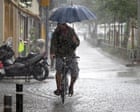
Water does not forget the paths it carved last year. Across eastern Spain, valleys and coastal plains are once again bracing for torrential rain and catastrophic flooding, an escalating cycle of meteorological violence that reveals deep systemic vulnerabilities in modern infrastructure. Meteorologists track the approaching pressure systems with grim familiarity, knowing that what begins as a heavy Atlantic or Mediterranean plume too often transforms into a wall of muddy runoff sweeping through narrow streets, carrying vehicles, livestock, and livelihoods toward the sea.
Eastern Spain is facing yet another severe weather episode involving torrential rain and flash flooding, driven by recurring atmospheric phenomena known locally as gota fría or DANA (Depresión Aislada en Niveles Altos). These isolated high-altitude depressions trap warm, moisture-laden air from a heating Mediterranean Sea and slam it against rugged coastal mountain ranges. The result is an explosive release of precipitation that overwhelms natural drainage basins in hours. Learn more on a connected topic: this related article.
The immediate danger is obvious: rising rivers, submerged underpasses, and sudden torrents tearing through towns built centuries ago along ancient floodplains. Yet the deeper crisis lies in the decades of unchecked urban expansion that have paved over natural absorption zones.
The Mechanics of a Mediterranean Deluge
To understand why eastern regions like Valencia, Murcia, and Catalonia suffer disproportionately, one must look at geography and thermodynamics. The Mediterranean basin is warming faster than the global average. Every fraction of a degree increase in sea surface temperature pumps more moisture into the lower atmosphere. When an upper-level cold front collides with this dense reservoir of maritime vapor, the atmosphere unleashes hundreds of liters of water per square meter in mere hours. More journalism by TIME highlights similar views on the subject.
Historical city planning relied on dry riverbeds, known as ramblas, to naturally channel infrequent storm runoff safely to the coast. Modern development treated these same dry beds as prime real estate. Concrete has replaced permeable soil. Industrial parks, housing complexes, and sprawling road networks now sit squarely within historic flood channels. When the sky opens, the water has nowhere to go. It accelerates down paved slopes, turning ordinary streets into high-velocity rivers capable of moving heavy machinery.
Emergency response teams face an impossible geometry. Flash floods provide almost no lead time. By the time a red weather warning registers on official monitors, rural roads are already impassable and urban drainage systems are reversing, spewing sewage back into basements and ground-floor apartments.
Institutional Paralysis and the Politics of Prevention
Civil protection agencies issue warnings with increasing frequency, yet public communication often clashes with economic reality. Shutting down a regional economy every time a yellow or orange alert flashes produces fatigue. Businesses stay open, delivery drivers take risks, and commuters head toward coastal hubs because local labor protections and economic survival outweigh cautious forecasts. When red alerts finally trigger mandatory restrictions, the chaos is already underway.
Political responsibility fragments across municipal, regional, and national jurisdictions. Local councils manage zoning permits and local drainage maintenance. Regional governments direct emergency services. National authorities oversee major river basin confederations. In the frantic hours before a storm, jurisdictional friction slows down critical resource deployment.
Financial compensation packages following past disasters reveal a reactive model of governance. Billions of euros flow into post-disaster reconstruction funds to repair bridges, asphalt, and damaged storefronts. Meanwhile, long-term structural mitigation—such as the creation of massive upstream retention basins, the systematic relocation of vulnerable homes, and the restoration of natural wetlands—lags behind due to prohibitive costs and political cowardice. No elected official wants to mandate the expropriation of riverfront neighborhoods today to prevent a hypothetical disaster tomorrow.
The Human Toll on the Ground
Beyond the macroeconomic figures and political wrangling, the human cost falls heaviest on working-class communities and agricultural sectors. Citrus groves and horticultural fields in the Spanish Levant absorb the initial blow, turning fertile topsoil into a wasteland of drowned crops and choked irrigation canals. Farmers watch years of investment wash away in minutes, uninsured or underinsured against rapid climate volatility.
In urban areas, underground parking garages and basement dwellings become lethal traps. When water surges three feet deep into a subterranean garage within five minutes, drivers rushing to save their vehicles risk being trapped by electrical failures and heavy pressure against doors. It is a grim script repeated with horrifying regularity across the Mediterranean arc.
Civilian resilience remains high, driven by community solidarity and neighbors helping neighbors with shovels and hoses once the waters recede. But community spirit is a poor substitute for structural engineering. Volunteers washing mud out of neighborhood shops are treating symptoms while the structural disease remains untouched.
The Cost of Inaction
The trajectory ahead is mathematically clear. Climate projections indicate that extreme precipitation events will become more frequent and more intense along the Spanish coastline. Clinging to the illusion that these are one-off anomalies or unpredictable acts of god is no longer a naive oversight; it is an active policy failure.
Adapting to this new meteorological reality requires an aggressive, unsparing overhaul of land-use policy. It means tearing up concrete where nature demands space, enforcing strict building moratoriums in high-risk zones, and investing heavily in sub-surface retention mega-projects that can temporarily store millions of cubic meters of sudden runoff.
Until regional authorities prioritize long-term geographic survival over short-term real estate revenues, every autumn will bring the same frantic sirens, the same mud-choked streets, and the same desperate search for survivors along shores that refuse to hold back the sea.