At 10:01 PM on election night in Tel Aviv, the television screen splits into colored bars, and the room goes dead silent.
Wait. Also making news in related news: What the New Hampshire Senate Debate Really Revealed About the Battle for the Granite State.
Watch the edge of the screen. Forget the prime minister’s podium, forget the roaring crowds waving blue-and-white flags, and forget the sweeping victory speeches already being drafted in backrooms across Jerusalem. Look instead at a tiny sliver of purple or green hovering right near the bottom of the graphic. A fractional party run by a man you have barely heard of just cleared a 3.25 percent hurdle by four thousand votes. Suddenly, a veteran leader who has dominated Israeli politics for over a decade is no longer looking at a triumph. He is looking at a trap.
To understand whether Benjamin Netanyahu—or any Israeli prime minister—can hold onto power, you have to stop thinking about elections the way Americans or Britons do. There is no landslide here. There is no winner-take-all glory. In Israel, democracy is a high-stakes game of Jenga played on a table that never stops shaking, and the magic number is sixty-one. Further information into this topic are explored by The Washington Post.
The Architecture of a Fragile House
Picture a hypothetical neighborhood dinner table in Haifa. Around it sit a secular tech entrepreneur from Tel Aviv, an ultra-Orthodox seminary student from Bnei Brak, a nationalist settler from the hills of Samaria, and an Arab-Israeli pharmacist from Nazareth. They all live under the same sky, pay into the same tax system, and worry about the same grocery bills. Yet they disagree fundamentally on what the country should look like on Saturday morning, who should serve in the military on Sunday, and where the borders should be drawn on Monday.
Now, shrink that dinner table into a 120-seat parliament called the Knesset.
Israel uses a pure proportional representation system. If a party wins ten percent of the national vote, it gets ten percent of the seats—twelve chairs in the chamber. Because no single party in Israel’s entire history has ever won sixty-one seats on its own, governing requires building a coalition. You have to stitch together a patchwork quilt of rivals, ideologues, and opportunists until you reach that bare majority of sixty-one.
It sounds simple on paper. Sixty-one out of one hundred and twenty. Half plus one.
In reality, it is an exercise in constant, exhausting extortion. When you hold sixty-one or sixty-two seats, the smallest faction in your alliance—a party with maybe four or five seats—suddenly possesses the power of a guillotine. If its leader threatens to walk out over a budget line, a cabinet post, or a religious exemption, the entire government collapses. The prime minister doesn't rule over his partners; he survives at their mercy.
The Ghost of Five Elections
I remember sitting in a cramped Jerusalem café during the dizzying cycle between 2019 and 2022, watching exhausted voters stir lukewarm coffee as the news announced yet another dissolution of parliament. Five elections in less than four years. Five times the posters went up on the lampposts, five times the text messages flooded every phone in the country, and five times the morning after brought the exact same math problem.
People stopped arguing about grand visions for the Middle East and started arguing about arithmetic.
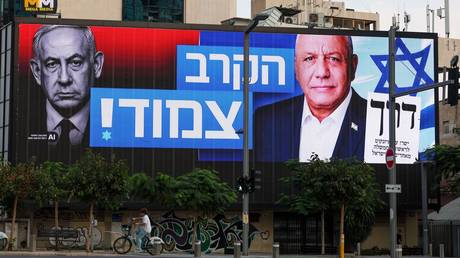
During that stretch, the country wasn't really divided into traditional left and right anymore. The fault line hardened into a single, binary referendum: "Yes Bibi" or "Just Not Bibi." Benjamin Netanyahu, Israel’s longest-serving prime minister, became the sun around which every political planet orbited—either pulled into his gravitational field or flung violently to the outer edges.
Consider what happens when a political system freezes around one person. Former allies who once sat in his cabinet—men like Avigdor Lieberman, Gideon Sa’ar, and Naftali Bennett—broke away, vowing never to sit with him again. Suddenly, Netanyahu’s path to sixty-one narrowed to a razor-thin corridor. He could no longer easily reach across the center to build broad, stable alliances. To reach that magic number, he had to rely almost exclusively on a bloc made up of his own Likud party, ultra-Orthodox factions, and increasingly hardline religious-nationalist parties.
When your options shrink, the price of loyalty skyrockets.
The Price of the Sixty-First Seat
Let us step away from the pundits and look at how coalition arithmetic hits the pavement of everyday life. Imagine a young reservist named Daniel—a composite of thousands of Israelis who have spent the last few years juggling civilian jobs with exhausting stints in uniform. Daniel cares about the cost of his apartment in Rishon LeZion, the quality of his daughter's public school, and the fairness of who shares the burden of national service.
When a prime minister is fighting to keep a narrow coalition alive, Daniel’s quiet, everyday concerns often take a back seat to the loud, urgent demands of the kingmakers.
If an ultra-Orthodox party holds ten seats that are essential to keeping the government at sixty-one, its leaders will demand guarantees: funding for religious institutions, control over key ministerial committees, and protection from mandatory military conscription for their youth. If a far-right faction holds seven vital seats, its leaders will demand the policing portfolio, aggressive settlement expansion, and veto power over diplomatic concessions.
The prime minister becomes a tightrope walker carrying anvils in both hands. Lean too far toward the demands of the religious parties, and secular Likud voters revolt. Push back against the nationalists, and the coalition fractures from within. Every cabinet meeting turns into a high-wire negotiation where survival takes precedence over long-term strategy.
And what happens if a party falls just below the 3.25 percent electoral threshold? That single detail has decided Israeli governments before. In a system where every ballot counts toward the national pool, if two small parties on the same side of the political map refuse to merge out of pure ego, and one of them finishes at 3.1 percent, hundreds of thousands of votes vanish into thin air. Those wasted votes don't just disappear; they mathematically inflate the seat count of the rival bloc. Elections in Israel have been won and lost not because voters changed their minds, but because two party leaders couldn't agree on whose name went first on the ballot.
The Illusion of Control
There is a seductive myth surrounding strongmen in politics—the idea that a dominant leader bends the system to his will through sheer charisma and tactical brilliance. Netanyahu has certainly earned his reputation as a master tactician, nicknamed "the Magician" by supporters and detractors alike for his ability to escape political death traps that would have finished anyone else.
Yet even a magician cannot change basic addition.
When critics ask whether Netanyahu can retain power, they are really asking two entirely different questions. The first is about his personal durability: can he keep his own Likud party disciplined, fend off internal challengers waiting in the wings, and rally his base when crisis hits? History suggests you bet against his survival skills at your own peril.
The second question, however, has nothing to do with his political instincts and everything to do with cold, unforgiving numbers. Can the bloc of parties willing to crown him actually clear sixty-one seats without tearing itself apart over irreconcilable demands?
Think of the Knesset as a lifeboat built for sixty-one people, floating in rough seas. If sixty-four people climb aboard, the boat sits low in the water, tense and uncomfortable, but it floats. If three people jump out because they hate the direction the captain is steering, the boat capsizes immediately. And the opposition doesn't even need a unified vision to sink it; they only need sixty-one hands to vote "no confidence" on a single Monday afternoon.
Why the Math Never Sleeps
Even on the day a new government is sworn in—when the champagne is poured in the Knesset cafeteria and the official portraits are hung—the arithmetic doesn't stop working. It ticks beneath the floorboards like a metronome.
A single backbencher from the ruling party gets passed over for a deputy minister role and decides to vote against a routine budget bill out of spite. A scandal breaks in the morning papers, forcing a minor partner to distance itself from the prime minister to save face with its own voters. A war or an economic shock forces painful decisions that one faction calls treason and another calls necessity.
In countries with strong two-party systems, a prime minister with a solid majority gets four or five years of breathing room to govern, make mistakes, and hope things improve before the next ballot. In Israel, the campaign never truly ends because the coalition is always one bad Tuesday away from unraveling. Every policy is filtered through the lens of survival. Every speech is aimed not just at the public, but at the four or five men sitting in the front row of the cabinet who hold the keys to the exit door.
Walk through the Mahane Yehuda market in Jerusalem on a Friday afternoon, just hours before the Sabbath siren sounds. Shoppers are shouting over crates of pomegranates and warm challah bread, arguing about prices, security, and who is to blame for the latest crisis. Nobody there is talking about "electoral thresholds" or "proportional seat allocation." They are talking about their lives, their sons and daughters, and whether tomorrow will feel steadier than today.
Yet all of it—the price of the bread, the length of military service, the fate of diplomatic deals, and the survival of the man at the top—comes down to the cold geometry of that room on the hill in Jerusalem. One hundred and twenty chairs. Sixty-one votes. And a leader standing at the center of the floor, counting heads in the dark, knowing that one step to the left or one step to the right means the floor vanishes beneath his feet.