The basement of a natural history museum always smells the same. It is a musty, sterile cocktail of powdered limestone, ancient dust, and the faint, chemical tang of chemical consolidants.
For months, a quiet researcher sits under a buzzing fluorescent bulb, scraping away matrix from a block of sandstone. The world outside is loud, chaotic, and obsessed with the immediate future. But in this basement, time moves backward. The researcher is chasing a shadow.
We think we know the monsters of our past. Pop culture has rendered them in loud, predictable brushstrokes. We see a Tyrannosaurus rex as a cinematic engine of chaos, roaring into the sky, chasing down jeeps, acting as an apex predator operating on pure, unadulterated rage. It is a caricature built on teeth.
But stone does not care about Hollywood. Stone preserves the quiet, brutal truth of a Tuesday afternoon 66 million years ago.
When a rare, remarkably preserved fossil finally made its way into the hands of scientists, it did not just offer a few new metrics for a database. It shattered a long-held myth about how the most famous predator in Earth's history actually operated. It turned out that our understanding of prehistoric violence was completely backward.
The Bone That Spoke
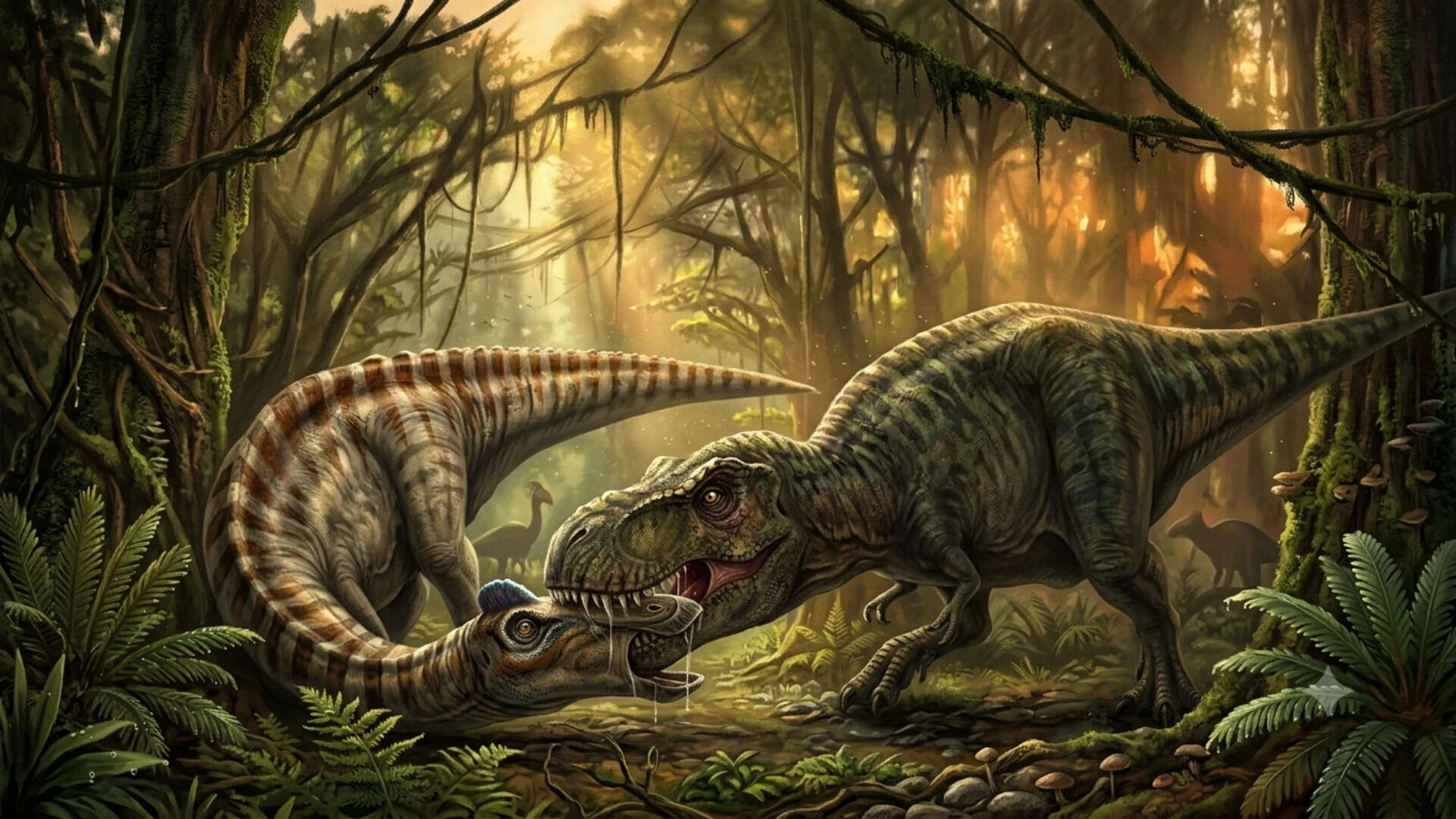
Consider a single tail vertebra belonging to a duck-billed Edmontosaurus. On its own, it looks like an ordinary chunk of petrified wood, heavy and gray. But look closer. Nestled deep within the bone tissue is a puncture. Curving perfectly inside that wound is a broken fragment of a tooth.
Not just any tooth. A banana-sized, serrated dagger belonging to a sub-adult Tyrannosaurus rex.
This fossil is a crime scene frozen in time. For decades, paleontology wrestled with a frustrating debate: was the king of dinosaurs an active hunter or a glorified scavenger? Skeptics argued that its massive body was too heavy for high-speed chases, its tiny arms too useless to secure struggling prey. They painted a picture of a giant, lumbering vulture, cleaning up the leftovers of more agile killers.
This single bone destroyed that theory.
The most crucial detail of the fossil is not the tooth itself, but the bone surrounding it. The edges of the puncture wound are smooth, rounded, and dense. The bone had healed.
Hypothetically, imagine the scene playing out in the late Cretaceous. A young Edmontosaurus is feeding near a riverbank, its senses trained on the tree line. Out of the shadows, a multi-ton predator lunges. There is no cinematic roar—roaring warns the meat. There is only the wet thud of impact, a horrific crush of jaws against the dinosaur's flank, and a desperate, agonizing break for freedom. The prey pulls away with a horrific wrenching motion, snapping the predator’s tooth off in its own flesh.
The Edmontosaurus escaped. It lived for months, perhaps years, after the attack. The bone grew back, sealing the weapon of its enemy inside its own body like a grim biological medal of honor.
This is not the work of a scavenger. A scavenger does not bite an animal that runs away.
The Geometry of the Kill
But the story goes deeper than just proving the hunt. The angle of the wound tells us exactly how the strike occurred.
For a long time, we imagined T. rex attacking like a modern lion or tiger, leaping at the neck or flank of an animal to bring it down through sheer physical struggle. The fossil evidence suggests something far more calculated. Something cold.
The strike came from behind. Low and fast.
The mechanics of a Tyrannosaurus are a masterclass in biological engineering. Its skull was not built like the delicate, scissor-like jaws of an Allosaurus, which sliced through flesh to cause blood loss. The T. rex possessed a massive, fused skull driven by jaw muscles capable of exerting thousands of pounds of pressure. It did not cut. It crushed.
When you analyze the puncture marks on the Edmontosaurus, along with similar rare finds on the frills of Triceratops, a terrifying pattern emerges. The predator was an ambush hunter that targeted the locomotive engines of its prey.
By striking low from behind, a T. rex was not aiming for a dramatic kill shot to the throat. It was aiming for the tail muscles and the hips. A single crush from those jaws would sever tendons, shatter the pelvis, and instantly immobilize the target. Once the prey was grounded, the fight was over.
It was a strategy of terrifying efficiency. It minimizes the risk to the predator. In the wild, a broken leg or a fractured jaw is a death sentence for a hunter. T. rex did not engage in fair fights. It stayed in the shadows, waited for an angle, and executed a swift, debilitating strike.
The Vulnerability of a Tyrant
It is easy to look at these discoveries and feel a sense of detached awe. They are, after all, just monsters from a forgotten era. But when you look at the raw data, the human element begins to bleed through. You start to feel the terrifying reality of survival.
We often view evolution as a linear progression toward perfection. We look at the T. rex and see the ultimate weapon. But the fossils reveal an existence defined by profound vulnerability.
Many discovered Tyrannosaurus skeletons show signs of massive, healed trauma. They have cracked ribs, gouged skulls, and fused spinal columns. A close look at the jaws of several specimens reveals horrific gouges that match the teeth of their own species. They were not just fighting their food; they were fighting each other for territory, mates, and resources.
The life of the king was short, brutal, and plagued by constant pain. Most never made it past their thirtieth birthday.
This is where the cold science of paleontology connects with something deeply human. We recognize this struggle. We understand what it means to carry the scars of our environments, to survive an impact and carry the pieces of the weapon inside us as we heal.
The Stories We Leave Behind
When we look at the history of life on Earth, we are looking at an unbroken chain of survival. Every creature alive today, including the human being reading these words, is the product of an infinite line of ancestors who managed to escape the jaws in the dark.
The duck-billed dinosaur that fled into the Cretaceous ferns with a broken tooth in its tail did not know it was making history. It was just trying to see tomorrow. It ran through the pain, its body did the quiet, miraculous work of knitting itself back together, and it kept moving.
Eventually, the world ended anyway. An asteroid saw to that. The hunter and the hunted were buried in the same ash, pressed into the same mud, and turned to stone by the slow, indifferent march of millions of years.
But the truth remained.
It waited in the dark until a quiet researcher in a museum basement scraped away the last layer of rock, exposing the precise angle of a strike that happened a lifetime ago. We are left not with a monster from a movie, but with a real, breathing animal that calculated its risks, made its move, and sometimes, despite all its terrifying power, missed.