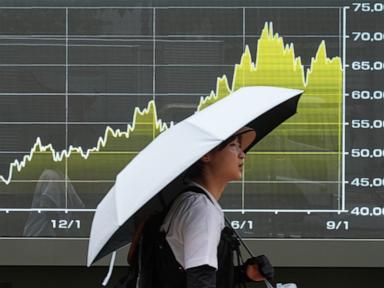
The coffee in the glass cup has gone cold. It has been cold for an hour.
In a high-rise office overlooking the neon-soaked canyons of Seoul, Park sits motionless in front of three glowing monitors. Numbers cascade down the glass in emerald waterfalls. To anyone else, it is just code, or finance, or abstract metrics divorced from breath and bone. To Park, it is the heartbeat of a machine that never sleeps. Tokyo is waking up. Wall Street is going to bed. And somewhere between the two, an entire global economy is tilting on the precise pivot of a fingernail-sized piece of etched silicon.
Markets are mixed today. That is the phrase the morning anchors use. It is a polite, antiseptic way of saying that the world is holding its collective breath. Global shares drift in an uneasy equilibrium, caught between the gravity of old anxieties and the upward pull of a new obsession. But look closer past the broad indexes, past the blinking red and green tickers on cable news, and you will find the real story.
Silicon is king again.
The Anatomy of a Rally
In the sleek trading floors of Tokyo and Seoul, a specific kind of electricity is in the air. Chipmaker shares are climbing, dragging regional benchmarks upward with them. Tokyo Electron surges. SK Hynix reaches for new heights. Samsung flickers green.
Why? Because the world has realized, with a sudden and jolting clarity, that the future cannot be built out of thin air. It has to be cast in furnaces, printed on wafers of pure hyper-pure crystal, and cut with lasers.
Think of it like plumbing. For decades, we obsessed over the water—the apps, the streaming services, the sparkling software that made our digital lives look effortless. We talked endlessly about the interface, ignoring the pipes. Now, the pipes are bursting. The demand for specialized processors capable of handling massive computational loads has outpaced the physical capacity of the earth to supply them.
When a chipmaker in Seoul catches a cold, Detroit sneezes, Frankfurt slows down, and Silicon Valley panics. Conversely, when Tokyo rallies, it is because millions of invisible transactions are whispering the same promise: the infrastructure of tomorrow is finally arriving.
The Human Cost of the Circuit Board
It is easy to talk about equities as if they exist in a vacuum. We throw around terms like market sentiment and quarterly yield as if they were weather patterns sweeping across an indifferent sky.
Let us bring it down to earth.
Imagine a man named Kenji. He is fifty-four years old. For twenty-eight of those years, he has worked inside a cleanroom jumpsuit in Ibaraki Prefecture, inspecting silicon wafers so pristine that a single speck of dust looks like a boulder on a lunar plain. He wears the mask. He breathes through filtered air. His hands, gloved in nitrile, guide robotic arms that manipulate materials worth more than his childhood home.
Kenji does not watch the stock ticker all day. But he feels its tremors. When the share price of his employer jumps six percent in a single morning, it does not mean a bonus lands in his account by Friday. It means the shifts are getting longer. It means the urgency in the management meetings has ratcheted up a notch. It means the world wants more, faster, smaller, denser.
"We are carving the future out of stone," Kenji said to me once over a quiet bowl of noodles, speaking of his craft with the quiet reverence of a medieval cathedral builder. "And nobody even knows we are holding the chisel."
That is the invisible stake of today's market mix. The mixed signals on the global board—where European equities hesitate and American futures twitch—are actually a symptom of a deeper tug-of-war. Traditional manufacturing is stalling under the weight of stubborn interest rates and fractured supply chains. Consumers are spending cautiously, eyeing their grocery bills with quiet fatigue. Yet, the tech sector—anchored by these Asian semiconductor titans—refuses to drop. It is a house divided. One half is worried about paying the rent; the other half is busy building a supercomputer.
The Geography of Ambition
Geography used to be about rivers, mountains, and oil fields. Today, geopolitics is mapped in nanometers.
When Tokyo and Seoul rally simultaneously, it signals a regional alignment of sheer manufacturing might. Taiwan holds the crown with TSMC, but Japan and South Korea provide the critical ecosystem—the chemicals, the lithography machines, the high-bandwidth memory chips that act as the neural pathways for advanced artificial intelligence.
If you want to understand why global shares refuse to crash despite a sluggish macroeconomic backdrop, you have to look at the sheer stubbornness of human innovation. Investors are hedging their bets against inflation and geopolitical friction, yes. But they are pouring capital into semiconductors because they know a fundamental truth: no matter what happens to consumer spending, the world is not going back to the analog age. We are locked into an upward spiral of digital dependency. Every automated factory, every electric vehicle, every server farm processing a billion daily queries demands more silicon.
And so the money flows eastward. It floods into the Tokyo Stock Exchange. It cascades through the Kospi in Seoul.
The Silence Before the Next Shift
Back in the high-rise, Park watches the Tokyo market close. The numbers freeze. The frantic blinking slows to a steady, calm glow.
The day's tally is a mixed bag—some sectors down, some sideways, the global index hovering in that familiar, frustrating gray area between a bull run and a correction. But the chip stocks remain elevated, a monument of green in a sea of cautious yellow.
Park takes a sip of his stone-cold coffee. It tastes bitter. He doesn't mind. He is already looking ahead to the European open, then London, then the bell in New York. The machine never stops breathing. Somewhere in a sterile cleanroom, a robotic arm places a wafer onto a track, and a new world begins to etch itself into existence, one atomic layer at a time.