The air before dawn on a farm does not smell like fresh earth or crisp morning dew. It smells like anxiety.
If you have never stood in the middle of a two-hundred-acre field at 4:00 AM, watching the horizon bleed from indigo to gray, it is difficult to grasp the sheer weight of the silence. You are looking at a crop that represents your life savings, your family's legacy, and the food supply for thousands of people you will never meet. Every leaf looks perfectly green under the beam of your flashlight.
Yet, you know they might already be dying.
Agriculture has always been a game of Russian roulette played with the weather and microscopic fungi. By the time a plant actually looks sick—when the leaves wilt, turn yellow, or develop those telltale rusty spots—the battle is usually lost. The damage has cascaded through the tissue. The yield has already plummeted. You are no longer managing a crisis; you are performing an autopsy.
But a quiet revolution is happening right at the stem, changing how we interact with the living world around us. Scientists have found a way to give plants a voice long before they start to wither. They have built them smartwatches.
The Invisible Suffocation
To understand why this matters, we have to look at how a plant breathes. It is a beautiful, fragile system. On the underside of almost every leaf are thousands of microscopic mouths called stomata. They open to breathe in carbon dioxide and release water vapor, a process called transpiration that keeps the plant cool, much like human sweat.
When drought hits, or when a fungus begins to burrow into the root system, the plant panics. It closes those microscopic mouths to preserve water.
To the human eye, everything looks fine. The field still ripples like a sea of vibrant green in the afternoon sun. But underneath that calm exterior, the plant is suffocating, baking from the inside out as its internal temperature spikes.
Imagine trying to diagnose a human illness by only looking at them from a helicopter. That is how we have farmed for ten thousand years. Even modern satellite imaging and drones can only tell us what happened yesterday, or last week. They capture the aftermath of stress.
The real magic happens on a microscopic scale, in real time.
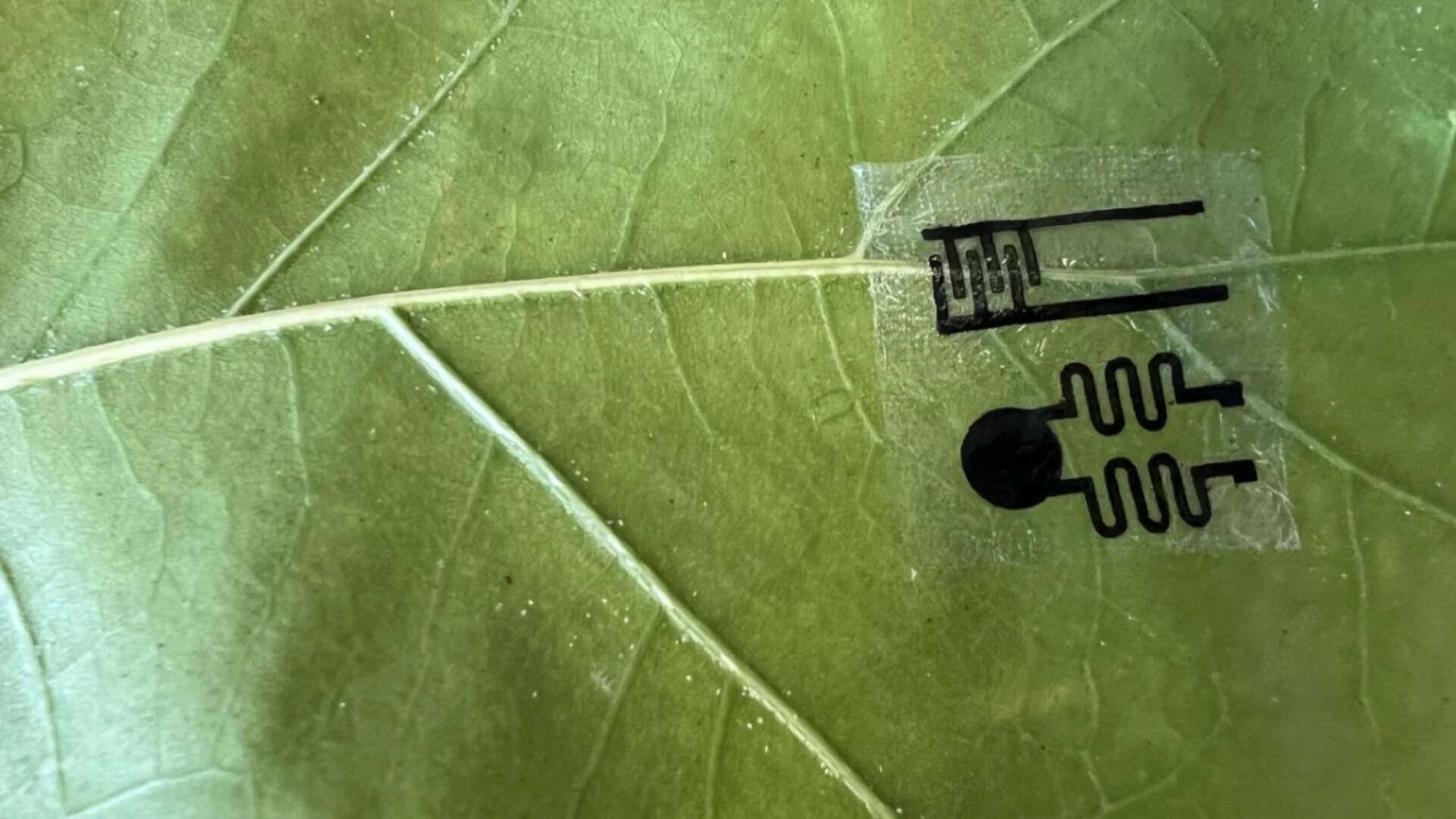
Engineering teams have recently developed wearable sensors designed specifically for plants. These are not bulky gadgets strapped to a branch with zip ties. They are incredibly light, flexible, film-like patches that adhere directly to the leaf or stem without disrupting its natural growth. Think of them as a continuous, non-invasive fitness tracker for a stalk of corn or a grape vine.
Listening to the Vapor
These tiny devices do not look for visible decay. Instead, they monitor the micro-environment right at the leaf's surface. They measure volatile organic compounds—the chemical alarms plants spray into the air when attacked—alongside microscopic shifts in humidity and temperature.
Consider a hypothetical grape grower named Elena. She manages a vineyard that has been in her family for three generations. The climate is shifting; the rains are erratic, and a new strain of root rot has been creeping across the valley.
In the old days, Elena would walk the rows, checking the soil moisture with a metal probe and looking for early signs of distress. But the probe only tells her about the dirt, not the living organism trying to drink from it.
With the new wearable sensors clipped to a representative sample of her vines, Elena’s phone pings while she is drinking her morning coffee.
Vineyard Block 4 is running hot. The humidity right beneath the leaves has dropped sharply, signaling that the stomata have slammed shut. The soil still feels damp to her touch, but the wearable knows better: the roots are struggling to draw nutrients due to an early-stage fungal infection that won't show visible symptoms for another four days.
Because she knows right now, she doesn't have to spray her entire vineyard with chemical fungicides. She can target just that single block, saving thousands of dollars and preventing unnecessary chemicals from soaking into the groundwater.
The Chemistry of Stress
The engineering behind these plant wearables is wonderfully elegant. The sensors utilize graphene or biocompatible conductive inks printed onto breathable, stretchable substrates. They stretch as the plant grows, moving with the wind rather than restricting the tissue.
They track three critical pillars of plant health:
- Hydration Dynamics: By measuring the electrical impedance across the leaf, the sensor can calculate exactly how much water is moving through the plant’s vascular system.
- Nutrient Deficiencies: Micro-needles, completely painless to the plant, can sample tiny amounts of sap to monitor nitrogen, phosphorus, and potassium levels in real time.
- Pathogen Alerts: When a plant is attacked by insects or disease, it releases specific chemical signals. The sensors can detect these airborne molecules instantly, serving as an early-warning radar for the entire farm.
This is not about chasing a high-tech novelty. It is a necessity driven by a world where the margin for error in food production has shrunk to near zero.
We often view technology and nature as opposing forces. We build concrete jungles and contrast them against pristine forests. But this new wave of bio-electronics suggests a different path forward—one where technology does not dominate nature, but translates it.
The complexity of the data these sensors collect can be intimidating. Interpreting raw electrical impedance or volatile organic compounds is not something a farmer has time to do between fixing tractors and managing payroll. The success of these devices relies entirely on translating that raw biochemistry into simple, actionable insights. A notification that says "Row 12 needs nitrogen" is infinitely more valuable than a complex graph of chemical output.
A New Vernacular
There is something deeply humbling about realizing that the flora around us has been screaming for help for millennia, and we simply lacked the ears to hear it.
We have treated fields as monoliths, dumping water and fertilizer uniformly across thousands of acres, hoping for the best. We did this because we had to. We lacked the granularity to do anything else.
The future of farming looks less like industrial manufacturing and more like personalized medicine. Every plant becomes an individual patient with its own medical chart, its own daily biometrics, and its own specific needs.
But the real transformation isn't just economic or environmental. It is psychological.
When Elena walks through her vineyard now, she doesn't just see a crop. She sees a conversation. She looks at a row of vines and knows exactly which ones are thriving, which ones are thirsty, and which ones are fighting off an infection in the quiet dark of the soil.
The silence of the early morning field isn't empty anymore. It is alive with data, waiting for the sun to rise, speaking in a language we are finally learning how to read.