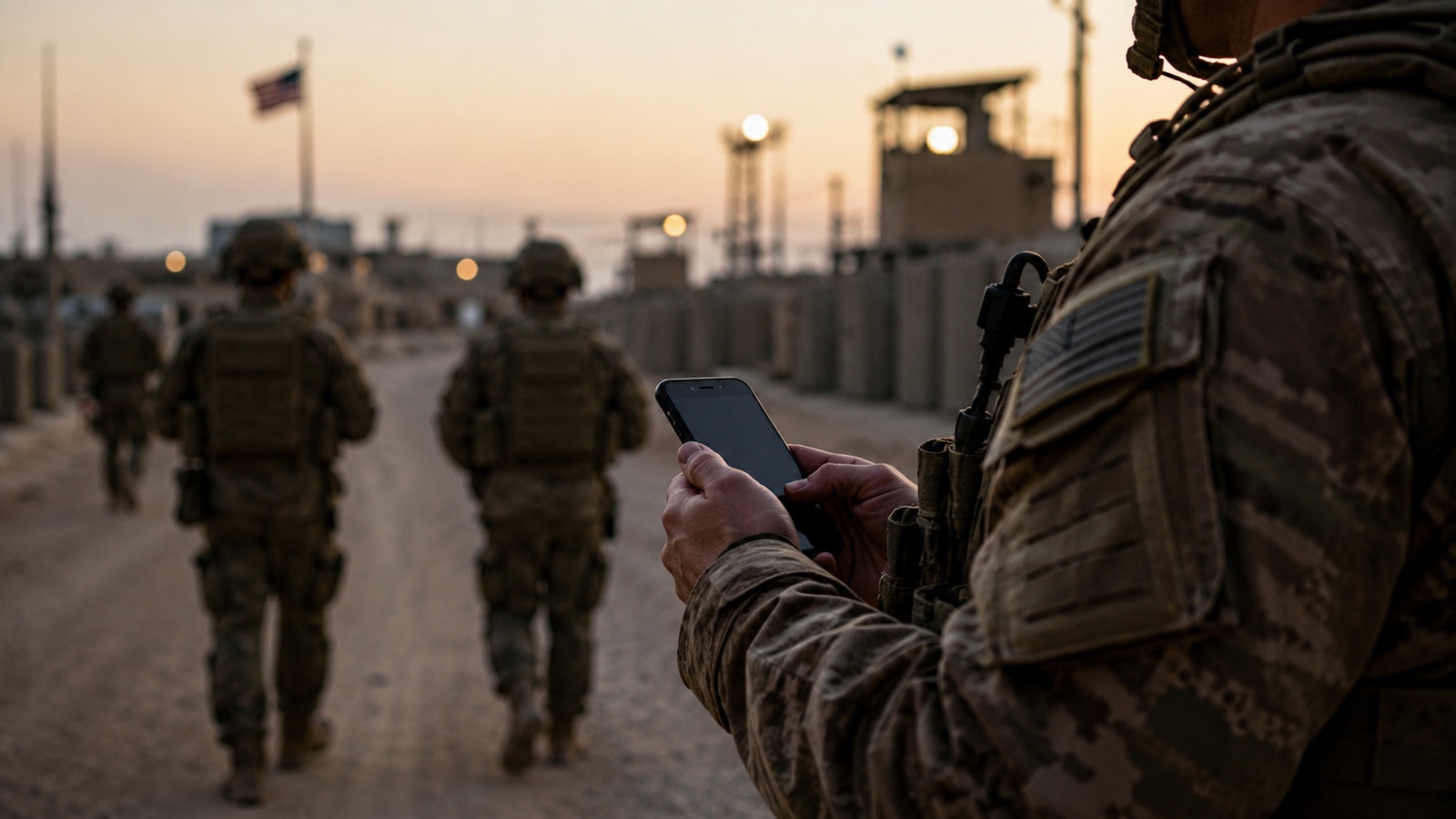
The screen glows in the dark. It is a blueish, artificial twilight that illuminates the dust motes dancing in a concrete bunker somewhere in the Jordanian desert.
Three thousand miles away, a toddler is laughing into an iPad camera, babbling about a dog. Here, a twenty-two-year-old corporal stares at that glowing glass, his thumb hovering over the screen. He cannot touch her. Not really. He can only watch compressed pixels stutter across a satellite connection that costs millions of dollars to maintain and seconds to exploit.
We forget how intimate modern warfare has become. We imagine soldiers as statues carved from stoicism, marching silently through history books. We do not picture them scrolling through Instagram feeds at midnight, worrying about bills back home in Ohio, or sending frantic text messages during a mortar attack. We do not think about the tether.
That tether is about to be cut.
Rumors have rippled through the ranks of United States military personnel stationed in Jordan. Whispers of a sweeping directive. A total ban. The phones, the personal portals to civilian life, the glowing windows of connection—they might soon be confiscated or strictly prohibited in operational areas.
Silence. Absolute, terrifying silence.
Consider what happens when you strip a human being of their primary coping mechanism.
To understand why military leadership in places like Jordan is eyeing personal electronics with mounting dread, you have to look through the lens of operational security. A smartphone is not just a phone anymore. It is a beacon. It is a beacon that broadcasts your exact GPS coordinates to commercial satellites, local cell towers, and adversarial intelligence agencies who harvest metadata like digital scavengers.
Picture an airfield in the Middle East. It hums with the low, constant bass of C-130 engines. Jets are fueled. Crews move with practiced, brutal efficiency. A sergeant major walks past a flight line, and out of habit, glances at a private's hand. The screen is unlocked. Strava is running in the background, mapping a morning jog around the perimeter fence—complete with elevation data, exact routes, and timestamped coordinates.
Just like that, a multi-million-dollar installation's layout is compromised by a fitness app.
It has happened before. It will happen again, unless the cord is severed. Adversaries do not need James Bond spies when soldiers carry glowing beacons in their cargo pockets. Foreign intelligence units trawl social media geolocations, harvest Wi-Fi connection logs, and piece together troop rotations with terrifying ease. Every selfie taken near a hangar tells a story to someone who wants you dead.
Yet, policy is never just about logistics. It is about the human cost.
When I talk to veterans about the prospect of losing digital contact during deployment, they do not talk about tactical vulnerabilities first. They talk about the quiet.
Deployments used to be defined by distance. When my uncle deployed in the nineties, a letter took two weeks to cross an ocean. You lived in a state of suspended animation. You adapted to the absence because the absence was absolute. You wrote letters on yellow legal pads and folded them into damp envelopes. You waited.
Smartphones destroyed that sacred distance. They brought the anxieties of home straight into the theater of operations.
Imagine receiving a text message at two in the morning while rockets are incoming. Your spouse is panicking because the water heater broke. You are in a bunker wearing body armor, sweating through Nomex, trying to troubleshoot a domestic plumbing emergency via WhatsApp while mortars impact three hundred meters away. The psychological fracture is profound. You are in two places at once, anchored to neither, failing at both.
Then there is the inverse terror. What happens when the phone goes dead by command?
The psychological impact of seizing personal communication devices is an invisible shockwave. Morale plummets before it stabilizes. For young service members, the smartphone is the umbilical cord connecting them to sanity, to youth, to the people who remember who they were before they put on the uniform. Take that away, and you risk a different kind of operational hazard: isolation, anxiety, and a crushing sense of confinement.
Commanders face an agonizing calculus. On one side of the ledger sits blood and operational security. A single careless geotag can vector a drone strike onto a barracks. On the other side sits human endurance. How much pressure can you put on a twenty-year-old mind before it cracks under the weight of forced silence?
The discussions happening behind closed doors at command headquarters in Amman are not casual. They are heavy with precedent. The military is wrestling with an uncomfortable truth: the very technology that makes modern life bearable also makes modern war uncontainable.
We built a world where total connectivity is treated as a fundamental human right. We assume we have a right to reach anyone, anywhere, at any second. But the desert does not care about our comfort. The desert demands focus.
When the order finally comes down—if it comes down—there will be a collective intake of breath across the base. Bins will be filled. Passwords will be logged out. Screens will fade to black one by one.
The soldiers will look at each other, really look at each other, without the blue light reflecting in their eyes. They will talk. They will play cards. They will listen to the wind howling across the sand, unfiltered by algorithms or notifications.
They will be isolated from the world they swore to protect, precisely so they can protect it.
The screen goes dark. The bunker is quiet again. Outside, the stars wheel across a vast, indifferent sky, ancient and unmapped.


